

Showing posts with label God. Show all posts

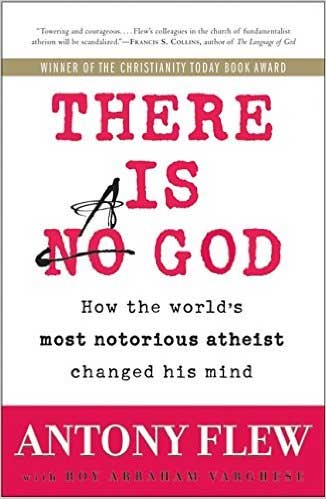
Famed Atheist Philosopher, Antony Flew, Now a Theist/Deist

Antony Flew Conversion

Edward: Famed lifelong atheist philosopher, Antony Flew (age 81),has become a theist / deist. The London TIMES had this to say about Flewʼs recent conversion: “He [Flew] is unlikely to proclaim his faith from a pulpit. He is still not a Christian and dismisses the conventional forms of divinity as ‘the monstrous oriental despots of the religions of Christianity and Islam.’ He also stands by his rejection of an afterlife.”

Flew:Iʼm thinking of a God very different from the God of the Christian and far and away from the God of Islam, because both are depicted as omnipotent Oriental despots, cosmic Saddam Husseins,” he said. “It could be a person in the sense of a being that has intelligence and a purpose, I suppose.”

In his lengthiest inteview thus far about his theism (an interview with Liberty University Christian apologist Gary Habermas), Flew had this to add:

Habermas: “In your view, then, God hasnʼt done anything about evil.”

Flew: No, not at all, other than producing a lot of it…

Habermas: Are you any closer to thinking that the resurrection could have been a historical fact?

Flew: No, I donʼt think so… What we do not have is evidence from anyone who was in Jerusalem at the time, who witnessed one of the allegedly miraculous events, and recorded his or her testimony immediately after the occurrence of that allegedly miraculous event. In the 1950s and 1960s I heard several suggestions from hard-bitten young Australian and American philosophers of conceivable miracles the actual occurrence of which, it was contended, no one could have overlooked or denied. Why, they asked, if God wanted to be recognized and worshipped, did God not produce a miracle of this unignorable and undeniable kind?”… [According to Luke-Acts, the raised Jesusʼ ascension into heaven was only witnessed by the eleven apostles, and even Luke-Acts admits that there was no preaching of “the resurrection” until seven weeks after the crucifixion.]

Habermas: Do you think that there is any chance that you might in the end move from theism to Christianity?

Flew: I think itʼs very unlikely, due to the problem of evil. But, if it did happen, I think it would be in some eccentric fit and doubtfully orthodox form: regular religious practice perhaps but without belief. If I wanted any sort of future life I should become a Jehovahʼs Witness [because at least their paradise involves corporeal persons; and Flew said earlier in the interview: “I think those who want to speak about an afterlife have got to meet the difficulty of formulating a concept of an incorporeal person… it is simply impossible to create a concept of an incorporeal spirit… Swinburne and I had been the only Gifford lecturers to treat the question of a future life for the sixty years past. Even more remarkably, Swinburne in his Gifford Lectures ignored Bishop Butlerʼs decisive observation: ‘Memory may reveal but cannot constitute personal identity.’”

One should also note that in the realm of philosophy, many theistic philosophers as well as Christian theistic philosophers, have been unable to agree on quite a lot of questions. See Contemporary Debates in the Philosophy of Religion (2003) by Michael Peterson, managing editor of the journal Faith and Philosophy, published by the Society of Christian Philosophers. Here are some questions from that book, questions on which theistic philosophers disagree:

  • Can Only One Religion Be True?

  • How to Sink in Cognitive Quicksand: Nuancing Religious Pluralism: Keith E.Yandell (University of Wisconsin)

  • It Is Not Reasonable to Believer that Only One Religion is True: Peter Byrne (Kingʼs College, University of London)

  • Does God Take Risks in Governing the World?

  • God Takes Risks: William Hasker (Huntington College)

  • God Does Not Take Risks: Paul Helm (Regent College)

  • Does God Respond to Petitionary Prayer?

  • God Responds to Prayer: Michael J. Murray (Franklin and Marshall College)

  • God Does Not Necessarily Respond to Prayer: David Basinger (Roberts Wesleyan College)

  • Is Eternal Damnation Compatible with the Christian Concept of God?

  • Eternal Hell and the Christian Concept of God: Jerry Walls (Asbury Theological Seminary)

  • No Hell: Thomas Talbott (Willamette University)

  • Is Morality Based on Godʼs Commands?

  • Divine Commands Are the Foundation of Morality: Janine Marie Idziak (Loras College)

    Ethics Is Based on Natural Law: Craig A. Boyd (Greenville College) and Raymond J. VanArragon (Asbury College)

  • Should a Christian Be a Mind-Body Dualist?

  • Christians Should Affirm Mind-Body Dualism: Dean W. Zimmerman (Rutgers University)

  • Christians Should Reject Mind-Body Dualism: Lynne Rudder Baker (University of Massachusetts)


In a letter to Philosophy Now magazine (Issue 47, August/September 2004, p. 22) Flew noted that “It has become inordinately difficult even to begin to think about constructing a naturalistic theory of the evolution of that first reproducing organism.” Flew then recommends two books: “The first book is Roy Abraham Vargheseʼs “The Wonderful World: A Journey from Modern Science to the Mind of God” (Fountain Hills, Arizona: Tyr Publishing, 2003). The second book is Gerald L. Schroederʼs The Hidden Face of God: Science Reveals the Ultimate Truth (Touchstone, New York 2001).”

“Gerald Schroederʼs” name also came up in Flewʼs interview with Habermas in which Flew said: “I am open to [the notion of theistic revelation], but not enthusiastic about potential revelation from God. On the positive side, for example, I am very much impressed with physicist Gerald Schroederʼs comments on Genesis 1. That this biblical account might be scientifically accurate raises the possibility that it is revelation.” (Original Source: La Mirada, Calif., Dec. 9/PRNewswire)

Questioning Flewʼs Praise of the Works of “Gerald Schroeder”

Schroederʼs attempts to discover direct concordances between Genesis and modern science are far from satisfactory in the view of many of his fellow scientists, so I hope Flew will look into such matters a bit deeper. For instance, Schroederʼs claim about how much genetic change it would take to create human beings is wrong. According to the latest data, “The difference between human and chimp genomes is only about 1.23%, rather than 1.4% as originally thought.”

Even more importantly, if man and chimp diverged from a common ancestor, you must half those differences yet again. In fact the differences between human and chimp genomes are less than that between the genomes of near identical sibling species of fruit flies. And there is even evidence in human chromosome #2 that points to it being the result of a fusion of two chromosomes that very closely resemble two chromosomes found in the chimpanzees, whose banding patterns line up band for band to those inside human chromosome #2. Moreover, human chromosome #2 still contains remnants of that fusion process—in the form of a faint second centromere (there is almost always just one centromere per chromosome, found in its middle, not two centromeres), and reversed teleomeric sequences in the middle of that chromosome (telomeres are almost always found at the tips of chromosomes, not in the middle, and not in reverse order, hence finding them in the middle of a chromosome means that portion used to be the tip or end of a second chromosome).

Here are some reviews of Schroederʼs books that perhaps Flew might like to acquaint himself with before lending any more praises to Schroederʼs work: Frank Sonleitner,Department of Zoology, University of Oklahoma, Norman OK 73019 reviews Schroederʼs The Science of God:

Source: www.ncseweb.org/

“This book is essentially an elaboration and update of Schroederʼs earlier book Genesis and the Big Bang published in 1990. Schroeder is an Israeli physicist who has also extensively studied biblical interpretation. He uses the arguments of the Anthropic principle (the Big Bang and the fine-tuning of the universal constants) as evidence for God; but he also insists that the Bible and science agree. Genesis is not to be taken literally nor dismissed as poetry but must be interpreted correctly following the lead of talmudic scholars such as Nahmanides and Maimonides. Although his interpretation twists, stretches, and sometimes directly contradicts the literal meaning of Genesis, it confirms all the findings of modern cosmology and geology.

“Using a universal time clock based on the stretching of the wavelengths of light as the universe expands, he concludes that the universe is 15.75 billion years old. The six days of Genesis consist of a nonlinear day-age description of the history; day 1 covers the first 8 billion years, and day 6 only the last 1/4 billion.

“Schroeder accepts the standard geologic and paleontologic history of the earth but he balks at evolution (although he admits some sort of genetic continuity as suggested by the evidence of comparative anatomy, biochemistry and embryonic recapitulation). He rejects all transitional forms among higher categories such as classes and phyla, but later admits that there might be transitional forms within classes. (He does discuss the recently discovered intermediate forms of whales.)

“Schroeder rejects evolution because he considers its mechanism to rest solely on pure chance. There is no discussion of natural selection; it doesnʼt appear in the index although the term is used in passing while discussing Dawkins. His “proof” that it is impossible for convergent evolution to produce similar eyes in taxa which did not inherit these structures from a common ancestor uses a mathematical calculation based on two assumptions - (1) evolution is pure chance; and (2) the taxa have no genes in common except those “inherited” from the protozoa. Yet in other places he seems to be aware of the recent evidence that the phyla have many genes in common; he discusses the Hox genes that determine body plans and the Pax genes that are involved in eye formation!

“Schroeder admits that there were “pre-Adamites” (Cro-Magnon and Neanderthals) living for 40 000 years prior to Adam, but questions the existence of earlier hominid species because of the fragmentary nature of their fossils. Again he uses a mathematical model to show that the evolution of humans from an ape ancestor is impossible. This model also assumes that (1) evolution would occur by pure chance and (2) one million mutations would be necessary to produce the ape-human transition! “It takes more than the Big Bang and the fine tuning of universal constants to demonstrate that the creator is the kind, loving, personal God worshipped by Christians. And there Schroederʼs arguments fall apart. For example, he argues that quantum mechanics provides the basis of free will and that the determinacy of our genes does not prevent our exercising free will, yet later he says that randomness in nature (including random mutations) is necessary for free will! And natural disasters are necessary. We must suffer earthquakes and volcanic eruptions that result from plate tectonics made possible by the earthʼs molten core because the latter is necessary to generate a magnetic field to protect us from the high energy radiation produced by the life-giving sun. But then he says that the biblical Creator could have made stars that didnʼt produce those lethal rays but “they would not be natural” and would offer absolute testimony of the Creatorʼs existence! And still later he contradicts this principle (that the universe is organized “naturally” to hide the existence of the Creator) by saying that the earth is at an “unnatural” distance from the sun and hints that this may be miraculous! (According to Schroeder some exponential law determines the distance of the planets, and the earthʼs distance does not fit the pattern.)

“Evolutionists will justifiably criticize Schroeder for his simplistic and inconsistent treatment of evolution while the real creationists will reject him for his theology which includes rejection of the literal reading of Genesis, acceptance of the Big Bang, an old age for the earth, existence of pre-Adamites, a local flood, and ignoring Christ, Christianity and the New Testament.”


Victor J. Stenger, professor of physics and astronomy at the University of Hawaii. Review of Schroederʼs The Science of God:

“How can both the Bible and science be right? Israeli physicist Gerald Schroeder says he can show us how. Letʼs start with cosmology. The Bible says God created the universe in six days and indicates the passage of only about 6,000 years since then. Science currently estimates the visible universe to be about 13 billion years old, give or take a few billion. Schroeder reconciles the two, explaining that the six days of the Bible refer to a different measure of time. He explains: “there is no possible way for those first six days to have an Earth-based perspective simply because for the first two of those six days there was no Earth” (51). “Instead, time during this six day period was measured on a cosmic clock. And what else could be used for that clock but the vibrations of light (electromagnetic waves)? Today the light from creation appears as the cosmic microwave background. This is now redshifted by a factor of a trillion (1012) from the period of “quark confinement” when matter as we know it first began to form. Thus the cosmic clock at that epoch ran off a trillion days for each of our modern days. The six cosmic days of creation thus took about 15 billion years earth time, give or take a few billion. So, according to the author, Genesis is not only consistent with cosmology, it gives the correct age of the universe!

“Each of the six days in Schroederʼs Genesis actually takes a different length of earth time. The duration D, in earth days, of each cosmic day t is calculated from the formula D = (Ao/L)exp(-Lt), where Ao = 4x10¹² (the ratio of the frequencies of the cosmic microwave background at quark confinement compared to now) and L = 0.693 (natural log of 2). More simply, cosmic day one is 8 billion earth years long and you divide by two to get the duration of each succeeding cosmic day. “Cosmic day one starts 15.75 billion earth years ago and covers the creation of the universe, the “breaking free” of light as electrons bind to atomic nuclei, and the beginning of galaxy formation. This is described in Gen. 1:1-5 as the creation followed by light separating from the darkness.

“Cosmic day two starts 7.75 billion earth years ago and lasts four billion earth years. During this period the stars and galaxies are born. This corresponds to Gen. 1:6-8, the formation of the heavenly firmament. “Cosmic day three starts 3.75 billion earth years ago. During two billion earth years, the earth cools, water appears, and the first life forms appear. In Gen. 1:9-13, vegetation first appears during the third day. “Cosmic day four starts 1.75 billion earth years ago and lasts a billion earth years. The earthʼs atmosphere becomes transparent and photosynthesis produces an oxygen-rich atmosphere. Schroeder says that this corresponds to Gen. 1:14-19 when “the Sun, Moon, and stars become visible in the heavens” (67).

“Cosmic day five starts 750 million earth years ago and lasts 500 million earth years. During this period, the first multicellular animals appear and the oceans swarm with life. Gen. 1:20-23 says the waters bring forth swarms of living creatures and “birds fly above the earth” (94). “Cosmic day six starts 250 million years ago and ends at the time of Adam. During this period we have a massive extinction in which 90 percent of life is destroyed and then repopulated with humanoids and humans. This, Schroeder says, corresponds to what is described in Gen. 1:24-31. “Technically, Schroederʼs formula gives the present as the end of the sixth day. However, it could just as well have ended a few thousand years ago and not affect the rest of the calculation where things are rounded off at hundreds of millions of years. Schroeder argues that after the six cosmic days of creation, Genesis switches its focus over to humanity and starts measuring time in human terms. The rest of the Bible concerns itself with the 6,000 earth years since Adam and Eve, estimated from the Bible in Bishop Ussher fashion.

“Schroeder does not deny the existence of hominid creatures before Adam. He talks about Neanderthals and Cro-Magnons, and accepts that they had developed tools, pottery, and many human-like qualities. In Lev. 11:33 the Bible talks about pottery. But, Schroeder argues that since it never mentions the invention of pottery, that event must have pre-dated Adam (130).

“According to the author, the Bible has no interest in these pre-Adam hominids because they were not yet fully human and had no souls. Thus they are never mentioned. Adam represents the quantitative change to a large brain, but more important, the qualitative change that makes us different from all other forms of life: “our soul of human spirituality” (133). God breathed this into Adam, the first real human, 6,000 years ago. “Schroederʼs attempt to connect 31 lines of Genesis to big-bang cosmology and earth paleontology makes entertaining reading, but will convince no one who is not already convinced or totally lacking of critical facilities.

“Let us return to the beginning. Schroederʼs use of quark confinement as the defining moment for his cosmic time scale is completely arbitrary. He seems to have chosen it for no better reason than it gives the answer he wants. The redshift from quark confinement to the present is of the order of 1012. Multiplying this by six days gives 15 billion years, which is consistent with our current estimate for the age of the universe. “Alternatively, Schroeder might have chosen the moment in the early universe called “decoupling,” which represents the point where radiation separates from matter. Indeed, he relates this event to the separation of the “light from the darkness” described in Genesis day one. But the redshift from decoupling to the present is only of the order of 1,000, which would give an earth time interval of only fifteen years for the six cosmic days of creation. If he had chosen some other moment, he would have obtained yet a different time scale.

“Furthermore, by Schroederʼs own formula the universe creation corresponds to the time of quark confinement. Blueshifting back from that point rather than redshifting ahead, the events prior to quark confinement would recede infinitely into the past, in earth time, and we would have no creation at all.

“Schroederʼs use of an exponential function to give different earth periods for each cosmic day is not justified by his argument that earth time is simply redshifted cosmic time. While an exponential relationship would apply for the inflationary epoch in the early universe, that has ended by the time of quark confinement. Afterwards we have the almost linear Hubble expansion in which the redshift varies as a power law with time, not exponentially. By having each cosmic day half as long as the preceding one in earth years, again a completely arbitrary, unjustified procedure, Schroeder is able to vaguely relate events known from cosmology to those described in Genesis.

“In cosmic day two the “firmament” is created. Note that Schroeder excludes from the “firmament” all galaxies more than 7.75 billion light years away, of which there are many. Furthermore, he sees no problem with calling the expanding universe a “firmament.” Like all apologists, he selects his data carefully, accepting only those which agree with his hypotheses and discarding those which do not.

“Primitive life first appears in cosmic day three. Here again it takes some mighty stretching to associate what is described in the Bible for the third day, including fruit trees, with the primitive life described by paleontology for that epoch.

“Schroeder has the sun, moon, and stars becoming visible in cosmic day four. In fact, Genesis seems to say the that sun, moon, and stars are created at that time - well after the earth was created.

“Cosmic day five has the waters teeming with life. But the biblical verses imply birds as well. Schroeder says that “birds” is a mistranslation and that the Bible here is referring to water insects instead. Translation is so easy when you know what you want a passage to say.

“Cosmic day six contains the mass extinctions of life that occurred 65 million years ago. The biblical verses referenced make no mention of mass extinction. The Biblical Flood occurs well after Adam, but Schroeder needs to end the six days of creation with Adam for other purposes. This is one event he simply cannot make fit, although he is not honest enough to say so and leaves the impression that everything is consistent.

“At times you get the impression that this book is a parody, with quite a few good chuckles when read in that context. However, the sections on evolution soon convince you that no parody is intended. They are just too unfunny, too dull. Schroeder trots out all the old, tiresome arguments about why “life could not have stared by chance” and how the simplest forms, even viruses, are “far too complex to have originated without there being an inherent chemical property of molecular self-organization and/or reaction enhancing catalysts at every step of their development” (85). He applies the usual creationist deception of calculating chance probabilities as if chance is the only operative mechanism, and then saying this “proves” that God intervenes along the way when they come out very low. And, of course, the “staccato aspect of the fossil record” refutes classical evolution. “These rapid changes cannot be explained by purely random mutations at the molecular-genetic level” (87).

“Notice how often theists tell us that something cannot be explained except by God? They never seem to learn from history.”

Revised Title: The Delusions of Gerald Schroeder, December 5, 1997


A young-earth creationist Amazon reviewer of The Science of God:

“I find many of his interpretations manipulated to his own cause, e.g. Gen. 1:12 which he interprets: “and the earth brought forth life.” A more reliable interpretation of the text renders: “and the earth(or land) brought forth vegetation.” Further, he cites no credible Hebrew scholar who agrees with his interpretation of day for order and night for chaos. He relies much more for his case on the mystical kabbalah, especially Nahmanides, which can only be explained at best as “opinion.” This leaves him in positions which do not square with all of inspired Scripture…For the exact opposite view of Schroederʼs key thesis: clocks ticking faster at the center and slow at the edge of the cosmos—- see young-earth creationist, D. Russell Humphreysʼs book “Starlight and Time.”


Old earth creationist Hugh Ross reviews Schroederʼs Genesis And The Big Bang:

Source: www.reasons.org/resources/apologetics/p9401.html?main

“One problem with his view is that it clashes with the scientific data on the timing of Earthʼs origin. Since the earth already exists on the first creation day of Genesis 1, Schroederʼs model would say that Earth began at least 12 billion years ago. Scientific measurements, however, show that it is only 4.6 billion years old. Our view is that Genesis 1:2 establishes the frame of reference for the creation events: “The Spirit of God was brooding (or hovering) over the surface of the waters.” In other words, Godʼs time and space frame in describing creation is the earthʼs surface, a frame in common with all readers of the account. The text gives no hint of Schroederʼs relativistically time-extended creation days. If one seeks Jewish support for a day-age interpretation of Genesis 1, Nathan Aviezer, another Jewish physicist, offers it in a book entitled In the Beginning: Biblical Creation and Science (Hoboken, NJ: KTAV Publishing House, 1990). Aviezer acknowledges that the six creation days of Genesis 1 must refer to long time periods.”


Amazon Reviewer of The Science of God: seapapa from Los Angeles “Schroederʼs thesis is that the author of Genesis is describing a 15 billion year history of the universe and life, even though that was never his understanding or his intention. The true meaning Genesis 1 went undetected until it was discovered by the cabalist author Nahmanides in the 11th Century AD. It was lost again until Schroeder rediscovered it. “Even accepting the dubious proposition that people can write things that actually mean the exact opposite of what they intend, the match between the Genesis timeline and the scientifically proposed history of the universe makes an ill fit. Schroeder tries to reconcile the two by focusing minutely on certain words in Genesis that could be interepreted to allow for longer time periods, while totally ignoring the text read in its entirety. For example, day three of creation supposedly lasts 1.6-3.6 billion years ago. Genesis said “let the land produce vegetation”. Success, proclaims Schroder, that matches the plant life on the planet, which is found only in the… water! He conveniently ignores the rest of the verse which calls for fruit-bearing trees and seed-bearing plants. There was nothing but protozoa and plankton back then. This is typical of the book.

“The most absurd argument is that, if properly interpreted, the 6 creation days correspond to 6 actual 24 hour days on earth AND 15 billion cosmic years. How so? Einsteinʼs relativity of time! Schroeder makes such an effort to preserve the 6 days of creation and the order of creation. “This book is ultimately a polemic. Although brilliant and articulate, one gets the feeling that Schroeder cannot bear to have Genesis undermined. That compromizes his scientific judgement.”


A Reviewer of The Science of God (at amazon.com):

“contains a few good passages, but also some egregious errors, which are puzzling when made by a PhD in Physics. For example, G. Schroeder completely misinterprets the experiments with particles moving through openings, invents some odd concept of heat diluting in enlarged volumes, misrepresents the story of photoelectric effect, etc. One striking feature of this book is that Schroeder suggests in it the chronological data , which completely contradict his own data on the same subject, given in his first book, without a word of explanation why he changed those data. A useless book.”


A Reviewer of The Science of God (at amazon.com) wrote:

“His time dilation calculations are totally at fault. The factor of one million million he uses is totally arbitery (nothing really special happened at z=1 million million). His redshift/blueshift calculations are also wrong: The background temperature (and the redshift) changed by less than 10% in the last billion years. Nowhere near the rate needed to slow down from a 500 million year per day (Day 5, according to Schreoder) to 24 hours per day. “Another serious mistake appears in his coverage of evolution: He says the the evolution from chimpanzees to humans requires a million point mutations because the difference in the active DNA between human and chimps is 1,000,000 bases.

“This is simply false. Schroeder himself says that the number of changes needed is no more than 70,000. In most cases a single point mutation is enough to complete a change.

“It would have been better if Schreoder, as a nuclear physicist, asked an expert biologist before writing his chapters about evolution…”


Reviewer: gsssew@m… from St. Louis, Missouri

I was intrigued by the title, but agitated by the contents. The entire book is filled with completely preposterous assumptions and conclusions. After reading such a book, I begin to question why someone, such as Gerald Schroeder, view themselves as scientists.

Denis: Ed, If Jerry Falwell became an evolutionist, be assured, that would be news.

Edward: Flew hasnʼt become a creationist, nor even a “life everlasting”-ist. His god is like Spinozaʼs and Einsteinʼs. So, what I meant to say was that the media played up Flewʼs change of mind (even some Christians on the web bragging he was close to converting to Christianity and holding up his example as a sort of sacred talisman against further thought concerning their particular beliefs.)


Denis: Itʼs news because of who Flew is and what he has written.

Edward: I doubted Flewʼs competency in his first debate with Habermas, published as, “Did Jesus Rise From the Dead?” because Flew demonstrated in that debate that he knew much about Hume but nearly nothing about the relevant Gospel passages. I subsequently wrote Habermas to point out Flewʼs inadequacies and got into a little letter debate with Habby that he even presented to a Christian publisher, who, however, wasnʼt interested in publishing such an exchange.

Flew himself admitted recently that he lacks competency when it comes to judging physics and biology arguments:

Flew Update (January 2005) by Richard Carrier who exchanged letters with Flew

Flew admits: “I have been mistaught by Gerald Schroeder.” He says “it was precisely because he appeared to be so well qualified as a physicist (which I am not) that I was never inclined to question what he said about physics.” Apart from his unreasonable plan of trusting a physicist on the subject of biochemistry (after all, the relevant field is biochemistry, not physics—yet it would seem Flew does not recognize the difference), this attitude seems to pervade Flewʼs method of truthseeking, of looking to a single author for authoritative information and never checking their claims (or, as in the case of Dawkins, presumed lack of claims). As Flew admitted to me, and to Stuart Wavell of the London Times, and Duncan Crary of the Humanist Network News, he has not made any effort to check up on the current state of things in any relevant field (see “No Longer Atheist, Flew Stands by ‘Presumption of Atheism’” and “In the Beginning There Was Something”). Flew has thus abandoned the very standards of inquiry that led the rest of us to atheism.

Despite all this, Flew has not retracted his belief in God, as far as I can tell. But in response to theists citing him in their favor, Flew strangely calls his “recent very modest defection from my previous unbelief” a “more radical form of unbelief,” and implies that the concept of God might actually be self-refuting, for “surely there is material here for a new and more fundamental challenge to the very conception of God as an omnipotent spirit,” but, Flew says, “I am just too old at the age of nearly 82 to initiate and conduct a major and super radical controversy about the conceivability of the putative concept of God as a spirit.” This would appear to be his excuse for everything: he wonʼt investigate the evidence because itʼs too hard. Yet he will declare beliefs in the absence of proper inquiry. Theists would do well to drop the example of Flew. Because his willfully sloppy scholarship can only help to make belief look ridiculous.

See also…

The London TIMES had this to say about Flewʼs recent conversion: “He [Flew] is unlikely to proclaim his faith from a pulpit. He is still not a Christian and dismisses the conventional forms of divinity as ‘the monstrous oriental despots of the religions of Christianity and Islam.’ He also stands by his rejection of an afterlife.”

Flew: “Iʼm thinking of a God very different from the God of the Christian and far and away from the God of Islam, because both are depicted as omnipotent Oriental despots, cosmic Saddam Husseins,” he said. “It could be a person in the sense of a being that has intelligence and a purpose, I suppose.”

abcnews.go.com

In his lengthiest interview thus far about his theism (an interview with Liberty University Christian apologist Gary Habermas), Flew had this to add:

Habermas: “In your view, then, God hasnʼt done anything about evil.”

Flew: No, not at all, other than producing a lot of it….

Habermas: Are you any closer to thinking that the resurrection could have been a historical fact?

Flew: No, I donʼt think so… What we do not have is evidence from anyone who was in Jerusalem at the time, who witnessed one of the allegedly miraculous events, and recorded his or her testimony immediately after the occurrence of that allegedly miraculous event. In the 1950s and 1960s I heard several suggestions from hard-bitten young Australian and American philosophers of conceivable miracles the actual occurrence of which, it was contended, no one could have overlooked or denied. Why, they asked, if God wanted to be recognized and worshipped, did God not produce a miracle of this unignorable and undeniable kind?”… [According to Luke-Acts, the raised Jesusʼ ascension into heaven was only witnessed by the eleven apostles, and even Luke-Acts admits that there was no preaching of “the resurrection” until seven weeks after the crucifixion.]

Habermas: Do you think that there is any chance that you might in the end move from theism to Christianity?

Flew: I think itʼs very unlikely, due to the problem of evil. But, if it did happen, I think it would be in some eccentric fit and doubtfully orthodox form: regular religious practice perhaps but without belief. If I wanted any sort of future life I should become a Jehovahʼs Witness [because at least their paradise involves corporeal persons; and Flew said earlier in the interview: “I think those who want to speak about an afterlife have got to meet the difficulty of formulating a concept of an incorporeal person… it is simply impossible to create a concept of an incorporeal spirit… Swinburne and I had been the only Gifford lecturers to treat the question of a future life for the sixty years past. Even more remarkably, Swinburne in his Gifford Lectures ignored Bishop Butlerʼs decisive observation: ‘Memory may reveal but cannot constitute personal identity.’”


Denis: Finally, to answer the question in the title of your piece: Itʼs because liberalism is OLD news.

Edward: It appears to me to be relatively big news that churchgoing continues to decline in the northern hemisphere of the Western industrialized world, especially in Christianityʼs birthplace, Europe. (The regular churchgoers who remain in North America and Europe, tend to be of a more conservative varieties.) Also, Islamʼs rate of biological reproduction means that she may possibly overtake Christianity in the future as the worldʼs number one religion, especially since reproductive rates in Europe have slipped to a low rate. So, Europe may yet be conquered by Islam in the future. Though Christianity in the southern hemisphere continues to grow, especially conservative Catholicism and miracle-mongering Protestant sects. And further conflicts with Islam will probably continue to arise there.

Nigeria Christians Attack Muslims, Kill Dozens

On the decline of churchgoing in the Northern Hemisphere see: “Trends Among Christian Believers in America” (includes links at the bottom to trends round the world)

On the rise in Christianity in the Southern Hemisphere see the links

The Next Christianity - About the kinds of Christianity that are gaining popularity in the Southern hemisphere: very hardcore, including a revival of witchhunts.

Christianityʼs New Center - More about the rapid growth of hardcore

Christianity (along with Islam) in the Southern hemisphere.

Oh, Gods! - About worldwide religious trends in general, including new religious movements.

Welcome to the Next Church - About the new American evangelical (not quite fundamentalist, but fundy-leaning) Christian megachurches, some with wealthy parishioners, although Christianityʼs primary appeal is to the poor.


Edward: Regarding Wheaton College (Billy Grahamʼs alma mater), it no longer demands that all of its professors agree that Adam and Eveʼs bodies were created directly from the earth.

Denis: Is that true? Iʼve got a friend going there this summer, and he believes that he has to sign it. But he might be wrong. So, clue me (and him) in if something has changed.

Edward: A few years ago I read in First Things or Christianity Today that Wheaton was no longer requiring faculty, staff and students to sign a statement demanding that they believe Adam and Eveʼs bodies were created directly from the dust of the earth. I havenʼt been able to find a copy of Wheatonʼs earlier statement of faith, but the present one reads, “We believe that God directly created Adam and Eve, the historical parents of the entire human race; and that they were created in His own image, distinct from all other living creatures, and in a state of original righteousness.” www.wheaton.edu/welcome/mission_textonly.html The mention of a “distinct creation” does not specify whether the body or the soul is being addressed as “distinctly created.” Even Mr. Jones, the provost at Wheaton, wrote that while professors were not required to advocate creationism, they were expected to treat it with respect. [From The Chronicle of Higher Education, May 24, 2002, “Do Professors Lose Academic Freedom by Signing Statements of Faith? Critics say the oaths at some religious colleges are intellectually confining” by Beth McMurtrie

A Wheaton College professor of Old Testament, John Walton, wrote in 2002 the NIV Application Commentary Of Genesis and he left open the question of whether certain verses in Genesis demand belief in the bodies of Adam and Eve from the dust of the earth. Walton even argues that commentary that the ancient Hebrews believed the earth was flat, and that the “serpent” in Genesis was not originally understood to be “Satan.” Waltonʼs commentary was published in 2002. Every Evangelical ought to read it. A simplified presentation by Walton.

Also, Wheaton College has a huge collection of C. S. Lewis writings and memorabilia. Lewis of course wouldnʼt be able to sign any statement of faith that demanded one must believe that Adam and Eve were created directly from the dust of the earth. In fact C. S. Lewis wasnʼt disturbed in the least by the thought of Genesis being “…derived from earlier Semitic stories which were Pagan and mythical.” [C. S. Lewis, Reflections on the Psalms (London: Collins, Fontana Books, 1958), p. 93]

“We read in Genesis (2:7) that God formed man of the dust and breathed life into him. For all the first writer knew of it, this passage might merely illustrate the survival, even in a truly creational story, of the Pagan inability to conceive true Creation, the savage, pictorial tendency to imagine God making things ‘out of’ something as the potter or the carpenter does.” [C. S. Lewis, “Scripture,” Reflections on the Psalms]

In short, “Lewis found more truth in the story of the ‘Garden of Eden’ when he regarded it as myth than as history.” [Michael J. Christensen, C. S. Lewis on Scripture: His Thoughts on the Nature of Biblical Inspiration, The Role of Revelation and the Question of Inerrancy (Waco, Texas: Word Books, 1979), pp. 34-35)]

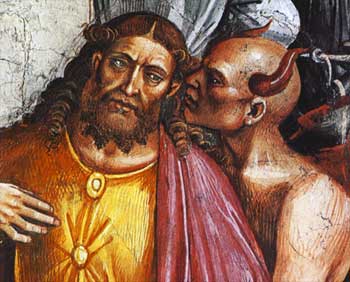
What is an Anti-Christian?

You are deluding yourself if you *really* believe that you are not an “anti-Christian”.
AntiChrist

Arguing “delusions” with you seems to be the order of the day. Christianity interests me, as does the Bible, the age of the earth, the fossil record, evolution, Darwinism, I.D., religion, philosophy, philosophy of consciousness, and I also have files on different religions, american history, music, comedy, famous wits, comedy and video ideas, chess. Speaking of famous wits, like Twain and Voltaire, they used their wit to deflate pomposity in their day, as they saw it, including, but not limited to, religious pomposity. Twain once remarked that the “funniest things are the forbidden.” Even as a Christian I somewhat agreed, having run into The Wittenberg Door

The “forbidden” includes topics like sex, politics, and religion, or any combination of them. Speaking of one particular combination of them: “Religion is a queer thing. By itself, itʼs all right. But sprinkle a little politics into it and dynamite is bran flour compared with it.” [Finley Peter Dunneʼs “Mr. Dooley”] Or take science and religion, or anything and religion, and youʼve got a mixture that is more volatile than most. That is partly why religion continues to interest me, like a moth drawn to the flame of volatile discussions. So I like controversy and the challenge of communicating with people who disagree with me. However, my past being what it is, you can imagine what types of controversies I continue to be attracted to today.

Do I still consider myself a Christian?
No.

Do I consider myself an “anti-Christian?”
No. But I do consider myself pro-question.

No doubt believers of MANY different religions and philosophies might consider me to be “anti-them” because such people believe that the cosmos revolves around their particular holy book, religion and/or denomination, so whenever I question their holy book (or more precisely, their understanding of their holy book), or question the possibility of them basing scientific theories on various passages in their holy books, I become in their eyes, their “anti,” but of course if they hadnʼt made such singular claims to a particular holy book and equally singular claims to their particular understanding of that book, and made claims to particular dogmas and their particular understanding of those dogmas, then I wouldnʼt have anything to question.

As things stand, I live in a country with a Christian majority, and in the Southern part of that country, the “Bible Belt.” (I moved down from New Jersey after college.) And that, along with my past, has contributed to my continuing interest in, and questioning focus on the dominant religion of my past and of where I live.

If you donʼt define yourself by what you are not, what do you define yourself as that more accurately expresses what you in fact are and do?

Each believer in a particular holy book and/or holy religion, prides themselves on wearing the label of their faith, prides himself on raising and calling his chldren by his particular faith label too. And they cannot conceive how anyone would eschew labels!

I think in our commercialized society there are already far too many labels, ads, religions. I am a thinking loving laughing caring changing human being and would like to leave it at that and simply have people call me by name, though I grant that some people are not comfortable unless they have securely labeled themselves and all the people around them, either metaphysically, or psychologically, or politically, etc.

And you responded to this with a message that you titled “Your friendly neighborhood “anti-Christianʼs” intellectual journey”.

It was meant as a joke. If someone had called me a “scowling monk” I would probably reply with an email that said, “Your friendly neighborhood scowling monk.” I used to read Spiderman comics, and he was a reviled criminal in the eyes of the editor of the Daily Bugle, and so in response, Spider Man would respond to being reviled with the tag line, “Your friendly neighborhood Spider Man.”

Now do you get the joke? Especially after having read the previous portion of this email?

Apart from yours truly perceiving you to be an “anti-Christian”, you *are* perceived by other Christians as an “anti-Christian”, indeed as an “antichrist”

I joked in my email directly previous to this one that although you called me an “antichristian” at least you hadnʼt called me the “antichrist” When I joked about that, I hadnʼt even read this email of yours! Bingo! I guess I know how you think. “Everyone who is not for us is again us” Jesus says in one part of the Gospels. Itʼs a metaphysical wrestling match to you, and Iʼm the guy in the black hood. Though Iʼd prefer grey come to think of it, because people who only see things in black in white arenʼt using their grey matter. But you may not get that, because you seem to have had trouble with my sense of humor.

As for Douglas Cox, the fellow who named me “AntiChrist for a Day” at his site,
Nominations for the Antichrist-for-a-Day Award
he seems to abide by the biblical rule that “one day is as a thousand years,” because Iʼve remained the one and only antichrist for a day since he first put up that page. As for just how “on target” Mr. Cox is with his beliefs, including me being “an antichrist,” why not study his site? Mr. Cox is sure that “in the second century BC, Antiochus IV caused corruptions supporting the supported the flawed geocentric cosmology of the Greeks to be inserted in the Greek and Hebrew versions of the scriptures.” Unlike Mr. Cox, I have no idea how Antiochus could have done that to all the Greek and Hebrew versions around, “causing corruption” of the text in so many ways so as to give people the impression that the heavens moved, indeed were commanded to move and to stop on occasion, and to fiddle with Genesis (in all three versions, namely the Hebrew MT, the Greek Septuagint, and Samaritan versions of the Pentateuch!), making it appear to be speaking of a solid “firmament” in which the sun moon and stars are set, and “above” which lay waters. But Mr. Cox is sure that Antiochus did something evil like that, and his corruption of Scripture is confusing almost all of Christendom today. Without such a conspiracy hypothesis as Mr. Coxʼs, then it would indubitably be true that the Bible appears to be as unscientific as other ancient creation accounts of its day and age; and Mr. Cox canʼt stand that thought. (Though of course once you accept that corruptions occur why not recognize the possibility of more corruptions of many different types? Additions of myths, legends, exaggerations? How can you trust the Bible as being incorruptible, infallible?)

Mr. Cox also has some ideas concerning a world-wide Flood I believe, based on the other articles listed at his site. He also cites George MacCready Price, a 7th Day Adventist and “Flood” geologist at this site. So if you want to cite Cox as proof of me being an “antichrist” go ahead. Both Cox and I agree that the Bible as it stands, reflects ancient prescientific cosmologies.

just because one denies what seems obviously to be the truth, does not make it true. A person might deny till he is blue in the face that his position is not what it obviously seems to be, but the mere fact of that denial, does not make it so. He/she could be sincerely mistaken, or deluded. And especially in the case of anti-Christianity, those on the receiving end, namely us Christians

“us Christians?” But exactly which “Christian” are you? There are geocentrist “Biblical Astronomers” like Dr. Bouw, young-earth creationists, old-earth creationists, theistic evolutionists, pre-mid-post-trib and amillennialists, Christians with different sacramental practices and beliefs, and also Calvinists, Arminians, “Openness Theologians,” Moderates, Liberals, Snake-handlers, Holy Ghosters, Fire and Brimstoners, “Soul-Deathers,” Universalists, and for a while there were lots of Unitarians or non-Trinitarians (Isaac Newton among them, but I was speaking primarily of the Arians and Athanasians and their disputes). Often in history “us Christians” [quote] did not feel all that “us-y” but instead one Christian called the other “AntiChrist” which was what Luther said about the Pope. In fact the Reformers themselves were known to speak ill of each other when it came to debating their different sacramental views.

I donʼt know if you want to consider changing the headings from “Remember: attack the *position* not the *person*!” to “Remember: threaten the *person* with eternal hell [the “wager” you P.S.ed me] if youʼre not ‘a Christian’ and use every assumption and association you can to make others think he is an ‘atheist’ or in league with the ‘anti-Christ.’”

I view you as a fellow human being and neither as demon nor angel. You are like me in more ways that you currently care to think about, and probably also share many commonsense doubts concerning things that neither you nor I have personally seen nor heard.

Still, you throw around the word “Christianity” like you or a few particular church councils in the past held the exclusive patent on it. Have you studied the conflicts in the early church? Do you know how even some of the most basic “Christian” interpretations of sacraments and doctrines that you take for granted today were not taken for granted early on? How one church council denounced another and then was in turn ignored by other church councils? The history of “Christianity” appears to be, among other things, the history of conflicts too numerous to mention:

Even during the persecutions of the Romans against the Christians, churches were cleft by rivalry and schism.
- Samuel Laeuchli, The Serpent and the Dove: Five Essays on Early Christianity
[Christians and their churches were cleft by rivalries and schisms even before the persecutions if you read Acts and the Letters in the New Testament. - E.T.B.]


Constantine [the first Roman Emperor to embrace Christianity] united the whole Roman Empire under his rule and reigned for twenty-five years. He brought up his sons to be pious Christians, and the last of them reigned for another twenty-five years, having ultimately reunited the empire under his rule. During that half-century the Church had enjoyed imperial protection and paganism had been viewed with disfavor. Christians had been promoted and pagans frowned upon. With only two short-lived exceptions no pagan was to reign as Emperor after Constantine.
- A. H. M. Jones, Constantine and the Conversion of Europe


A spirit of scornful tolerance breathes through not a few of his [Constantineʼs] edicts. As the years passed, toleration of paganism gave place to active repression; the emperor felt that he was strong enough to advance to a frontal attack upon paganism. The important fact to realize, however, is that this alteration in policy entailed no change of spirit, only a change of method. What Constantine would have recommended in 323 he later felt free to proclaim as the imperial will.
- Norman H. Baynes, Constantine the Great and the Christian Church


Constantine…banned the construction of new pagan temples, the consulting of oracles, and animal sacrifices. That these decrees were enforced sporadically did not detract from their symbolic value. With the old faith in decline, new converts poured into the Christian churches.
- Richard E. Rubenstein, When Jesus Became God: The Epic Fight over Christʼs Divinity in the Last Days of Rome


Constantineʼs allegiance to his God was backed by massive patronage. Emperors had always honored their favored gods with benefactions and buildings. Constantineʼs patronage was so lavish that he had to strip resources from pagan temples to fund it. One of his early foundations in Rome was the church of St. John Lateran, whose apse was to be coated in gold. Around 500 pounds of it was needed…Another 3,700 lbs was required for light fittings and another 400 pounds of gold for fifty gold vessels.
- Charles Freeman, “The Emperorʼs State of Grace,” History Today, January 2001


Edward Gibbon On Constantine and The Church

The grateful applause of the clergy has consecrated the memory of a prince, who indulged their passions and promoted their interest. Constantine gave them security, wealth, honors, and revenge; and the support of the orthodox faith was considered as the most sacred and important duty of the civil magistrate. The edict of Milan, the great charter of toleration, had confirmed to each individual of the Roman world the privilege of choosing and professing his own religion. But this inestimable privilege was soon violated: with the knowledge of truth the emperor imbibed the maxims of persecution; and the sects which dissented from the catholic church were afflicted and oppressed by the triumph of Christianity. Constantine easily believed that the heretics, who presumed to dispute his opinions or to oppose his commands, were guilty of the most absurd and criminal obstinacy; and that a seasonable application of moderate severities might save those unhappy men from the danger of an everlasting condemnation.
- Edward Gibbon, The Decline and Fall of the Roman Empire, Chapter 21


The privileges that have been granted in consideration of religion must benefit only the adherents of the Catholic faith. It is Our will moreover, that heretics and schismatics shall not only be alien from these privileges but shall also be bound and subjected to various compulsory public services.
- Letter of Constantine to his Vicar of the Praetorian Prefect, 326 A.D.; as cited in A New Eusebius: Documents Illustrating the History of the Church to AD 337, Ed., J. Stevenson, newly revised by W. H. C. Frend


The First Ecumenical Church Council at Nicea and The Arian Controversy

From the very first the Church was faced with the task of establishing dogmas. For Christianity abounds in problems more hinted at than answered in the New Testament…The first ecumenical church council, the Council of Nicea, assembled in the year 325 in the imperial palace of the first Christian emperor, Constantine. Once the discussions started the participants threw their episcopal dignity to the wind and shouted wildly at each other. They were concerned primarily with improving their positions of power. Diplomacy was wielded as a weapon, and intrigues often replaced intelligence. There were so many ignorant bishops that one participant bluntly called the council “a synod of nothing but blockheads.” Constantine, who treated religious questions from a political point of view, assured unanimity by banishing all the bishops who would not sign the new profession of faith hammered out at the council. In this way unity was achieved.

[The Christians at Nicea displayed their shrewd theological insight by condemning and forbidding kneeling at prayer on Sundays and also between Easter and Whitsunday. - E.T.B.] The council also pronounced a Christian theologian named “Arius” to be a heretic. People who owned his writings were ordered to deliver them up on pain of punishment. Arius was banished.
- Walter Nigg, The Heretics


If any treatise composed by Arius should be discovered, let it be consigned to the flames, in order that no memorial of him may be by any means left. This therefore I [Constantine] decree, that if any one shall be detected in concealing a book compiled by Arius, and shall not instantly bring it forward and burn it, the penalty for this offence shall be death; for immediately after conviction the criminal shall suffer capital punishment.
- Letter of Constantine To the Bishops and People, c. 333 A.D. in which he proscribed the works of Arius [a Christian] and in which he also proscribed the works of the pagan scholar Porphyry [who had written numerous works that questioned Christianity, all of which were destroyed]; as cited in A New Eusebius:
Documents Illustrating the History of the Church to AD 337, Ed., J. Stevenson, newly revised by W. H. C. Frend


Probably more Christians were slaughtered by Christians in two years [A.D. 342-343, during the Arian controversy] than by all the persecutions of Christians under the Romans during the previous three hundred years.
- Will Durant, The Story of Civilization, Vol. 4, The Age of Faith


In the century opened by the Peace of the Church [after the first Christian Roman Emperor began his rule], more Christians died for their faith at the hands of fellow Christians than had died before in all the persecutions.
- Ramsay MacMullen, Christianity and Paganism in the Fourth to Eighth Centuries


Arianism, which orthodox Christians now consider the archetypal heresy, was once at least as popular as the doctrine that Jesus is God…Ordinary tradespeople and workers felt perfectly competent - perhaps even driven - to debate abstract theological issues and to arrive at their own conclusions…Disputes among Christians, specifically arguments about the relationship of Jesus Christ the Son to God the Father, had become…intense.
[p.7]

The anti-Arians…demanded that Christianity be “updated” by blurring or even obliterating the long-accepted distinction between the Father and the Son. From the perspective of our time it may seem strange to think of Arian “heretics” as conservatives, but emphasizing Jesusʼs humanity and Godʼs transcendent otherness had never seemed heretical in the [Eastern half of the Roman Empire]. [p.74]

The Great Council of Nicaea…was the largest gathering of Christian leaders, up to that time with 250 bishops in attendance, almost all of them from the Eastern Empire…To some extent, this Eastern predominance can be attributed to the westernerʼs lack of interest in the Arian controversy, which still seemed to them an obscure “Greek” matter.

The Council of Nicaea, then, was not universal…Several later gatherings would be more representative of the entire Church; one of them, the joint council of Rumini-Seluicie (359), was attended by more than five hundred bishops from both the East and West. If any meeting deserves the title “ecumenical,” that one seems to qualify, but its results - the adoption of an Arian creed - was later repudiated by the Church. Councils whose products were later deemed unorthodox not only lost the “ecumenical” label but virtually disappeared from official Church history. [p.74]

[After the Council of Nicaea, Constantine exiled Arian theologians.] But within three years, Arius, Eusebius, and their fellow exiles would be forgiven by Constantine and welcomed back to the Church. Eusebius would become Constantineʼs closest advisor, and would insist that Athanasius, now bishop of Alexandria, readmit Arius to communion in that city as well. A decade after that, Bishop Athanasius himself was exiled, and Arianism was well on its way to becoming the dominant theology of the Eastern Empire. [p.84]

The Council of Nicaea was the last point at which Christians with strongly opposed theological views acted civilly toward each other. When the controversy began, Arius and his opponents were inclined to treat each other as fellow Christians with mistaken ideas. Constantine hoped that his Great and Holy Council would bring the opposing sides together on the basis of a mutual recognition and correction of erroneous ideas. When these hopes were shattered and the conflict continued to spread, the adversaries were drawn to attack each other not as colleagues in error but as unrepentant sinners: corrupt, malicious, even satanic individuals. [p. 84-85]

Athanasiusʼs ambition was endless; and he was very much at home in the “real” world of power relations and political skullduggery…Athanasius would soon be recognized as the anti-Ariansʼ champion. But first, he had to become bishop of Alexandria. [p. 104-105]

Athanasius sent gangs of thuggish supporters into the Melitian Christian district, where they beat and wounded supporters of the Melitian leader, John Arcaph, and, according to Arcaph, burned churches, destroyed church property, imprisoned and even murdered dissident priests. [p. 106]

Constantine ordered a council of bishops to meet in Tyre [concerning charges leveled against Athanasius]…Athanasius reacted with desperation…He had his agents terrorize those who might have provided evidence against him and prevented them from leaving the country…The pro-Athanasius bishops who attended the council at Tyre behaved so disruptively that the council later cited their activities as proof of Athanasiusʼs unfitness for office…The debate at the council was stormy, with many witnesses contradicting each otherʼs stories, and much name calling…After weeks of squabbling the bishops decided to send a commission to the region to interview witnesses there and the decide the truth of various accusations…The investigative commission left for Egypt…accompanied by a company of imperial troops…For the next two months Egypt was in an uproar. The Athanasians charged that the commission was obtaining evidence by means of threats and torture. The commissioners charged that Athanasiusʼs supporters were intimidating and kidnapping witnesses. By the end of the investigation it was clear that the commissionʼs report would indict Athanasius, who fled the city by night…The Bishops in Tyre condemned Athanasius for specific acts of violence and disobedience. [p.123-125]

When Constantine convened the Great Council of Nicaea, he could not have imagined that the bishops would be meeting almost every year to rule on charges of criminal activity and heresy. Partisan control of these gatherings virtually guaranteed that condemned churchmen would attempt to rehabilitate themselves and punish their enemies by denying the authority of “illegitimate” councils and convening new ones. The emperor probably considered this a temporary problem. Surely, after blatant troublemakers and fanatics like Bishops Athanasius and Marcellus were removed from office, reasonable churchmen could learn to live together despite occasional differences of opinion! But this was to repeat the original mistake made at Nicaea. It was to assume that doctrinal differences among Christians were not that important, that they did not reflect serious divisions of class, culture, and moral values within the community, and that they could be resolved by discovering the correct form of words. [p.133]

[The former exile, Arius, on the eve of being readmitted to membership in the church at Alexandria, was found dead on the floor beside a toilet. Poisoning is one possibility to account for the timing and manner of his passing. However, Athanasius used Ariusʼs death as a public relations opportunity.] He announced that Alexandriaʼs prayers had been answered and “condemned the Arian heresy, showing it to be unworthy of communion with the Church.” Most telling is the language Athanasius uses in describing the manner of Ariusʼs death: “Arius…urged by the necessities of nature withdrew, and suddenly in the language of Scripture, ‘falling headlong, he burst asunder in the midst,’ and immediately expired as he lay, and was deprived of both communion and of his life together.’” [The biblical reference is to Acts 1:18 - the manner of death of Judas, the apostle who betrayed Jesus.] [p. 137]

[But even after Ariusʼs death, Arianism remained, for there remained other more influential Christian leaders who dominated the movement.] Moreover, another death was of greater consequence than Ariusʼs. The death in question was Emperor Constantineʼs…Eusebius [an Arian Bishop] heard the Emperorʼs confession, and administered the last rites…Following Constantineʼs death a decree was made that permitted all exiled bishops to return to their sees…

Athanasius [who was in exile at that time] returned to Alexandria after making a political tour of several provinces. Everywhere he rallied the anti-Arian forces and helped return exiles to power, organized opposition to “heretical” bishops, and intervened actively in local disputes. Violence dogged his steps, since both sides had organized popular support and were quite ready to use angry mobs to expel churchmen they despised or defend friendly incumbents. The result in a number of key cities was something close to civil war…Finally, Athanasius returned to Alexandria where, according to his enemies, ‘he seized the churches…by force, by murder, by war.’” [p.141-142]

Soon afterwards a large council of bishops met in Antioch [in 338] to declare that Athanasius had committed new atrocities…The leaders of the church met again in Antioch in the winter of 338-339. With the new Emperor, Constantineʼs son, Constantius in attendance, they convicted Athanasius of violence and mayhem, and ordered him deposed…Warned by his agents, Athanasius fled, and rioting and arson (which had also accompanied his return) erupted across the city…The Church of Dionysius was burned, a number of people on both sides were injured and killed, and fighting even broke out on Easter Sunday in the Church of Quirinius. Several weeks later, the mobs supporting Athanasius had been suppressed, at least for the time being.

What really happened in Alexandria during this stormy month? Athanasius in a letter charged that “Arian madmen” incited pagans, Jews, and “disorderly persons” to attack the faithful, set churches on fire, strip and rape holy virgins, murder monks, desecrate holy places, and plunder the churchesʼ treasures. He presents pictures designed to horrify and madden his readers: Jews, for example, are presented as cavorting naked in the churchesʼ baptismal waters. And, of course, he says nothing about any violence that his own supporters may have offered in his defense or in opposition to the installation of the new bishop.

Athanasius had always had a following in Alexandria, but Arius was also an Alexandrian with his share of supporters…The truth seems to be that in Alexandria and many other cities large groups of militant fighters could be mobilized by both sides, and that both sides made frequent use of them in the confused period following Constantineʼs death…What is most striking is the closeness and bitterness of the conflict in important cities like Constantinople, Antioch, Ancyra, Caesarea, Tyre, and Gaza. [p. 143-144]

But what caused this deep division?…The split between Nicene and Arian Christians seems to reflect a rough division between those more in need of a powerful, just ruler and those more in need of a loving advocate and friend. Neither side in the controversy could afford to turn its back entirely on either image: the Athanasians therefore called Jesus “God from God.” And the Arians called him “a paradigm and an example.” Each side put its primary emphasis on one image while paying lip service to the other, and each side was prey to fears that the other side was aiming to obliterate “its” Jesus. While Athanasians denounced the Arians for lowering Christ to the point that his majesty and saving power would be lost, the Arians accused Athanasius and Marcellus of raising him to the point that his love (and Godʼs majesty) would be lost…

The violence in the Eastern cities ended for the time being with the forcible eviction of major anti-Arian bishops and their exile to the Western half of the Roman Empire. Many were arriving in Rome, where Athanasius had already fled. But the uncalculated efforts of these deportations would be to make the Roman pontiff [the pope] a major participant in the controversy, to embroil the Western bishops, and, finally, to dive a wedge between the Christian churches of the Greek East and the Latin West. [p. 146-147]

[It was at this time that the Emperor Julian “the Apostate,” though raised a Christian, came to power and declared himself a pagan.] He reflected the common peopleʼs distaste for the scandalous disunity of the Church. Christianity had conspicuously failed to bring the empire together or to secure it from enemy attack. As the contemporary historian Ammianus said, “no wild beasts are such enemies to mankind as are most Christians in their deadly hatred of one another.” He deprived the Christian clergy of the special privileges [and tax exemptions] bestowed on them by his predecessors, and also took steps to re-inflame the Arian controversy by permitting Athanasius and other anti-Arians to return from exile. Violence between competing Christian groups broke out almost immediately…Bishop George of the city of Alexandria [and several of his fellows]…were killed by a mixed mob of pagans and anti-Arian Christians, his body paraded through the streets on the back of a camel and burned. [p. 195]

In the second century, Christians in the city of Alexandria, inspired by anti-Semitic preaching, had launched one of the earliest riots against the cityʼs Jewish community. Two hundred years later those who called Jesus “Lord” were battling each other in the streets…and lynching bishops. By the time bishop George of Alexandria met his grisly death, religious riots had become commonplace throughout the region. [p.6]

[Julian “the Apostate” was killed in battle which led to a string of more Christian Roman Emperors, one of the most intolerant of whom was Theodosius] Theodosius banned Arianism and officially declared Christianity the religion of the Roman Empire…[p.226]
- Richard E. Rubenstein, When Jesus Became God: The Epic Fight over Christʼs Divinity in the Last Days of Rome


Theodosius passed a decree in 380 A.D. that read: “We shall believe in the Holy Trinity. We command that those persons who follow this rule shall embrace the name of Catholic Christians. The rest, however, whom We adjudge demented and insane, shall sustain the infamy of heretical dogmas, their meeting places shall not receive the name of churches, and they shall be smitten first by divine vengeance and secondly by the retribution of Our own initiative, which We shall assume in accordance with the divine judgment.”
- J. N. Hillgarth, The Conversion of Western Europe


[During the reign of Theodosius] bands of wandering monks attacked synagogues, pagan temples, hereticsʼ meeting places, and the homes of wealthy unbelievers in Mesopotamia, Syria, Egypt, Palestine, and North Africa. [Also during his reign] the bishop of Alexandria incited local vigilantes to destroy the Temple of Serapis [also known as the Serapeum], one of the largest and most beautiful builds in the ancient world that also housed a library donated by Cleopatra. Alexandrian Christians whipped up by Bishop Cyril rioted against the Jews in 415, and then murdered Hypatia, a wise and beloved Platonic philosopher. Since Arianism was now identified with the “barbarians” who were its main advocates, the remaining Arians within the empire, now split into small, powerless sects, were also fair game for Christian avengers. And the struggle to uproot paganism, conducted sporadically ever since the days of Constantine the Great, now resumed in earnest.

Was the Arian controversy resolved?…Unresolved issues, appearing in changed form, continued to produce serious religious conflicts…which ended in the Great Schism separating the Roman Catholic and Orthodox churches. [p.226-227]

In the Greek-speaking lands, the end of the Arian controversy triggered more than two centuries of intense conflict [over the question of the relationship between Jesusʼs human and divine natures]. Once again, bishops met in councils to proclaim the orthodoxy of their views and to excommunicate their opponents. Once more the East knew depositions and exiles, riots and assassinations. Each side accused the other of Arianism. The Second Council of Ephesus (449) condemned the school of Antioch; the Great Council of Chalcedon (541) condemned the Alexandrians; numerous emperors intervened on one side or the other; and the controversy did not end until the one-nature “Monophysites” were driven from their own churches, many of which exist to this day.
- Richard E. Rubenstein, When Jesus Became God: The Epic Fight over Christʼs Divinity in the Last Days of Rome


The Donatist Controversy

[After the persecution of Christians by pagan Emperors ended, Christians in North Africa debated whether or not priests that had recanted their faith under threat of persecution should still be recognized as valid members of the priesthood.] This issue [among others] led to a schism between Donatist Christians and mainstream Christians of North Africa. Saint Augustine advocated violent suppression of the Donatists, justifying massacres in the name of Christian unity. Armed groups, called the Circumcellions, formed to defend the “pure” [Donatist] churches, and perpetrated acts of terrorism in their name, and some committed mass suicide rather than yield to the forces they identified as Antichrist. The virtual civil war among North African Christians would not end until the fifth century, when invading Vandals suppressed all the churches, Donatist and orthodox alike. [p.39]
- Richard E. Rubenstein, When Jesus Became God: The Epic Fight over Christʼs Divinity in the Last Days of Rome


At the church council held at Ephesus in 449 the discussion became so inflamed that the delegates went at one another with clubs, until one party held the field and could enforce the decree it desired. Fanatical bands of monks terrorized the assembly of Church notables. Envoys from the church at Rome were set upon and soundly thumped. Leo the Great called it “The Robber Council,” nor was this the only one of its kind. There were other councils at which the Church Fathers became so incensed that they hurled the Bible at each otherʼs heads.
- Walter Nigg, The Heretics


After one “election meeting” in a church, in October 366, the “ushers” picked up from the floor one hundred and sixty Christian corpses! It is sheer affectation of modern Roman Catholic writers to question this, as we learn it from a report to the emperor of two priests of the time. The riots of the Christians that filled the streets of Rome with blood for a week, are, in fact, ironically recorded by the contemporary Roman writer, Ammianus Marcellinus.

In one day the Christians murdered more of their brethren than the pagans can be positively proved to have martyred in three centuries, and the total number of the slain during the fight for the papal chair (in which the supporters of Pope Damasus literally cut his way, with swords and axes, to the papal chair through the supporters of the rival candidate Ursicinus) is probably as great as the total number of actual martyrs. If we add to these the number of the slain in the fights of the Arians and Trinitarians in the east and the fights of Catholics and Donatists in Africa, we get a sum of “martyrs” many times as large as the genuine victims of Roman law; and we should still have to add the massacre by Theodosius at Thessalonica, the massacre of a regiment of Arian soldiers, the lives sacrificed under Constantius, Valentinian, etc.

This frightful and sordid temper of the new Christendom is luridly exhibited in the murder of Hypatia of Alexandria in 415. Under the “great” Father of the Church, Cyril of Alexandria, a Christian mob, led by a minor cleric of the church, stripped Hypatia naked and gashed her with oyster shells until she died [though I have read that she was clubbed to death before her flesh was stripped off her bones - E.T.B.]. She was a teacher of mathematics and philosophy, a person of the highest ideals and character. This barbaric fury raged from Rome to Alexandria and Antioch, and degraded the cities with spectacles that paganism had never witnessed.

Salvianus, a priest of Marseilles of the fifth century, deplores the vanished virtue of the pagan world and declares that “The whole body of Christians is a sink of iniquity.” “Very few,” he says, “avoid evil.” He challenges his readers: “How many in the Church will you find that are not drunkards or adulterers, or fornicators, or gamblers, or robbers, or murderers - or all together?” (De Gubernatione Dei, III, 9) Gregory of Tours, in the next century, gives, incredible as it may seem, an even darker picture of the Christian world, over part of which he presides. You cannot read these truths, unless you can read bad Latin, because they are never translated. It is the flowers, the rare examples of virtue, the untruths of Eusebius and the Martyrologies, that are translated. It is the legends of St. Agnes and St. Catherine, the heroic fictions of St. Lawrence and St. Sebastian that you read. But there were ten vices for every virtue, ten lies for every truth, a hundred murders for every genuine martyrdom.
- Joseph McCabe, How Christianity Triumphed


Art, philosophy, literature, the very psychology of Western man, all suffered by the victory of the bishops.
- John Holland Smith, The Death of Classical Paganism


The Christian zealots for conversion took to the streets or criss-crossed the countryside, destroying no doubt more of the architectural and artistic treasure of their world than any passing barbarians thereafter.
- Ramsay MacMullen, Christianizing the Roman Empire


Institutions of higher learning had been largely destroyed. The [Christian] emperorsʼ attacks had centered on the chief of them, Athens and Alexandria, in the late fourth century and were turned against them again toward the end of the fifth and in 529 [the year that the School of Athens was closed by the decree of the Christian Roman Emperor Justinian. - E.T.B.].

As to the initiators of the persecution, the [Christian] emperors themselves, a steady decline in their level of cultivation has been noticed. Thus books and philosophy were bound to fade from sight.

After Constantine there existed an empire-wide instrument of education: the church. What bishops, even emperors, made plain, and what could be heard in broader terms from every pulpit, was an agreed upon teaching. Every witness, every listener should know the great danger to his soul in Platoʼs books, in Aristotleʼs, in any of the philosophical corpus handed down from the past. The same danger threatened anyone using his mind according to their manner, with analytical intent, ranging widely for the materials of understanding, and independent of divine imparted teachings.

Another factor that arose specifically out of the ongoing conversion of the empire was the doctrine of demonic causation. The belief in the operation of maleficent forces on a large scale had to await Christianity; and it was of course Christianity that was to form the medieval and Byzantine world.

Satanic agents were to be seen as the cause not only of wars and rebellions, persecution and heresy, storms at sea and earthquakes on land, but of a host of minor or major personal afflictions. So, in consequence, Christians were forever crossing themselves, whatever new action they set about, and painted crosses on their foreheads too, responding to their leadersʼ urging them to do so. It would protect them against all evil.
- Ramsay MacMullen, Christianity and Paganism in the Fourth to Eighth Centuries