Showing posts with label christianity. Show all posts

Have any FAMOUS atheists ever converted to Christianity? C.S. Lewis and Josh McDowell

Thomas Cook writes: Hi guys,
This is going to be a pretty dumb question. But… Was CS Lewis ever an atheist? I was just briefly watching a show about him, and I thought the show hinted that he was an atheist.
I looked on the net, but I only found pro Christian stuff.
Thanks,
Thomas
Famous Conversions - C.S. Lewis

Edward Babinski: There are Christians who consider themselves “former atheists,” but certainly not “famous ones,” aside from Madelyn Murray OʼHairʼs son, Bill, who converted to Christianity while an adult alcoholic. But he was merely famous for being the subject of her lawsuit to remove prayer from the schools, and he was quite young and immature of mind when he was “famous.” Aside from him there are no famous atheists I can think of who have later converted to Christianity, certainly not after having penned some impressive atheist books, or been atheist leaders. While there ARE a few famous Christians, like Charles Templeton who was one of the most impressive preachers in all of North America, had the biggest Youth for Christ group, preached on alternative nights in Europe with Billy Graham during the Youth for Christ crusades in Europe, and even was chosen by the U.S. Council of Churches to represent them, the first official “Evangelist for the U.S. Council of Churches,” and had his own religious TV show in the 1950s, “Look Up and Live,” who later “walked away from God,” and who wrote a book about why he did so.

Lewis, like Josh McDowell, became “famous Christians,” but were never “famous atheists,” and in fact they didnʼt begin to speak of themselves and firmly picture themselves as “former atheists” until they became Christians. But for all of their “former atheism,” neither Lewis, like McDowell, wrote anything noteworthy on the subject prior to becoming a Christian. I seem to recall in Lewisʼ autobiography, SURPRISED BY JOY, that he had been raised Anglican, and, quote, “decided to rejoin the church” during a trip to the zoo. Lewis apparently had no firm or well thought out beliefs of his own until he became attracted to Hegalianism in college, a type of theistic philosophy. Then still later he read Chestertonʼs THE EVERLASTING MAN which is the book that Lewis credited with making him consider the historical truth of Christianity, probably since Chesterton's theme is to try and prove that in this one stance, “myth became reality,” and Lewis was a huge student of mythology, he loved myths before he ever loved the Gospels. Till his dying day, when asked to suggest books on why to become a Christian, Lewis wrote letters back to people suggesting they read Chesteronʼs book. Lewis even stole and expanded upon Chestertonʼs own “Liar, Lunatic, or Lord” argument. But in the end, neither Lewis nor Chesterton were aware of Biblical scholarship in anything but the most cursory Sunday School sense. They both loved myths and stories though.

Lewis also wrote a novelistic version of his religious journey, Lewisʼ earliest semi-autobiographical Christian work, titled, THE PILGRIMʼS REGRESS, an updated version of Bunyanʼs Christian classic, THE PILGRIMʼS PROGRESS. I donʼt believe Lewis pictured himself as an “atheist” in that book, but as a sort of Everyman, as Bunyan also pictured his main character. Though the main character in Lewisʼ novel did meet and chat with “Mr. Atheist,” I believe.

“Now that I am a Christian I do have moods in which the whole thing looks very improbable.”

—C.S. Lewis, Mere Christianity

Great admission, though Lewis then went on to add,

“…but when I was an atheist I had moods in which Christianity looked terribly probable. This rebellion of your moods against your real self is going to come anyway. That is why Faith is such a necessary virtue: unless you teach your moods where they get off, you can never be either a sound Christian or even a sound atheist, but just a creature dithering to and fro, with its beliefs really dependent on the weather and the state of its digestion. Consequently one must train the habit of Faith."

Unfortunately, Lewis merely “dithered” around with not much more than your average Sunday School knowledge of the Bible and Gospel comparisons, and believed that the Gospels were history because they “didnʼt seem like myths,” i.e., to Lewis.

Today's Teenagers are Deists

Deists

Today's teenagers are deists. Maybe there's hope for the world after all. BOOK see below:

Soul Searching: The Religious and Spiritual Lives of American Teenagers Christian Smith with Melinda Lundquist Denton (Oxford)

Christianity Today calls the above book, a masterful, scholarly study of spirituality. What American youth mostly hold to—what Smith and Denton call Moralistic Therapeutic Deism—is, sadly, a long way from full-blooded, traditional Christian faith.

From Publishers Weekly
Encyclopedic in scope and exhaustive in detail, this study offers an impressive array of data, statistics and concluding hypotheses about American teenage religious identity, with appendixes explaining methodology and extensive endnotes. Sociologists of religion at the University of North Carolina, Chapel Hill, Smith and Denton cover a range of topics: e.g., “mapping” religious affiliations, creating new categories to describe teenage spirituality, exploring why Catholic teens are largely apathetic. All the book's findings derive from interviews conducted with teenagers for the National Study of Youth and Religion. Interestingly and against popular belief, Smith and Denton conclude that the “spiritual but not religious” affiliation thought to be widespread among young adults is actually rare among Americans under 18, and that the greatest influence shaping teens' religious beliefs is their parents. Despite the personal tone adopted in the first chapter and the topic's wide appeal, readers should be prepared to wade through lengthy presentations of research findings. Most helpful are summaries appearing in bullet form within several chapters, providing accessible and succinct overviews of the raw information and statistics. Regardless of whether this research will be “a catalyst for many soul-searching conversations in various communities and organizations” among parents and pastors, scholars will surely agree that this study advances the conversation about contemporary adolescent spirituality.
(Mar.) Copyright © Reed Business Information, a division of Reed Elsevier Inc. All rights reserved.

From The Washington Post's Book World/washingtonpost.com
Any parent with a conscience who is raising a teenager will read these two books and immediately fall to her knees at the altar before God, Yahweh, Jesus, Muhammad — nearly any recognizable deity will do — and hope her children follow suit. Neither of these is remotely a parenting book, but the evidence they compile about American teenagers is pretty stark. Kids who describe themselves as religious are less likely to cut classes, do drugs, have sex, get depressed, feel alone or misunderstood, talk back to their parents, lie. Practically the only thing they score higher on is feeling guilty if they fail to do the right thing. Apparently it doesn't just take a village; it takes a congregation.

Those findings are from Soul Searching, the final report of the National Study of Youth and Religion. Christian Smith, a widely respected sociologist at the University of North Carolina, conducted the study as the first comprehensive survey of the spiritual life of American teenagers. Occasionally Smith and his fellow researchers arranged in-depth interviews with some of the subjects, using pseudonyms. “Joy's” view of religion is: “People believe what they want to believe and if they get something out of that, then that's what they should believe.” Joy drinks and does drugs, but her parents don't know because “my parents don't know me that well.” She has a 23-year-old boyfriend and a best friend who tried to kill himself. In contrast, “Kristen,” as a young child, found her father's body after he'd shot himself; but then her mother taught her that God is “father to the fatherless,” and at 16 she still deeply believes it. She's never tried drugs or alcohol; she's active in her church youth group. Sometimes she thinks she might keep a secret from her mom, “but then it all comes out.” As for her friends who experiment and see R-rated movies, “They're the ones missing out,” she says. Now, which child would you rather raise?

Skip Kristen forward three years and you have the characters that populate God on the Quad, a survey of the nation's 700 religious colleges with a focus on the most devout ones. Naomi Schaefer Riley opens her book with a pair of preconceptions: Secular schools are havens for goofy vegetarians and transgendered politics; floating above this mess is what she calls the “missionary generation,” the 1.3 million graduates of religious colleges who reject sex outside marriage, drugs, homosexual relationships, a “spiritually empty education” and the “sophisticated ennui of their contemporaries.” So it's no surprise that her survey goes on to find just that: smart, ambitious, God-fearing coeds. They are slightly defensive about the fact that, say, Bob Jones University had a longtime ban on interracial marriage or that the students at Brigham Young University still follow restrictive Mormon dating rituals. But they are basically happy and confident and, most important, they seem totally normal, the kind of graduates any employer would be proud to hire.

The premise of the book is that religious colleges are trying a grand experiment: They don't want to send their graduates out into the Christian ghetto; more than ever, they want to “give their students… the tools to succeed in the secular world and the strength to do so without compromising their faith.” They want to produce students who can compete with Ivy Leaguers for consulting jobs at McKinsey and, when they get there, ace the in-house ethics exam. Riley assumes these young people will thrive, but the best parts of the book are those in which she examines the many tensions inherent in the marriage of a fundamentalist faith and a broad intellect.

At Thomas Aquinas College, a sort of pre-seminary in Southern California, Riley presses a tutor on whether teaching Nietzsche won't make students doubt the existence of God. The tutor gives a somewhat smug answer, explaining that the college doesn't view education as intellectual sparring about fundamental questions; rather, doubt is, as Riley understands her, “a necessary evil in the process to saving souls.” Riley doesn't press her any further, but still the question is out there: Can you expand minds and teach heresy without it ever taking root? A professor at Notre Dame, a Catholic university, complains that parents won't let their children marry young, which creates a “moral disaster,” meaning the students have sex outside marriage. His complaint raises another fundamental question: Is it possible to live an essentially 19th-century lifestyle (chaperones, no sex before marriage, teenage weddings) and keep up with 21st-century ambitions?

The chapter on the Jewish Yeshiva University in New York captures the tension most vividly. The school's secular teachers and its rabbis sneer at one another across a great divide. The rabbis complain that the secular teachers use Christian themes in their classes; the secular teachers complain that strict Judaism is “passé.” They fight over Israel, American politics, kosher pizza. The school produces most of the nation's rabbis, yet the new president is not one, and the religious half of the faculty worries he'll secularize the school; the religious students complain because a new French teacher wears low-cut blouses. The chapter ends with the mystery of “what is an educated Jew.”

But outside the rarefied atmosphere of religious schools these extremes turn out to be pretty unusual — just as, reading deeper in Soul Searching, one discovers that Joy and Kristen are atypical. Only a small slice of teenagers is as devoted as Kristen or as lost as Joy. Most fall into the vast foggy middle where God is some dude you heard about in, uhhm, some youth group your parents made you go to one time and He can help you out with anything, like, if you can't figure out whether to skip a test one Friday you should just ask Him. Here is one sample transcript: “What is God like?” asks the interviewer.

“‘Um. Good. Powerful.’

“‘Okay, anything else?’

“‘Tall.’”

Later: “‘What good has God done in your life?’

“‘I, well, I have a house, parents, I have the internet, I have a phone, I have cable.’”

This, in a snapshot, is the real American teenager the book depicts. He is neither on fire for God nor a drug addict. She is neither the avid spiritual seeker nor the secret Wiccan portrayed in popular culture. She turns out to be, on the whole, pretty conventional, following whatever religious practices her parents have introduced her to and not thinking too deeply about them. His sense of morality is not really rooted, and so is subject to whim. You shouldn't kill or steal from someone, one of them says, because it will “ruin their day.” Fundamentally, her philosophy is: “Who am I to judge?” or “If that's what they choose, whatever.” He is, as the clearly exasperated researchers write, “incredibly inarticulate.” As one teen who inspires a subchapter and possibly a generational motto declares: “I believe there is a God and stuff.”

Reviewed by Hanna Rosin
Copyright 2005, The Washington Post Co. All Rights Reserved.

A Non-Christian Nation, August 4, 2005
Reviewer: John M. Custis (Gresham, OR USA) - See all my reviews

Christian Smith and Melinda Denton have produced a wonderful analysis of the religious condition of teenagers (ages 13-17) in the USA. They collected survey data on 3290 teenagers and then followed up with more extended interviews of 267 of those surveyed.

The initial survey gave an over all picture of the religious character of these teenagers including their affiliations, participation, beliefs and experiences. The interviews provided an in-depth exposure of what these teens really believe.

As it turns out, the seeming wide-spread acceptance of religious life by teens (only 16% were “not religious”) is largely to a vague, self-defined religion which the authors defined as: Moralistic Therapeutic Deism. The teens believed in a generally disinterested divine power who supervised a system to provide personal peace and prosperity for nice people, or perhaps to help them them be nice. They adhered to a religion that is helpful, but not entirely necessary. While there were those who could be described as believers in Christianity as defined by the Bible, and also those who denied any religion, the clear majority favored MTD.

The book is a “must read” for any who would like to better understand the status of the spiritual interests of youths. It also is valuable for all who would generally understand American culture. While the authors make no such claim, it is likely that the youths' view of religion is likely the common view of our age. At the least, it surely will be the increasingly dominant religion as these youths enter adult life.

For parents and youth workers who are interested in true spiritual life for their children, it shows the arena in which their own youths reside. It should stimulate good thinking and discussion of how properly to intervene in what turns out to be a huge spiritual void in the lives of professing spiritual/religious youths.

This is an excellent book.

Lopsided, Biased and Anti-Catholic, April 1, 2005
Reviewer: “Truth Seeker” - See all my reviews
This book is by no means the final say on teens and religion in the United States of America. It's a statistical survey which attempts to get to the heart of US teens so that the readers may truly understand contemporary kids and their relationship with God and religion. However, there are some basic flaws: it does not treat Catholic fairly and it just about ignores Muslims altogether.

The surveyors use statistical categories which are inaccurate and misleading. They categorize Protestants into three categories: Conservataive Protestant, Mainline Protestants, and Black Protetants. These groups are each compared to one large dumping group called “Roman Catholics”, and “Roman Catholics” come out at the bottom of the barrel each time. No surprise. Why? Because it was an unfair comparison. Had they compared Conservative Protestants with Catholic youth who consider themselves “conservative”, it would have been a fair an accurate comparison. The percentage numbers indicating their understanding of their faith, their religious life, etc, would have been comparable. Similarly they would have produced a more accurate and fair result had they compared the Mainline Protestant youth with the average once-a-week-Cathlic who is educated at CCD, and the Black Protestant youth, who tend to be Penecostal and Baptist in many cases, with Catholic Charismatic youth who are similar in their worhship and living out of their faith. This casuses the survey to be deeply flawed in my opinion. Whether or not it was intentional is not for me to judge. I believe it simply shows ignorance of the Catholic community rather than malicious intent, but nonetheless it flaws the results.

The other categories which were thrown into the mix were Morman/Latter Day Saints, Jewish, and in some tables, No Religion at all when appropriate. Muslims were left out altogether.

It's section on Catholic youth, while accurate in that the section highlghted three intereviews with three “Catholics”, did in fact, give a distorted image of Catholic Youth in general because among these three “representative” Catholic youth interviewed, not one was really religious, or understanding of their faith. Not one had even been Educated In A Catholic School! Why did they not at least choose ONE student who had through the Cathoic school system. That would have been fair and representative of the Catholic population. It almost seems as though they went out of their way to find the least religious, most ill-educated of Catholic youths to represent the whole group. I really believe this was an enormous flaw.

I shared one of the case studies, “Heather”, with some youth I know. They were appalled at the lack of information this young women had in terms of her faith, and were embarassed that she should have been chosen to represent them, young Catholics.

In addition to this, the treatment of contemporary Catholic adults, while, again, true in part, leaves something to be desired as well. It is true that many contemporary Catholic adults have become successful and engaged in their careers and communities. The authors imply that this demonstrates that they have,in effect, abandoned their faith. I believe that this does not mean that they have abandoned their faith at all; they have been assimilated into the society are large and “look” like the rest of the community. Isn't that a good thing? If Catholics had not assimilated, then they would be accused of being “radical” or “fundamentalist”. Also, it is precisely because of the education they received in the Catholic Schools of the nineteen fifties and sixities, AND/OR because of the Catholic Chrisitan values and ethics which formed them, handed onto them by thier religious, Catholic immigrant grandparents and parents, in some cases, that they have become so successful in the world today. How about a Cheer for Catholic schools and Catholic families??

These are just some of my criticisms. To sum up, I was disappointed and frustrated in the book. However, to give the book its due, the authors did put in a tremendous amount of statistical and research work, and it could serve as a great discussion starter. There is certainly value for those who read it, and in a sense it has accomplished its goal in that it certainly makes one search one's soul. Thank you.

Catholic Report Author, September 24, 2005
Reviewer: Leigh E. Sterten (Springfield, Missouri) - See all my reviews

I would like to add to Dr. Christian Smith's clarification, as one of the authors on the Catholic report on the data he mentions (authored by Ministry Training Source and published by the National Federation for Catholic Youth Ministry). Soul Searching is not anti-Catholic. The researchers used advanced research techniques to produce a truly representative sample, and consulted Catholic youth ministry leaders in the development of the survey. The authors make sure to point out that while Catholic youth are the most inarticulate about their faith, they are merely the leading edge of a trend much larger than any one denomination. I have been across the country sharing this data with Catholic youth ministry leaders, who find that the results ring true with their experiences.

While the comparisons among denominations are sometimes difficult, they are none the less helpful and important. Looking at the Catholic data without comparing to other denominations is important in and of itself, and I would encourage “Truth Seeker” to seek out the Catholic report and read it.

Soul Searching is an amazing work, which was undertaken by professional researchers with no bias. They have contributed greatly to our understanding of youth and religion and I thank them for their work. To suggest anything to the contrary is simply unfounded conjecture.

The Author, April 1, 2005
Reviewer: Christian Smith (Chapel Hill, NC) - See all my reviews

In response to “Truth Seeker”’s review, a few basic points:

1. Muslims are not ignored in the book. The data include a full national sample of Muslim and other minority religion teens. As the book explains, however, because Muslim teens are so relatively few in number, only a handful show up in any national sample. Nevertheless, detailed attention is paid to Muslim (and Hindu and Buddhist) teens on pp. 315-317, based on the data we do have.

2. The analytical categories used (comparing conservative, mainline, and black Protestants with Catholics, LDS, and not religious) is state-of-the art method in the sociology of religion. These are the major religious traditions in the U.S., and most readers want to know how teens in those traditions are faring. Of course it is possible to focus on specific subgroups (e.g., Catholic school attenders) and get more highly specified results (see point #4 below), but the basic comparisons in the book are entirely valid and routinely employed in sociology of religion.

3. The book makes perfectly clear that the teens portrayed in the Catholic chapter are not “typical” Catholic teens, but representatives of those Catholic teens who are not doing well religiously. They are explicitly situated in the overall and clear finding that Catholic teens as a whole are not doing well religiously. Of course there are some very solid, committed Catholic teens, but they are not the norm, they are the minority. Whether or not (truth seeking) Catholic readers want to hear that unpleasant fact is another story. My request is simply: Don't shoot the messanger because of the message.

4. The NSYR (http://youthandreligion.nd.edu/) project from which this book comes has also collaborated with the National Federation of Catholic Youth Ministry and The Ministry Source to publish a special report focused exclusively on Catholic youth, which goes into greater depth in analyzing different kinds of Catholic youth. That report can be purchased at http://store.nfcym.org/shop/pc/viewcategories.asp. The Instituto Fe y Vida is also writing a book using NSYR data focused exclusively on Hispanic Catholic and Protestant teens.

I hope these points help to clarify some matters raised in Truth Seeker's review. I think a fair reading of the book shows that the charge of “Lopsided, Biased And Anti-Catholic” is simply false.

Protestantism in England / Humanism, Deism & Atheistic Contributions to Civilization

On Wednesday, September 29, 2004, aabaho wrote:
Protestantism in England
Thanks so much for your website. It actually leaves most history students with questions like who were the leading elites in the spread of protestantismin England and what contributions did they ever make?
While studying the reformation,one would probably think that only Luther and Calvin are the founders of this religion and indeed the leading elites in whatever parts it spread to which assumption seems wrong. If i may ask,who were the leading elites in the spread of the protestantism and their contributions?
Protestantism in England

Edward: Hi Aabaho! Thanks for writing. I am unsure why you would NOT consider Calvin and Luther two leading elites whose works helped spread Protestantism throughout Europe, including parts of Great Britain. For instance, John Knox helped spread Calvinism in Scotland, which today remains mainly Presbyterian I believe. English Christianity of course is mainly Anglican, the Anglical Church being a spin-off of the Catholic church. King Henry the VIII who was Catholic, made his country break with the Pope and break with Catholicism since it wouldnʼt allow the king to divorce and marry other women to seek to produce a male heir to his throne. English Christians also enjoyed the Geneva Bible, originally produced in Calvinʼs Geneva and translated into English by Knox and other Calvinists staying there at the time. King James however, wanted his own Bible, and had one produced that is still renowned for its use of Shakespearian-sounding Elizabeethan English. The Protestant Christians known as “Puritans” didnʼt see eye to eye with the religious majority in England, and many Puritans sailed to America as a result. Though soon after getting to America the Puritans began quarrelling with one another and forming rival sects, and banishing their fellow Christians. Roger Williams was banished I seem to recall, and helped found Maryland or Pennsylvania was it? Anglicans also sailed across the sea from England to the New World. Humanists and Deists also sailed to the New World.

Concerning the modern world, I am less concerned with which elites spread Protestantism in England, than I am with…

The Contributions of Non-Christians and Non-Evangelical Christians

If it was not for a host of scientists who happened to be either lapsed churchgoers, unorthodox Christians, heretics, apostates, infidels, freethinkers, agnostics, or atheists, and their successes in the fields of agricultural and medical science, hundreds of millions would have starved to death or suffered innumerable diseases this past century. Those agricultural and medical scientists “multiplied more loaves of bread” and “prevented/healed more diseases” in the past hundred years than Christianity has in the past two thousand.

Also, it has not always been the most orthodox of Christians who have changed the face of charity worldwide for the better. Florence Nightingale (the lady who helped make nursing a legitimate profession, and taught that no one should be refused admittance to a hospital based on their religious affiliation, and no patient should be proselytized in a hospital, but instead they should be allowed to see whichever clergyperson they preferred) was not an orthodox Christian, but instead a freethinking universalist Christian. (Ms. Nightingale also wrote some steamy letters that suggest she may have been bi-sexual or a lesbian.)

The founder of the International Red Cross (now called the International Red Cross and Red Crescent), Andre Dunant, was gay.

Clara Barton, founder of the American Red Cross, was another freethinking universalist Christian.

Dr. Albert Schweitzer, who spend years in Africa as a doctor and helped to publicize the plight of suffering Africans, was a liberal Christian and author of the The Search of the Historical Jesus in which he concluded that Jesus was a man who preached that the world was going to end soon.

And, Helen Keller (the woman who lost her sight and hearing to a bout with Scarlet Fever when she was very young, but who learned how to communicate via touch, and who proved an inspiration to several generations of folks suffering from severe disabilities) was both a Swedenborgian, and a member of the American Humanist Society.

Also, the “quest for civil liberty” in the United States owes at least as much to the ideals of the ancient Greeks and Romans, the Rennaisance and the Age of Reason:

“Secularism, agnosticism and atheism are as American as cherry pie. Indeed, ours was the first and only country to adopt a Constitution that specifically excluded all reference to a higher power. (I say ‘specifically’ because those meeting at the Constitutional Convention in Philadelphia did consider, and did decisively reject, any such reference. They also considered and voted to rejected Benjamin Franklinʼs suggestion that they open with a public prayer.) Many were the bishops and preachers of the time who warned that God would punish such profanity, but many were the preachers who said the same about the Virginia Statute on Religious Freedom, which did no more than state that no citizen could be obliged to pay for the upkeep of a church in which he did not believe.” Source: Washington Post

“The Rev. Dr. Wilson, who was almost a contemporary of our earlier statesmen and presidents, and who thoroughly investigated the subject of their religious beliefs, in his sermon already mentioned affirmed that the founders of our nation were nearly all Infidels, and that of the presidents who had thus far been elected — George Washington, John Adams, Thomas Jefferson, James Madison, James Monroe, John Quincy Adams, and Andrew Jackson — not one had professed a belief in Christianity. From this sermon I quote the following: ‘When the war was over and the victory over our enemies won, and the blessings and happiness of liberty and peace were secured, the Constitution was framed and God was neglected. He was not merely forgotten. He was absolutely voted out of the Constitution. The proceedings, as published by Thompson, the secretary, and the history of the day, show that the question was gravely debated whether God should be in the Constitution or not, and, after a solemn debate he was deliberately voted out of it. … There is not only in the theory of our government no recognition of Godʼs laws and sovereignty, but its practical operation, its administration, has been conformable to its theory. Those who have been called to administer the government have not been men making any public profession of Christianity. … Washington was a man of valor and wisdom. He was esteemed by the whole world as a great and good man; but he was not a professing Christian.’

“Dr. Wilsonʼs sermon was published in the Albany Daily Advertiser in 1831, and attracted the attention of Robert Dale Owen, then a young man, who called to see its author in regard to his statement concerning Washingtonʼs belief. The result of his visit is given in a letter to Amos Gilbert. The letter is dated Albany, November 13, 1831., and was published in New York a fortnight later. He says:

“I called last evening on Dr. Wilson, as I told you I should, and I have seldom derived more pleasure from a short interview with anyone. Unless my discernment of character has been rievously at fault, I met an honest man and sincere Christian. But you shall have the particulars. A gentleman of this city accompanied me to the Doctorʼs residence. We were very courteously received. I found him a tall, commanding figure, with a countenance of much benevolence, and a brow indicative of deep thought, apparently approaching fifty years of age. I opened the interview by stating that though personally a stranger to him, I had taken the liberty of calling in consequence of having perused an interesting sermon of his, which had been reported in the Daily Advertiser of this city, and regarding which, as he probably knew, a variety of opinions prevailed. In a discussion, in which I had taken a part, some of the facts as there reported had been questioned; and I wished to know from him whether the reporter had fairly given his words or not… I then read to him from a copy of the Daily Advertiser the paragraph which regards Washington, beginning, ‘Washington was a man,’ etc., and ending, ‘absented himself altogether from the church.’ ‘I indorse,’ said Dr. Wilson, with emphasis, ‘every word of that. Nay, I do not wish to conceal from you any part of the truth, even what I have not given to the public. Dr. Abercrombie said more than I have repeated. At the close of our conversation on the subject his emphatic expression was — for I well remember the very words — ‘Sir, Washington was a Deist.’”

“In concluding the interview, Dr. Wilson said: ‘I have diligently perused every line that Washington ever gave to the public, and I do not find one expression in which he pledges himself as a believer in Christianity. I think anyone who will candidly do as I have done, will come to the conclusion that he was a Deist and nothing more.’ In February, 1800, a few weeks after. Washingtonʼs death, Jefferson made the following entry in his journal: ‘Dr. Rush told me (he had it from Asa Green) that when the clergy addressed General Washington, on his departure from the government, it was observed in their consultation that he had never, on any occasion, said a word to the public which showed a belief in the Christian religion, and they thought they should so pen their address as to force him at length to disclose publicly whether he was a Christian or not. However, he observed, the old fox was too cunning for them. He answered every article of their address particularly, except that, which he passed over without notice.’” (Jeffersonʼs Works, Vol. iv., p. 572).
Source: Six Historic Americas, Chapter 3


Or consider the view of another Evangelical Christian, Luke Timothy Johnson, who PRAISES ancient moral philosophy in his college course (available from The Teaching Company), “Practical Philosophy: The Greco-Roman Moralists.” “Imagine a course that teaches you not only how to think like the great philosophers, but how to live. Greeks and Romans of the early imperial period are often overlooked in the annals of philosophical study, but provided down-to-earth advice on how to live a solid, happy life.” A friend of mine listened to Johnsonʼs tapes and said, “I would challenge any fundamentalist to listen to this course, but Iʼm sure they would say ‘Itʼs a tool of the Devil!’”

Which also reminds me of something that Dr. Albert Schweitzer (the liberal Christian theologian who focused on “reverence for life,” and who worked as a medical missionary in Africa for decades) pointed out: “For centuries Christianity treasured the great commandment of love and mercy as traditional truth without recognizing it as a reason for opposing slavery, witch burning and all the other ancient and medieval forms of inhumanity. It was only when Christianity experienced the influence of the thinking of the Age of Enlightenment that it was stirred into entering the struggle for humanity. The remembrance of this ought to preserve it forever from assuming any air of superiority in comparison with thought.” Also in the same book, Schweitzer cautioned against “the crooked and fragile thinking of Christian apologetics.” [Albert Schweitzer, Out of My Life and Thought: An Autobiography (New York: The New American Library, 1963)]

Falsity Of John Quincy Adams Quotation Cited Often By Evangelical Christians

Did John Quincy Adams ever say that the American Revolution “connected in one indissoluable bond the principles of civil government with the principles of Christianity?”
Research by Jim Allison.

In the first edition of his videotape, Americaʼs Godly Heritage, David Barton quotes John Quincy Adams as follows:

The highest glory of the American Revolution is this; it connected in one indissoluble bond the principles of civil government with the principles of Christianity.

While the quote doesnʼt appear in any of Bartonʼs later works, it does turn up in another popular Christian book, William J. Federerʼs, Americaʼs God and Country: Encyclopedia of Quotations, p. 18. Federer provides a date for the quotation (July 4, 1821), and gives the source as follows: John Wingate Thornton, The Pulpit of the American Revolution 1860 (reprinted NY: Burt Franklin, 1860; 1970), p. XXIX.

We recently located this source and now suspect that John Quincy Adams never uttered these words. Hereʼs what we found:

Pages X through XXXVIII of the Thornton book are a historical introduction to the subject of religion in the New England States, with a special focus on the state of Massachusetts. Throughout this introduction, Thornton quotes various early Americans on the subject of religion. At least some of the quotations are footnoted, and all of them appear to be enclosed in quotation marks. Sometimes portions of the quotations are italicized for emphasis.

The words attributed to John Quincy Adams appear on page XXIX. None of these words are placed in quotation marks. Rather, the sentence reads as if Thornton is making his own conclusion about what John Quincy Adams believed. Thorntonʼs sentence reads as follows:

The highest glory of the American Revolution, said John Quincy Adams, was this: it connected, in one indissoluble bond, the principles of civil government with the principle of Christianity (italics in the original). No footnote for these words is given. Nor are the words attached to a date. Hence, if these words are a quotation from Adams, it is impossible to trace them back from Thorntonʼs book to an original source. Elsewhere in the book Adamsʼ father (John Adams) is quoted properly, i.e., with footnotes and quotation marks.

It appears, in other words, that somewhere down the line Thorntonʼs conclusions about John Quincy Adams were passed off as Adamʼs own remarks. In Federerʼs case, his reproduction of the quotation doesnʼt edit out the words “said John Quincy Adams” and replace them with ellipses; either he knowingly misreports Thorntonʼs words, or he didnʼt check his sources for accuracy. It is, of course, possible, that the printer made a mistake and forgot the quotation marks but, until somebody can locate the original source of the quote, there is no ground whatsoever to treat these words and Adamsʼ own. The quote should be regarded as bogus.

Please note: even if Adams did say these words it wouldnʼt bolster the accomodationistʼs case; as we suggest elsewhere, Adams would simply be wrong to argue that the federal Constitution embodies the principles of Christianity. It doesnʼt, and Adamsʼ saying so doesnʼt prove a thing. Rather, the real importance of this quote is as a demonstration of just how far some popular Christian authors will go to prove their case. Nothing in the Thornton book justifies taking the “indissoluble bond” quote as John Quincy Adamsʼ own words, but because it says something the right wants to hear, the words are pressed into service anyway. This isnʼt good scholarship, and the consumers of Barton and Federerʼs work should be aware of just how poor their research is.

On A Lighter Note, Here Is The Story Of An Atheist And Christian Who Were Fast Friends

Speaking of atheist and Christian friendships, one famous atheist novelist in particular was close friends with the famous Catholic Christian novelist and apologist, G. K. Chesteron. The atheist I am speaking of was H.G. Wells. When Wells had taken seriously ill, he wrote Chesterton: “If after all my Atheology turns out wrong and your Theology right I feel I shall always be able to pass into Heaven (if I want to) as a friend of G.K.C.ʼs. Bless you.”

Chesterton replied: “If I turn out to be right, you will triumph, not by being a friend of mine, but by being a friend of Man, by having done a thousand things for men like me in every way from imagination to criticism. The thought of the vast variety of that work, and how it ranges from towering visions to tiny pricks of humor, overwhelmed me suddenly in retrospect; and I felt we have none of us ever said enough…Yours always, G. K. Chesterton.” [Dec. 10, 1933, letter from H.G. Wells to G.K. Chesterton. Undated reply from G.K. Chesterton to H.G. Wells. Letters, quoted in full in Maise Ward, Gilbert Keith Chesterton (New York: Sheed & Ward, 1943), pp. 604-605.] Note that Chesterton in his reply said Wells would “triumph” after death by “being a friend of Man.”

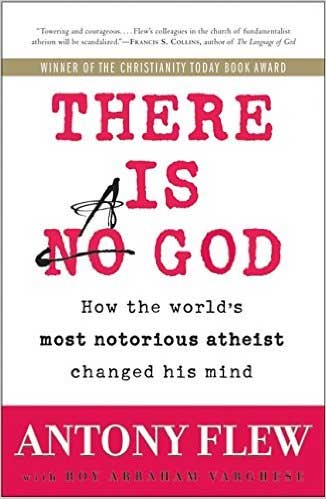
Famed Atheist Philosopher, Antony Flew, Now a Theist/Deist

Antony Flew Conversion

Edward: Famed lifelong atheist philosopher, Antony Flew (age 81),has become a theist / deist. The London TIMES had this to say about Flewʼs recent conversion: “He [Flew] is unlikely to proclaim his faith from a pulpit. He is still not a Christian and dismisses the conventional forms of divinity as ‘the monstrous oriental despots of the religions of Christianity and Islam.’ He also stands by his rejection of an afterlife.”

Flew: “Iʼm thinking of a God very different from the God of the Christian and far and away from the God of Islam, because both are depicted as omnipotent Oriental despots, cosmic Saddam Husseins,” he said. “It could be a person in the sense of a being that has intelligence and a purpose, I suppose.”

In his lengthiest inteview thus far about his theism (an interview with Liberty University Christian apologist Gary Habermas), Flew had this to add:

Habermas: “In your view, then, God hasnʼt done anything about evil.”

Flew: No, not at all, other than producing a lot of it…

Habermas: Are you any closer to thinking that the resurrection could have been a historical fact?

Flew: No, I donʼt think so… What we do not have is evidence from anyone who was in Jerusalem at the time, who witnessed one of the allegedly miraculous events, and recorded his or her testimony immediately after the occurrence of that allegedly miraculous event. In the 1950s and 1960s I heard several suggestions from hard-bitten young Australian and American philosophers of conceivable miracles the actual occurrence of which, it was contended, no one could have overlooked or denied. Why, they asked, if God wanted to be recognized and worshipped, did God not produce a miracle of this unignorable and undeniable kind?”… [According to Luke-Acts, the raised Jesusʼ ascension into heaven was only witnessed by the eleven apostles, and even Luke-Acts admits that there was no preaching of “the resurrection” until seven weeks after the crucifixion.]

Habermas: Do you think that there is any chance that you might in the end move from theism to Christianity?

Flew: I think itʼs very unlikely, due to the problem of evil. But, if it did happen, I think it would be in some eccentric fit and doubtfully orthodox form: regular religious practice perhaps but without belief. If I wanted any sort of future life I should become a Jehovahʼs Witness [because at least their paradise involves corporeal persons; and Flew said earlier in the interview: “I think those who want to speak about an afterlife have got to meet the difficulty of formulating a concept of an incorporeal person… it is simply impossible to create a concept of an incorporeal spirit… Swinburne and I had been the only Gifford lecturers to treat the question of a future life for the sixty years past. Even more remarkably, Swinburne in his Gifford Lectures ignored Bishop Butlerʼs decisive observation: ‘Memory may reveal but cannot constitute personal identity.’”

One should also note that in the realm of philosophy, many theistic philosophers as well as Christian theistic philosophers, have been unable to agree on quite a lot of questions. See Contemporary Debates in the Philosophy of Religion (2003) by Michael Peterson, managing editor of the journal Faith and Philosophy, published by the Society of Christian Philosophers. Here are some questions from that book, questions on which theistic philosophers disagree:

  • Can Only One Religion Be True?

  • How to Sink in Cognitive Quicksand: Nuancing Religious Pluralism: Keith E.Yandell (University of Wisconsin)

  • It Is Not Reasonable to Believer that Only One Religion is True: Peter Byrne (Kingʼs College, University of London)

  • Does God Take Risks in Governing the World?

  • God Takes Risks: William Hasker (Huntington College)

  • God Does Not Take Risks: Paul Helm (Regent College)

  • Does God Respond to Petitionary Prayer?

  • God Responds to Prayer: Michael J. Murray (Franklin and Marshall College)

  • God Does Not Necessarily Respond to Prayer: David Basinger (Roberts Wesleyan College)

  • Is Eternal Damnation Compatible with the Christian Concept of God?

  • Eternal Hell and the Christian Concept of God: Jerry Walls (Asbury Theological Seminary)

  • No Hell: Thomas Talbott (Willamette University)

  • Is Morality Based on Godʼs Commands?

  • Divine Commands Are the Foundation of Morality: Janine Marie Idziak (Loras College)

    Ethics Is Based on Natural Law: Craig A. Boyd (Greenville College) and Raymond J. VanArragon (Asbury College)

  • Should a Christian Be a Mind-Body Dualist?

  • Christians Should Affirm Mind-Body Dualism: Dean W. Zimmerman (Rutgers University)

  • Christians Should Reject Mind-Body Dualism: Lynne Rudder Baker (University of Massachusetts)


In a letter to Philosophy Now magazine (Issue 47, August/September 2004, p. 22) Flew noted that “It has become inordinately difficult even to begin to think about constructing a naturalistic theory of the evolution of that first reproducing organism.” Flew then recommends two books: “The first book is Roy Abraham Vargheseʼs “The Wonderful World: A Journey from Modern Science to the Mind of God” (Fountain Hills, Arizona: Tyr Publishing, 2003). The second book is Gerald L. Schroederʼs The Hidden Face of God: Science Reveals the Ultimate Truth (Touchstone, New York 2001).”

“Gerald Schroederʼs” name also came up in Flewʼs interview with Habermas in which Flew said: “I am open to [the notion of theistic revelation], but not enthusiastic about potential revelation from God. On the positive side, for example, I am very much impressed with physicist Gerald Schroederʼs comments on Genesis 1. That this biblical account might be scientifically accurate raises the possibility that it is revelation.” (Original Source: La Mirada, Calif., Dec. 9/PRNewswire)

Questioning Flewʼs Praise of the Works of “Gerald Schroeder”

Schroederʼs attempts to discover direct concordances between Genesis and modern science are far from satisfactory in the view of many of his fellow scientists, so I hope Flew will look into such matters a bit deeper. For instance, Schroederʼs claim about how much genetic change it would take to create human beings is wrong. According to the latest data, “The difference between human and chimp genomes is only about 1.23%, rather than 1.4% as originally thought.”

Even more importantly, if man and chimp diverged from a common ancestor, you must half those differences yet again. In fact the differences between human and chimp genomes are less than that between the genomes of near identical sibling species of fruit flies. And there is even evidence in human chromosome #2 that points to it being the result of a fusion of two chromosomes that very closely resemble two chromosomes found in the chimpanzees, whose banding patterns line up band for band to those inside human chromosome #2. Moreover, human chromosome #2 still contains remnants of that fusion process—in the form of a faint second centromere (there is almost always just one centromere per chromosome, found in its middle, not two centromeres), and reversed teleomeric sequences in the middle of that chromosome (telomeres are almost always found at the tips of chromosomes, not in the middle, and not in reverse order, hence finding them in the middle of a chromosome means that portion used to be the tip or end of a second chromosome).

Here are some reviews of Schroederʼs books that perhaps Flew might like to acquaint himself with before lending any more praises to Schroederʼs work: Frank Sonleitner,Department of Zoology, University of Oklahoma, Norman OK 73019 reviews Schroederʼs The Science of God:

Source: www.ncseweb.org/

“This book is essentially an elaboration and update of Schroederʼs earlier book Genesis and the Big Bang published in 1990. Schroeder is an Israeli physicist who has also extensively studied biblical interpretation. He uses the arguments of the Anthropic principle (the Big Bang and the fine-tuning of the universal constants) as evidence for God; but he also insists that the Bible and science agree. Genesis is not to be taken literally nor dismissed as poetry but must be interpreted correctly following the lead of talmudic scholars such as Nahmanides and Maimonides. Although his interpretation twists, stretches, and sometimes directly contradicts the literal meaning of Genesis, it confirms all the findings of modern cosmology and geology.

“Using a universal time clock based on the stretching of the wavelengths of light as the universe expands, he concludes that the universe is 15.75 billion years old. The six days of Genesis consist of a nonlinear day-age description of the history; day 1 covers the first 8 billion years, and day 6 only the last 1/4 billion.

“Schroeder accepts the standard geologic and paleontologic history of the earth but he balks at evolution (although he admits some sort of genetic continuity as suggested by the evidence of comparative anatomy, biochemistry and embryonic recapitulation). He rejects all transitional forms among higher categories such as classes and phyla, but later admits that there might be transitional forms within classes. (He does discuss the recently discovered intermediate forms of whales.)

“Schroeder rejects evolution because he considers its mechanism to rest solely on pure chance. There is no discussion of natural selection; it doesnʼt appear in the index although the term is used in passing while discussing Dawkins. His “proof” that it is impossible for convergent evolution to produce similar eyes in taxa which did not inherit these structures from a common ancestor uses a mathematical calculation based on two assumptions - (1) evolution is pure chance; and (2) the taxa have no genes in common except those “inherited” from the protozoa. Yet in other places he seems to be aware of the recent evidence that the phyla have many genes in common; he discusses the Hox genes that determine body plans and the Pax genes that are involved in eye formation!

“Schroeder admits that there were “pre-Adamites” (Cro-Magnon and Neanderthals) living for 40 000 years prior to Adam, but questions the existence of earlier hominid species because of the fragmentary nature of their fossils. Again he uses a mathematical model to show that the evolution of humans from an ape ancestor is impossible. This model also assumes that (1) evolution would occur by pure chance and (2) one million mutations would be necessary to produce the ape-human transition! “It takes more than the Big Bang and the fine tuning of universal constants to demonstrate that the creator is the kind, loving, personal God worshipped by Christians. And there Schroederʼs arguments fall apart. For example, he argues that quantum mechanics provides the basis of free will and that the determinacy of our genes does not prevent our exercising free will, yet later he says that randomness in nature (including random mutations) is necessary for free will! And natural disasters are necessary. We must suffer earthquakes and volcanic eruptions that result from plate tectonics made possible by the earthʼs molten core because the latter is necessary to generate a magnetic field to protect us from the high energy radiation produced by the life-giving sun. But then he says that the biblical Creator could have made stars that didnʼt produce those lethal rays but “they would not be natural” and would offer absolute testimony of the Creatorʼs existence! And still later he contradicts this principle (that the universe is organized “naturally” to hide the existence of the Creator) by saying that the earth is at an “unnatural” distance from the sun and hints that this may be miraculous! (According to Schroeder some exponential law determines the distance of the planets, and the earthʼs distance does not fit the pattern.)

“Evolutionists will justifiably criticize Schroeder for his simplistic and inconsistent treatment of evolution while the real creationists will reject him for his theology which includes rejection of the literal reading of Genesis, acceptance of the Big Bang, an old age for the earth, existence of pre-Adamites, a local flood, and ignoring Christ, Christianity and the New Testament.”


Victor J. Stenger, professor of physics and astronomy at the University of Hawaii. Review of Schroederʼs The Science of God:

“How can both the Bible and science be right? Israeli physicist Gerald Schroeder says he can show us how. Letʼs start with cosmology. The Bible says God created the universe in six days and indicates the passage of only about 6,000 years since then. Science currently estimates the visible universe to be about 13 billion years old, give or take a few billion. Schroeder reconciles the two, explaining that the six days of the Bible refer to a different measure of time. He explains: “there is no possible way for those first six days to have an Earth-based perspective simply because for the first two of those six days there was no Earth” (51). “Instead, time during this six day period was measured on a cosmic clock. And what else could be used for that clock but the vibrations of light (electromagnetic waves)? Today the light from creation appears as the cosmic microwave background. This is now redshifted by a factor of a trillion (1012) from the period of “quark confinement” when matter as we know it first began to form. Thus the cosmic clock at that epoch ran off a trillion days for each of our modern days. The six cosmic days of creation thus took about 15 billion years earth time, give or take a few billion. So, according to the author, Genesis is not only consistent with cosmology, it gives the correct age of the universe!

“Each of the six days in Schroederʼs Genesis actually takes a different length of earth time. The duration D, in earth days, of each cosmic day t is calculated from the formula D = (Ao/L)exp(-Lt), where Ao = 4x10¹² (the ratio of the frequencies of the cosmic microwave background at quark confinement compared to now) and L = 0.693 (natural log of 2). More simply, cosmic day one is 8 billion earth years long and you divide by two to get the duration of each succeeding cosmic day. “Cosmic day one starts 15.75 billion earth years ago and covers the creation of the universe, the “breaking free” of light as electrons bind to atomic nuclei, and the beginning of galaxy formation. This is described in Gen. 1:1-5 as the creation followed by light separating from the darkness.

“Cosmic day two starts 7.75 billion earth years ago and lasts four billion earth years. During this period the stars and galaxies are born. This corresponds to Gen. 1:6-8, the formation of the heavenly firmament. “Cosmic day three starts 3.75 billion earth years ago. During two billion earth years, the earth cools, water appears, and the first life forms appear. In Gen. 1:9-13, vegetation first appears during the third day. “Cosmic day four starts 1.75 billion earth years ago and lasts a billion earth years. The earthʼs atmosphere becomes transparent and photosynthesis produces an oxygen-rich atmosphere. Schroeder says that this corresponds to Gen. 1:14-19 when “the Sun, Moon, and stars become visible in the heavens” (67).

“Cosmic day five starts 750 million earth years ago and lasts 500 million earth years. During this period, the first multicellular animals appear and the oceans swarm with life. Gen. 1:20-23 says the waters bring forth swarms of living creatures and “birds fly above the earth” (94). “Cosmic day six starts 250 million years ago and ends at the time of Adam. During this period we have a massive extinction in which 90 percent of life is destroyed and then repopulated with humanoids and humans. This, Schroeder says, corresponds to what is described in Gen. 1:24-31. “Technically, Schroederʼs formula gives the present as the end of the sixth day. However, it could just as well have ended a few thousand years ago and not affect the rest of the calculation where things are rounded off at hundreds of millions of years. Schroeder argues that after the six cosmic days of creation, Genesis switches its focus over to humanity and starts measuring time in human terms. The rest of the Bible concerns itself with the 6,000 earth years since Adam and Eve, estimated from the Bible in Bishop Ussher fashion.

“Schroeder does not deny the existence of hominid creatures before Adam. He talks about Neanderthals and Cro-Magnons, and accepts that they had developed tools, pottery, and many human-like qualities. In Lev. 11:33 the Bible talks about pottery. But, Schroeder argues that since it never mentions the invention of pottery, that event must have pre-dated Adam (130).

“According to the author, the Bible has no interest in these pre-Adam hominids because they were not yet fully human and had no souls. Thus they are never mentioned. Adam represents the quantitative change to a large brain, but more important, the qualitative change that makes us different from all other forms of life: “our soul of human spirituality” (133). God breathed this into Adam, the first real human, 6,000 years ago. “Schroederʼs attempt to connect 31 lines of Genesis to big-bang cosmology and earth paleontology makes entertaining reading, but will convince no one who is not already convinced or totally lacking of critical facilities.

“Let us return to the beginning. Schroederʼs use of quark confinement as the defining moment for his cosmic time scale is completely arbitrary. He seems to have chosen it for no better reason than it gives the answer he wants. The redshift from quark confinement to the present is of the order of 1012. Multiplying this by six days gives 15 billion years, which is consistent with our current estimate for the age of the universe. “Alternatively, Schroeder might have chosen the moment in the early universe called “decoupling,” which represents the point where radiation separates from matter. Indeed, he relates this event to the separation of the “light from the darkness” described in Genesis day one. But the redshift from decoupling to the present is only of the order of 1,000, which would give an earth time interval of only fifteen years for the six cosmic days of creation. If he had chosen some other moment, he would have obtained yet a different time scale.

“Furthermore, by Schroederʼs own formula the universe creation corresponds to the time of quark confinement. Blueshifting back from that point rather than redshifting ahead, the events prior to quark confinement would recede infinitely into the past, in earth time, and we would have no creation at all.

“Schroederʼs use of an exponential function to give different earth periods for each cosmic day is not justified by his argument that earth time is simply redshifted cosmic time. While an exponential relationship would apply for the inflationary epoch in the early universe, that has ended by the time of quark confinement. Afterwards we have the almost linear Hubble expansion in which the redshift varies as a power law with time, not exponentially. By having each cosmic day half as long as the preceding one in earth years, again a completely arbitrary, unjustified procedure, Schroeder is able to vaguely relate events known from cosmology to those described in Genesis.

“In cosmic day two the “firmament” is created. Note that Schroeder excludes from the “firmament” all galaxies more than 7.75 billion light years away, of which there are many. Furthermore, he sees no problem with calling the expanding universe a “firmament.” Like all apologists, he selects his data carefully, accepting only those which agree with his hypotheses and discarding those which do not.

“Primitive life first appears in cosmic day three. Here again it takes some mighty stretching to associate what is described in the Bible for the third day, including fruit trees, with the primitive life described by paleontology for that epoch.

“Schroeder has the sun, moon, and stars becoming visible in cosmic day four. In fact, Genesis seems to say the that sun, moon, and stars are created at that time - well after the earth was created.

“Cosmic day five has the waters teeming with life. But the biblical verses imply birds as well. Schroeder says that “birds” is a mistranslation and that the Bible here is referring to water insects instead. Translation is so easy when you know what you want a passage to say.

“Cosmic day six contains the mass extinctions of life that occurred 65 million years ago. The biblical verses referenced make no mention of mass extinction. The Biblical Flood occurs well after Adam, but Schroeder needs to end the six days of creation with Adam for other purposes. This is one event he simply cannot make fit, although he is not honest enough to say so and leaves the impression that everything is consistent.

“At times you get the impression that this book is a parody, with quite a few good chuckles when read in that context. However, the sections on evolution soon convince you that no parody is intended. They are just too unfunny, too dull. Schroeder trots out all the old, tiresome arguments about why “life could not have stared by chance” and how the simplest forms, even viruses, are “far too complex to have originated without there being an inherent chemical property of molecular self-organization and/or reaction enhancing catalysts at every step of their development” (85). He applies the usual creationist deception of calculating chance probabilities as if chance is the only operative mechanism, and then saying this “proves” that God intervenes along the way when they come out very low. And, of course, the “staccato aspect of the fossil record” refutes classical evolution. “These rapid changes cannot be explained by purely random mutations at the molecular-genetic level” (87).

“Notice how often theists tell us that something cannot be explained except by God? They never seem to learn from history.”

Revised Title: The Delusions of Gerald Schroeder, December 5, 1997


A young-earth creationist Amazon reviewer of The Science of God:

“I find many of his interpretations manipulated to his own cause, e.g. Gen. 1:12 which he interprets: “and the earth brought forth life.” A more reliable interpretation of the text renders: “and the earth(or land) brought forth vegetation.” Further, he cites no credible Hebrew scholar who agrees with his interpretation of day for order and night for chaos. He relies much more for his case on the mystical kabbalah, especially Nahmanides, which can only be explained at best as “opinion.” This leaves him in positions which do not square with all of inspired Scripture…For the exact opposite view of Schroederʼs key thesis: clocks ticking faster at the center and slow at the edge of the cosmos—- see young-earth creationist, D. Russell Humphreysʼs book “Starlight and Time.”


Old earth creationist Hugh Ross reviews Schroederʼs Genesis And The Big Bang:

Source: www.reasons.org/resources/apologetics/p9401.html?main

“One problem with his view is that it clashes with the scientific data on the timing of Earthʼs origin. Since the earth already exists on the first creation day of Genesis 1, Schroederʼs model would say that Earth began at least 12 billion years ago. Scientific measurements, however, show that it is only 4.6 billion years old. Our view is that Genesis 1:2 establishes the frame of reference for the creation events: “The Spirit of God was brooding (or hovering) over the surface of the waters.” In other words, Godʼs time and space frame in describing creation is the earthʼs surface, a frame in common with all readers of the account. The text gives no hint of Schroederʼs relativistically time-extended creation days. If one seeks Jewish support for a day-age interpretation of Genesis 1, Nathan Aviezer, another Jewish physicist, offers it in a book entitled In the Beginning: Biblical Creation and Science (Hoboken, NJ: KTAV Publishing House, 1990). Aviezer acknowledges that the six creation days of Genesis 1 must refer to long time periods.”


Amazon Reviewer of The Science of God: seapapa from Los Angeles “Schroederʼs thesis is that the author of Genesis is describing a 15 billion year history of the universe and life, even though that was never his understanding or his intention. The true meaning Genesis 1 went undetected until it was discovered by the cabalist author Nahmanides in the 11th Century AD. It was lost again until Schroeder rediscovered it. “Even accepting the dubious proposition that people can write things that actually mean the exact opposite of what they intend, the match between the Genesis timeline and the scientifically proposed history of the universe makes an ill fit. Schroeder tries to reconcile the two by focusing minutely on certain words in Genesis that could be interepreted to allow for longer time periods, while totally ignoring the text read in its entirety. For example, day three of creation supposedly lasts 1.6-3.6 billion years ago. Genesis said “let the land produce vegetation”. Success, proclaims Schroder, that matches the plant life on the planet, which is found only in the… water! He conveniently ignores the rest of the verse which calls for fruit-bearing trees and seed-bearing plants. There was nothing but protozoa and plankton back then. This is typical of the book.

“The most absurd argument is that, if properly interpreted, the 6 creation days correspond to 6 actual 24 hour days on earth AND 15 billion cosmic years. How so? Einsteinʼs relativity of time! Schroeder makes such an effort to preserve the 6 days of creation and the order of creation. “This book is ultimately a polemic. Although brilliant and articulate, one gets the feeling that Schroeder cannot bear to have Genesis undermined. That compromizes his scientific judgement.”


A Reviewer of The Science of God (at amazon.com):

“contains a few good passages, but also some egregious errors, which are puzzling when made by a PhD in Physics. For example, G. Schroeder completely misinterprets the experiments with particles moving through openings, invents some odd concept of heat diluting in enlarged volumes, misrepresents the story of photoelectric effect, etc. One striking feature of this book is that Schroeder suggests in it the chronological data , which completely contradict his own data on the same subject, given in his first book, without a word of explanation why he changed those data. A useless book.”


A Reviewer of The Science of God (at amazon.com) wrote:

“His time dilation calculations are totally at fault. The factor of one million million he uses is totally arbitery (nothing really special happened at z=1 million million). His redshift/blueshift calculations are also wrong: The background temperature (and the redshift) changed by less than 10% in the last billion years. Nowhere near the rate needed to slow down from a 500 million year per day (Day 5, according to Schreoder) to 24 hours per day. “Another serious mistake appears in his coverage of evolution: He says the the evolution from chimpanzees to humans requires a million point mutations because the difference in the active DNA between human and chimps is 1,000,000 bases.

“This is simply false. Schroeder himself says that the number of changes needed is no more than 70,000. In most cases a single point mutation is enough to complete a change.

“It would have been better if Schreoder, as a nuclear physicist, asked an expert biologist before writing his chapters about evolution…”


Reviewer: gsssew@m… from St. Louis, Missouri

I was intrigued by the title, but agitated by the contents. The entire book is filled with completely preposterous assumptions and conclusions. After reading such a book, I begin to question why someone, such as Gerald Schroeder, view themselves as scientists.

Denis: Ed, If Jerry Falwell became an evolutionist, be assured, that would be news.

Edward: Flew hasnʼt become a creationist, nor even a “life everlasting”-ist. His god is like Spinozaʼs and Einsteinʼs. So, what I meant to say was that the media played up Flewʼs change of mind (even some Christians on the web bragging he was close to converting to Christianity and holding up his example as a sort of sacred talisman against further thought concerning their particular beliefs.)


Denis: Itʼs news because of who Flew is and what he has written.

Edward: I doubted Flewʼs competency in his first debate with Habermas, published as, “Did Jesus Rise From the Dead?” because Flew demonstrated in that debate that he knew much about Hume but nearly nothing about the relevant Gospel passages. I subsequently wrote Habermas to point out Flewʼs inadequacies and got into a little letter debate with Habby that he even presented to a Christian publisher, who, however, wasnʼt interested in publishing such an exchange.

Flew himself admitted recently that he lacks competency when it comes to judging physics and biology arguments:

Flew Update (January 2005) by Richard Carrier who exchanged letters with Flew

Flew admits: “I have been mistaught by Gerald Schroeder.” He says “it was precisely because he appeared to be so well qualified as a physicist (which I am not) that I was never inclined to question what he said about physics.” Apart from his unreasonable plan of trusting a physicist on the subject of biochemistry (after all, the relevant field is biochemistry, not physics—yet it would seem Flew does not recognize the difference), this attitude seems to pervade Flewʼs method of truthseeking, of looking to a single author for authoritative information and never checking their claims (or, as in the case of Dawkins, presumed lack of claims). As Flew admitted to me, and to Stuart Wavell of the London Times, and Duncan Crary of the Humanist Network News, he has not made any effort to check up on the current state of things in any relevant field (see “No Longer Atheist, Flew Stands by ‘Presumption of Atheism’” and “In the Beginning There Was Something”). Flew has thus abandoned the very standards of inquiry that led the rest of us to atheism.

Despite all this, Flew has not retracted his belief in God, as far as I can tell. But in response to theists citing him in their favor, Flew strangely calls his “recent very modest defection from my previous unbelief” a “more radical form of unbelief,” and implies that the concept of God might actually be self-refuting, for “surely there is material here for a new and more fundamental challenge to the very conception of God as an omnipotent spirit,” but, Flew says, “I am just too old at the age of nearly 82 to initiate and conduct a major and super radical controversy about the conceivability of the putative concept of God as a spirit.” This would appear to be his excuse for everything: he wonʼt investigate the evidence because itʼs too hard. Yet he will declare beliefs in the absence of proper inquiry. Theists would do well to drop the example of Flew. Because his willfully sloppy scholarship can only help to make belief look ridiculous.

See also…

The London TIMES had this to say about Flewʼs recent conversion: “He [Flew] is unlikely to proclaim his faith from a pulpit. He is still not a Christian and dismisses the conventional forms of divinity as ‘the monstrous oriental despots of the religions of Christianity and Islam.’ He also stands by his rejection of an afterlife.”

Flew: “Iʼm thinking of a God very different from the God of the Christian and far and away from the God of Islam, because both are depicted as omnipotent Oriental despots, cosmic Saddam Husseins,” he said. “It could be a person in the sense of a being that has intelligence and a purpose, I suppose.”

abcnews.go.com

In his lengthiest interview thus far about his theism (an interview with Liberty University Christian apologist Gary Habermas), Flew had this to add:

Habermas: “In your view, then, God hasnʼt done anything about evil.”

Flew: No, not at all, other than producing a lot of it….

Habermas: Are you any closer to thinking that the resurrection could have been a historical fact?

Flew: No, I donʼt think so… What we do not have is evidence from anyone who was in Jerusalem at the time, who witnessed one of the allegedly miraculous events, and recorded his or her testimony immediately after the occurrence of that allegedly miraculous event. In the 1950s and 1960s I heard several suggestions from hard-bitten young Australian and American philosophers of conceivable miracles the actual occurrence of which, it was contended, no one could have overlooked or denied. Why, they asked, if God wanted to be recognized and worshipped, did God not produce a miracle of this unignorable and undeniable kind?”… [According to Luke-Acts, the raised Jesusʼ ascension into heaven was only witnessed by the eleven apostles, and even Luke-Acts admits that there was no preaching of “the resurrection” until seven weeks after the crucifixion.]

Habermas: Do you think that there is any chance that you might in the end move from theism to Christianity?

Flew: I think itʼs very unlikely, due to the problem of evil. But, if it did happen, I think it would be in some eccentric fit and doubtfully orthodox form: regular religious practice perhaps but without belief. If I wanted any sort of future life I should become a Jehovahʼs Witness [because at least their paradise involves corporeal persons; and Flew said earlier in the interview: “I think those who want to speak about an afterlife have got to meet the difficulty of formulating a concept of an incorporeal person… it is simply impossible to create a concept of an incorporeal spirit… Swinburne and I had been the only Gifford lecturers to treat the question of a future life for the sixty years past. Even more remarkably, Swinburne in his Gifford Lectures ignored Bishop Butlerʼs decisive observation: ‘Memory may reveal but cannot constitute personal identity.’”


Denis: Finally, to answer the question in the title of your piece: Itʼs because liberalism is OLD news.

Edward: It appears to me to be relatively big news that churchgoing continues to decline in the northern hemisphere of the Western industrialized world, especially in Christianityʼs birthplace, Europe. (The regular churchgoers who remain in North America and Europe, tend to be of a more conservative varieties.) Also, Islamʼs rate of biological reproduction means that she may possibly overtake Christianity in the future as the worldʼs number one religion, especially since reproductive rates in Europe have slipped to a low rate. So, Europe may yet be conquered by Islam in the future. Though Christianity in the southern hemisphere continues to grow, especially conservative Catholicism and miracle-mongering Protestant sects. And further conflicts with Islam will probably continue to arise there.

Nigeria Christians Attack Muslims, Kill Dozens

On the decline of churchgoing in the Northern Hemisphere see: “Trends Among Christian Believers in America” (includes links at the bottom to trends round the world)

On the rise in Christianity in the Southern Hemisphere see the links

The Next Christianity - About the kinds of Christianity that are gaining popularity in the Southern hemisphere: very hardcore, including a revival of witchhunts.

Christianityʼs New Center - More about the rapid growth of hardcore

Christianity (along with Islam) in the Southern hemisphere.

Oh, Gods! - About worldwide religious trends in general, including new religious movements.

Welcome to the Next Church - About the new American evangelical (not quite fundamentalist, but fundy-leaning) Christian megachurches, some with wealthy parishioners, although Christianityʼs primary appeal is to the poor.


Edward: Regarding Wheaton College (Billy Grahamʼs alma mater), it no longer demands that all of its professors agree that Adam and Eveʼs bodies were created directly from the earth.

Denis: Is that true? Iʼve got a friend going there this summer, and he believes that he has to sign it. But he might be wrong. So, clue me (and him) in if something has changed.

Edward: A few years ago I read in First Things or Christianity Today that Wheaton was no longer requiring faculty, staff and students to sign a statement demanding that they believe Adam and Eveʼs bodies were created directly from the dust of the earth. I havenʼt been able to find a copy of Wheatonʼs earlier statement of faith, but the present one reads, “We believe that God directly created Adam and Eve, the historical parents of the entire human race; and that they were created in His own image, distinct from all other living creatures, and in a state of original righteousness.” www.wheaton.edu/welcome/mission_textonly.html The mention of a “distinct creation” does not specify whether the body or the soul is being addressed as “distinctly created.” Even Mr. Jones, the provost at Wheaton, wrote that while professors were not required to advocate creationism, they were expected to treat it with respect. [From The Chronicle of Higher Education, May 24, 2002, “Do Professors Lose Academic Freedom by Signing Statements of Faith? Critics say the oaths at some religious colleges are intellectually confining” by Beth McMurtrie

A Wheaton College professor of Old Testament, John Walton, wrote in 2002 the NIV Application Commentary Of Genesis and he left open the question of whether certain verses in Genesis demand belief in the bodies of Adam and Eve from the dust of the earth. Walton even argues that commentary that the ancient Hebrews believed the earth was flat, and that the “serpent” in Genesis was not originally understood to be “Satan.” Waltonʼs commentary was published in 2002. Every Evangelical ought to read it. A simplified presentation by Walton.

Also, Wheaton College has a huge collection of C. S. Lewis writings and memorabilia. Lewis of course wouldnʼt be able to sign any statement of faith that demanded one must believe that Adam and Eve were created directly from the dust of the earth. In fact C. S. Lewis wasnʼt disturbed in the least by the thought of Genesis being “…derived from earlier Semitic stories which were Pagan and mythical.” [C. S. Lewis, Reflections on the Psalms (London: Collins, Fontana Books, 1958), p. 93]

“We read in Genesis (2:7) that God formed man of the dust and breathed life into him. For all the first writer knew of it, this passage might merely illustrate the survival, even in a truly creational story, of the Pagan inability to conceive true Creation, the savage, pictorial tendency to imagine God making things ‘out of’ something as the potter or the carpenter does.” [C. S. Lewis, “Scripture,” Reflections on the Psalms]

In short, “Lewis found more truth in the story of the ‘Garden of Eden’ when he regarded it as myth than as history.” [Michael J. Christensen, C. S. Lewis on Scripture: His Thoughts on the Nature of Biblical Inspiration, The Role of Revelation and the Question of Inerrancy (Waco, Texas: Word Books, 1979), pp. 34-35)]

Agnosticism and the Christian World View

Dave: If they reject the Christian world view and start disbelieving in God or taking an agnostic position towards the question of His existence, then they have to come up with some superior alternative ethical system which isnʼt either arbitrary or unworkable in practice. I maintain that it cannot be done.
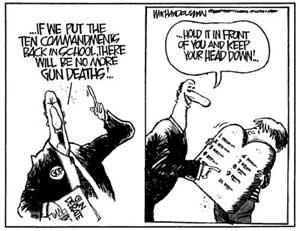
World View

Edward: Is that your foremost fear, that your ethics may prove baseless and youʼll walk out of the house one day and just start cursing, stealing or killing at random, or others will simply lose all control and do the same to you?

Have you considered the philosophical fallacies inherent in all attempts to base ethics on a particular authoritarian “world view?”

The Authoritarian Fallacy

Does philosophy really provide explanations? In any philosophy course you will learn that authoritarian explanations, such as claiming that “God made the rules,” explains one unquestionable premise (namely, “the rules”) by invoking an even more unquestionable and more mysterious premise (namely, “God”). So authoritarian explanations do not “explain” things much more coherently than other explanations.

Reminds me of a radio talk show in which the liberal and conservative hosts were taking calls from listeners, and someone called in agreeing with something the conservative host had said, adding, “I agree, Bob! And we must never ever do any wrong, not under any circumstances…” And the conservative host shouts, “Now thereʼs a man taking some sense!” But the called continued his thought, adding, “…or Zondar the Monkey King will come down and bop us with his big banana.”

Even C. S. Lewis was aware of the philosophical dangers of authoritarian-based ethical assumptions.
Apparently having second thoughts about a Supreme Being unrestrained by moral principles, in the year of his death C. S. Lewis wrote: “The real danger is of coming to believe such dreadful things about Him. The conclusion I dread is not ‘so thereʼs no God after all,’ but ‘So this is what God is really like. Deceive yourself no longer.’” Only four months before his death, Lewis wrote in a letter to an American philosopher that there were dangers in judging God by moral standards. However, he maintained that “believing in a God whom we cannot but regard as evil, and then, in mere terrified flattery calling Him ‘good’ and worshipping Him, is still greater danger.” Lewis was responding specifically to the question of Joshuaʼs slaughter of the Canaanites by divine decree and Peterʼs striking Ananias and Sapphira dead. Knowing that the evangelical doctrine of the Bibleʼs infallibility required him to approve of “the atrocities (and treacheries) of Joshua,” Lewis made this surprising concession: “The ultimate question is whether the doctrine of the goodness of God or that of the inerrancy of Scriptures is to prevail when they conflict. I think the doctrine of the goodness of God is the more certain of the two indeed, only that doctrine renders this worship of Him obligatory or even permissible.
In short, Lewis came close to saying that the Supreme Might must live up to moral standards if he is to be regarded as God and not as some cosmic sadist unworthy of worship.
In his letter to the philosopher, Lewis expresses the realization that he could not wholly relativize and trivialize the concept of goodness for the Supreme Being he envisioned:
To this some will reply “ah, but we are fallen and donʼt recognize good when we see it.” But God Himself does not say that we are as fallen at all that. He constantly, in Scripture, appeals to our conscience: “Why do ye not of yourselves judge what is right?” — “What fault hath my people found in me?” And so on. Socratesʼ answer to Euthyphro is used in Christian form by Hooker. Things are not good because God commands them; God commands certain things because he sees them to be good. (In other words, the Divine Will is the obedient servant to the Divine Reason.) The opposite view (Ockhamʼs, Paleyʼs) leads to an absurdity. If “good” means “what God wills” then to say “God is good” can mean only “God wills what he wills.” Which is equally true of you or me or Judas or Satan. Lewis was not always consistent in his attempt to find a foundation for morality. In some of his earlier books he suggests that Godʼs goodness is incompatible with whatever happens, which, instead of giving theism any advantage over atheism, does little more than make Cosmic Might the personification of moral randomness, of relativism gone out of control.
— Joe Edward Barnhard, “The Relativity of Biblical Ethics,” Biblical v. Secular Ethics: The Conflict, edited by R Joseph Hoffman and Gerald A Larue Buffalo, New York (1988), Prometheus Books

Judging by C. S. Lewisʼ statements above, he might have even given a thumbs up to the following saying by Voltaire, “The silly fanatic repeats to me that it is not for us to judge what is reasonable and just in the divine Being. That His reason is not like our reason, that His justice is not like our justice. Eh? How, you mad demoniac, shall we judge justice and reason otherwise than by the notions we have of them? Do you want us to walk otherwise than with our feet, and speak otherwise than with our mouths?”

Of course philosophers are continually debating what does “explain” things, to little satisfaction of other philosophers, even when the philosophers in question are all theists and/or Christians, as you can read in the latest debate vol. published by the Society of Christian Philosophers: Contemporary Debate in the Philosophy of Religion (Section III. features debates between Christian/theistic philosophers on questions such as “Can Only One Religion Be True?” “Does God Take Risks in Governing the World?” “Does God Respond to Petitionary Prayer?” “Is Eternal Damnation Compatible with the Christian Concept of God?” “Is Morality Based on Godʼs Commands?” “Should a Christian Be a Mind-Body Dualist?” Concerning such questions, none of the Christian/theistic philosophers appear to have been convinced by the othersʼ arguments in their debates.)

The question is what great philosophical system doesnʼt indulge in a tautological form of reasoning in order to explain our “reactions?” For instance, what advantage is it to know that the nature of being consists in the “will to live,” in the “idea,” or in the whim of “God” or of “chemistry?” A mere proliferation of words, subtle displacements of meanings. “What is” loathes the verbal embrace, and our inmost experience reveals us nothing beyond the privileged and inexpressible moment.

“We have infinite trouble in solving man-made mysteries; it is only when we set out to discover ‘the secret of God’ that our difficulties disappear.” - Mark Twain

“It is truly extravagant to define God, angels, and minds… when we do not know why we move our arms at will. Doubt is not a very agreeable state, but certainty is a ridiculous one.” - Voltaire

“I believe in Someone Out There - call Him God, since other names, like Festus or Darrin, do not seem to fit - but I am not entirely certain that He is all that mindful of what goes on down here. Example: Recently a tornado destroyed a town in Texas and dropped a church roof on a batch of worshipers. One of the few things left standing were two plaster statues, one of Jesus, the other of Joseph. The townspeople, according to the news, ‘looked at the statues’ survival as a sign of Godʼs love.’ Hold the phone. This sounds like the he-beats-me-because-he-loves-me line of thought. If the Lord in his infinite wisdom drops a concrete roof on the true believers but spares two hunks of modeling compound, it is time to question the big Fellaʼs priorities. If I have to be made up of plaster to command attention in this universe, something is amiss.”
— James Lileks, “God Has Call-Waiting,” Notes of a Nervous Man

I know that you have trust in a particular Biblical Catholic “God” and in your particular beliefs about “God.” And like the worshipers in the church above who were killed, regardless of what happens, you will continue to believe as you believe, trusting everything will turn out right and have some “explanation” in the end. Perhaps what you donʼt recognize is that I too have my own sense of trust as well. Lots of people do. People have been trusting and even praying for ages on this planet without joining any particular church or religion. Itʼs true that I did let go of the rock of my former beliefs, but I still have faith, hope, and love. Faith for me is more of a swimming thing than clinging to a particular sectarian or denominational or religious rock, and this whole cosmos swims in a sea of infinite space. And no, I donʼt seek converts to my view, only people willing to read books, including “holy books” as they would any other book, and ask the same types of questions as they would of any other book they read, and also admit that when it comes to things they donʼt know, then they just donʼt know them. I think we also both agree that when it comes to a person communing with a Higher Power, both of us probably have some skepticism concerning all the “middle men” in the field of “organized religion.”

“All great religions in order to escape absurdity, have to admit a dilution of agnosticism. It is only the savage, whether of the African bush or the American gospel broadcast, who pretends to know the will and intent of God exactly and completely.” - H. L. Mencken

On “Relativity” in the Realm of Ethics

Speaking of “relativity” in the realm of ethics, Calvin actually called the decrees of God “horrible,” and Luther admitted that he had trouble with the “acme of faith” by which so many people were condemned to hell simply by decree. And in the Bible you cannot find any verses that say polygamy, concubinage, slavery, or genocide are always and everywhere “sins.” In fact, according to the Bible such practices are perfectly acceptable to “God,” even praiseworthy — depending on the circumstances.

I shall make them eat the flesh of their sons and the flesh of their daughters, and they will eat one anotherʼs flesh in the siege… A curse on him who is lax in doing the Lordʼs work! A curse on him who keeps his sword from bloodshed. You are My war-club… with you I shatter old man and youth. young man and virgin.
— Jeremiah 19:9; 48:10; 51:20,22

The spirit of the Lord came upon Jephthah and he made a vow to the Lord and said, “If You will make it so that I can slaughter the sons of Ammon, then whatever comes out of my house to meet me when I return, it shall be Yours as a burnt offering.” [Jephthahʼs daughter came out of the house.] And he did to her according to his vow.
— Judges 11

The children of Israel stoned Achan and his daughters… burned them with fire… raised over them a heap of stones. And the Lord turned from the fierceness of His anger… The Lord hardened their hearts to meet Israel in battle in order that He might destroy them utterly, that they might receive no mercy.
— Joshua 7:24-26; 11:20

Moses said, “Kill every male among the little ones, and kill every woman who is not a virgin. But all the virgins save for yourselves.”
— Numbers 31 (How could the Israelites be sure which were virgins and which were not? Were the privates of each female probed to see if they had an unruptured hymen? — Mark Twain, Letters from the Earth)

The Lord said, “[Because] she has rebelled against her God… [Samarian] infants shall be dashed to pieces and women with child ripped open.”
— Hosea 13:16

The Lord said, “Slay man and woman, infant and suckling.”
— 1st Samuel 15:3

You shall fear (no other gods) only Yahweh… for He is a jealous God. Otherwise His anger will be kindled against you and He will wipe you off the face of the earth… In the cities He gives you leave alive nothing that breathes… utterly destroy them… show them no mercy… or Yahweh will destroy you utterly… The Lord delivered them before us… we… utterly destroyed the men… women, and the little ones of every city… If your brother, son, daughter, wife, or your friend who is your own soul, entice you away secretly, saying, “Let us go serve other gods”…you shall kill him; your hand shall be first against him to put him to death… These curses shall come on you… because you would not obey the Lord… you shall eat the offspring of your own body, the flesh of your sons and of your daughters… I [the Lord] will make mine arrows drunk with blood.
— Deuteronomy. 2:34; 5:9; 6:13,15; 7:2,4; 13:6-9; 20:16,17; 28:45,47,53; 32:42

Such verses bring to mind a question: Is “heaven” going to be a vacation paradise for obedient child slaughterers? I can just hear the pool-side chat, “We killed everyone in the city as God commanded . or thought we had. Then I spotted a heap of blankets rustling in an alleyway and yanked them aside, and there was a trembling young girl and her pregnant Mom. You should have seen the look on their faces as I raised my sword and . Hey waiter, can I get another Bloody Mary? Boy, I just love this place!”

And compare Matthew 5:7, “Blessed are the merciful” with the following verses:

“Leave alive nothing that breathes. show them no mercy.” (Deut. 7:2)

“The Lord hardened their hearts… that they might receive no mercy.”
(Joshua 11:20)

Not to mention questions raised by other laws and their interpretations in the Bible: The Pentateuch teaches, “Worship Yaweh, or die if you try to tempt others to worship other gods.” But the first amendment of the U.S. Constitution makes more sense to me, “Freedom of religion.”

How about the commandment, “Remember to keep the Sabbath day holy?” Under Constantine “Sunday” was “made holy” instead of the Hebrew “Sabbath” day. Neither do Christians refrain from working on Sunday, it has been reinterpreted to just mean not working at a job you get formally paid to do.

As for adultery, I donʼt know anyone who needs to read the Bible to understand that sleeping with another partner displeases the one youʼre with. Also, Born Again Christians have the same divorce rate as everyone else (as the Evangelical pollster, George Barna, admitted after his organization had conducted extensive polls over the past decade or two). Often the Born Again Christian is taught to wait until they are married in order to have sex, so they tend to get married at an earlier age than the rest of the population, and perhaps are less prepared financially and emotionally as a result. But even back in the days of the Puritans, their young teens had sex with each other, sometimes because of the practice of “bundling,” i.e., your kids sleeping with the neighborsʼ kids, or with visitorʼs kids, during cold winter nights just to keep warm, or young teen experimentation took place with the provision only that if the girl got pregnant, the two of them would get married. There are in fact figures of how many Puritan brides were pregnant on their wedding day, though I donʼt recall the exact percentage.

As for lying, there is a little command hidden in Leviticus against it, but in the Ten commandments the term used refers to “bearing false witness,” a legal term, not lying in general. And in fact the Hebrews employed a double standard for themselves and their neighbors. They could lie if it affected their chances in battle, be devious. They could sell foreigners animals that had died of sickness, and, slaves that the Hebrews bought from the lands around them (foreign slaves) were slaves for life, never released during Jubilee.

Concerning Accusations of “Selfish Autonomy”

We each learn throughout life, and each make plenty of our own decisions, what food to eat, who to date, what to drive, what occupations to pursue. We each are autonomous to an enormous degree.

Also, tell me what “self-LESS” reason is there to want to ensure your own personal “eternal life” in a land of “glory?”

Also, tell me how “self-LESS” the act of spreading oneʼs memes is? Everyone gets a thrill out of sharing their ideas with others and finding that the other person shares your own ideas. That goes for religious as well as political evangelists. I am reminded of a cartoon I saw that depicts two door-to-door evangelists: KNOCK! KNOCK! “Hello, Sir! May we blatantly disregard your privacy for a few minutes in order to further our own personal goals?”

Iʼm not judging except in the sense of drawing broader comparisons concerning the question of “selfishness” and “autonomy.”

“I have often remarked that the Christian in his treatment of the Freethinker passes through three distinct stages. In the first instance he depicts the heretic as someone almost incredibly vile. There is a good reason for this, since in order to justify his suppression, he must be loaded with moral opprobrium and the social censure used to enforce the religious condemnation. So to the orthodox imagination unbelief becomes a mere cloak to cover incredible scoundrelism. A catalogue of vices is drawn up of which the Freethinker ought to be guilty, and the heretic of religious fiction is made to live up to the program. The next stage is when the Freethinker is better known, and the Christian assumes a pitying attitude. The heretic may be a decent sort of a fellow, although he is terribly mistaken in his view, but — and the “but” is altogether fatal. Then, as Freethinkers become better known, he is promoted to almost the level of the Christian himself. Sometimes we are told that he may be as good as a Christian, a degree of excellence which to a visitor from another planet would hardly appear to mark an incredible degree of moral development.

“Professor Drummond used to address his class, “I knew a student, an avowed Atheist. He roomed with a man who contracted typhus. What do you think the Atheist did? He neglected his classes to nurse his chum, who after a severe struggle, recovered. What of the nurse? He contracted the disease and died. The Atheist died and went to heaven and received the ‘well done, thou good and faithful servant.’” Drummond thought it worthwhile to point out that an Atheist did what hundreds, probably thousands of people are doing every week in some form or another. Of course, in the majority of cases it is not advertised. Men and women help each other, nurse each other, take risks for each other, and sometimes pay the cost of the risks they run. It is only advertised when it happens to be done in the name of Christ, while the larger number of cases are known only to an immediate circle of friends. Clearly, if Christians had lied less about their opponents, if they had slandered them less, if they had been brought up with a healthier appreciation of the qualities and capabilities of normal human nature, Professor Drummond would not have needed to inform his class that an Atheist might be a decent human being.

“The author from whom I have taken the Drummond anecdote tells the story as illustrating the latterʼs liberality of mind. It is quite clear that had his hearers really understood the nature of morality, had they been taught that morality springs from, and has sole regard to the social relationships, there would have been no point in the story and no need for its telling. The Atheist does not need an anecdote to inform him that a Christian may act in a human manner. He knows that human nature, like murder, will out, and the moral promptings which are expressions of so many thousands of generations of associated life cannot be prevented expressing themselves by the most anti-social religious teachings.”
— Chapman Cohen, Essays in Freethinking

“The fact that monkeys, apes, and humans all engage in reconciliation behavior (stretching out a hand, smiling, kissing, embracing, and so on) means that it is probably over thirty million years old, preceding the evolutionary divergence of these primates… Reconciliation behavior [is] a shared heritage of the primate order. When social animals are involved… antagonists do more than estimate their chances of winning before they engage in a fight; they also take into account how much they need their opponent. The contested resource often is simply not worth putting a valuable relationship at risk. And if aggression does occur, both parties may hurry to repair the damage. Victory is rarely absolute among interdependent competitors, whether animal or human.”
- Frans De Waal, Peacemaking Among Primates

On Reactions Toward Death, Human Beings Are Not The Only Species That Does So

Living things react to death. Iʼve read about parrots (perhaps the most intelligent of bird species and highly sociable in the wild, even sending out scouts before descending on a farmerʼs crops) reacting to one of their own that had been shot by a farmer, and elephants coming upon the bones of one of their own, and handling them and reacting. You and I react to both psychological and physical pains and fears. Words and punches can hurt either of us. That doesnʼt make us either nihilists or theists, that just means weʼre human.

And knowing how I myself react to pain, makes me recognize signs of pain in other animals, and makes me think about the pains of animals that live off of eating other animals (or that parasitize other animals and drain them of life and health without killing them). But that doesnʼt mean that nature is all “red in tooth and claw,” since many creatures die from genetic defects, excessive cold or heat, lack of the leaves or grass or seeds that a species usually eats, or lack of enough to nourish every new youngster born, or lack of water, or natural disasters, or a plant crowding out the light so the plant lying beneath it does not receive enough to sprout and bloom, or bacteria reproducing so quickly and crowding so near one another that they drown in their own waste products. Likewise if a bat hanging from the roof of a cave falls to the floor, it gets caught in acidic toxic bat guano and soon dies. Some animals die from overexertion during migration, or soon afer mating (salmon come to mind in the later case, involving both migration and mating). I mention such cases because they donʼt involve one animal literally preying on another, “red in tooth and claw.”

The “non-red, non-toothed, non-clawed” side also include bacteria that live by breaking down minerals in rocks, and bacteria, beetles, worms, vultures and crows and other animals that simply live off the carcasses of already dead animals. And there are plenty of animals that simply live off of plants. As well as bacteria that live inside termite stomachs and cow stomachs and in our own intestines, and microscopic organisms on our skin that are helpful, or keep out worse bacteria and other microscopic organisms from taking up residence in those areas. So itʼs not all “red in tooth and claw.”

The type of behavior that is “red in tooth and claw” is true only of carnivorous species and the most damaging of microbes and parasites. Most other types get along. (See Kropotkinʼs book above, Mutual Aid.) And most conflicts between members of the same species are usually over mates, and may involve some head bashing as in rams (but they are built for that), or it may involve song and/or plumage competitions as in birds! The vast majority of such contests, such as aggression between wolves in the same pack, does not end with one wolf killing the other, but it ends with a “display of submission,” such as one wolf lying down and offering the other wolf his undefended neck, which the “winner” then does not bite. However, there is inter-pack aggression among primates, one pack of chimps or gorillas fighting another pack of chimps in territorial conflicts. And also one dolphin pack has been seen waging war against another dolphin pack. And sometimes animals can die in such pack behavior. Also, when a lion takes over another lionʼs pride, the winner kills the loser, and even eats the loserʼs cubs, which immediately forces the females in the pride to go into estrous after which the winning male lion mates with them all. Yes, that does sound like a process for lions that is indeed “red in tooth and claw.” I could give more examples like that, but they are examples within carnivorous species, and there are far fewer carnivorous animals overall than there are herbivorous ones on the planet. Sadly, pan chimpanzees will sometimes attack, kill and even eat another chimpʼs baby. Though bonobo chimpanzees (the species of chimp that may be nearest to humans DNA-wise), are not nearly as aggressive as the pan chimps — bonobo aggressive impulses seem to have been sublimated via increased attention to reconciliation behaviors and shared sexual stimulation of a wide variety.

The Ten Commandments and the Question of the Origin of Ethics

In 1997 Henry Jordan, a “born again” Christian on the State Board of Education in South Carolina, tried to get a copy of the Ten Commandments hung in every classroom in the state. When it was pointed out to him that members of other religions might not appreciate having only the Judeo-Christian teachings on display, he replied, “Screw the Buddhists and Kill the Muslims.”

Screw and Kill? Lot of good knowing the commandments did for him.
-E.T.B.


In the same year and the same state as the above incident the Charleston County Council of South Carolina unanimously passed a motion to post the Ten Commandments on a plaque outside the council chambers. Oddly enough, when a local reporter for the Post and Courier asked the nine council members to name the Ten Commandments, none could recall all ten. Two members refused to even try. Snapped Councilman Barrett Lawrimore, “I donʼt have time for this pop quiz.”
-Church and State


Letʼs Compare the U.S. Congress with the Ten Commandments

Beginning with “Do not bear false witness,” donʼt all Congresspeople “stretch the truth,” depending on which group of constituents or special interests or foreign dignitaries they are trying to woo or impress?

I also suspect thereʼs some “Sabbath-breakers” and “adulterers” in Congress.

Does Congress agree with the command, “Do not kill?”

How many Congresspeople have “used the Lordʼs name in vain” after discovering that their prize bill (say a bill to display the Ten Commandments) did not receive enough votes to become a law?

I donʼt suppose Congress will vote to display the “penalties” that go along with the Ten Commandments, since “death” is mentioned so often, even for “Sabbath-breakers.”

Lastly, I wonder how Congress will address the difference between the ancient Hebrewʼs “First Commandment” and our First Amendment? According to the “First Commandment” in the Bible “ye shall have no other gods before me” under penalty of death. While our First Amendment guarantees freedom of religion.
-E.T.B.


Preacher Pete: Without the Ten Commandments to lead them, people will wind up doing whatever they like.

Secular Sally: Most of us already do, but we like being liked, and hate being hated. In other words, most of us would sooner make friends than fill our freezers with heads, which, coincidentally, is a way to make enemies.
-E.T.B.


“Thou shalt not kill” is as old as life itself. And for this reason a large majority of people in all countries have objected to being murdered.
-Robert Ingersoll


How many people have to flip through the Bible, going, “Jeez, I want to screw my neighborʼs wife—donʼt know if I should?”
-Rick Reynolds, Only the Truth is Funny


I do not believe that ethics “without the Bible” are “completely relative.” People with no Bible to guide them still feel similar pains when stolen from, slapped, or called a stinging name. People with no Bible to guide them also feel similar pleasures when hugged, given a gift, or verbally petted. In other words, “ethical authority” resides in our bodies and brains, and in the multitude of lessons learned during lives of interaction with our fellow human beings. Neither is it easy for a person to turn to anti-social behavior if they have been taught from childhood to view other peopleʼs feelings and needs through the inner lens of their own. People also recognize (regardless of their religious beliefs or lack thereof) that “joys shared are doubled, while sorrows shared are halved.” Such recognitions even form the basis for wanting to “double” societyʼs joys, and “halve” societyʼs sorrows.

Of course not everyone learns morality in the manner described above. Some are raised to “fear hell” and memorize lists of “holy commandments.” Such people are liable to “fear what they (and others) might become” once such “external” holy threats and commands are called into question. Ironically, in nearly all cases, such a “hell” does not exist to promote universal ethical behavior, but to promote belief in the truth of that personʼs particular theology/denomination as opposed to rival theologies/denominations. So if you do not share their particular theology nor belong to their particular denomination, then they are convinced you are going to hell regardless of whatever kindnesses you share with them or society at large. So the threat of “hell” only helps promote good behavior in those who accept that particular theology/denomination that preaches “hell;” and such people can only understand the idea of a “moral” nation as one that consists solely of “fellow believers” in their particular theology/denomination. Of course any morality that tries to base itself (and impose itself on others) upon purely “external” religious threats and commands will break down once the religion supporting it is called into question.

To avoid such “breakdowns” it makes more sense for a nation, culture, or family to emphasize “internal” rather than “external” morality/ethics, just as it makes more sense to raise children to think and act in terms of how “they would feel if what they did was done back to them,” rather than depending on rote memorization of lists to promote ethical understanding in all circumstances and among all people. All the worldʼs religions enshrine the principle, “Do not do to others what you would not want done to yourself,” and, “Do to others what you would want done to yourself,” which assume in both cases that “you” already possess an “internal” recognition of what you should and shouldnʼt do. So, there need not be any overt conflict between “internal” and “external” morality and ethics. However, stressing the “internal” variety seems to have a far greater chance of drawing society together, rather than tearing it apart.

“Internal” ethical recognitions preceded the composition of humanityʼs earliest law codes such as those of King Hammurabi, or the moral injunctions found in the Egyptian Book of the Dead, or the later but more famous, “Ten Commandments.” Such “internal” recognitions inspired the creation of laws, and still do, and remind us that laws are but dust when people neglect to seek out what is best within themselves and each other.
-E.T.B.


A manʼs ethical behavior should be based effectually on sympathy, education, and social ties; no religious basis is necessary. Man would indeed be in a poor way if he had to be restrained by fear of punishment and hope of reward after death.
-Albert Einstein


Darwin proposed that creatures like us who, by their nature, are riven by strong emotional conflicts, and who have also the intelligence to be aware of those conflicts, absolutely need to develop a morality because they need a priority system by which to resolve them. The need for morality is a corollary of conflicts plus intellect:

“Man, from the activity of his mental faculties, cannot avoid reflection. Any animal whatever, endowed with well-marked social instincts, would inevitably acquire a moral sense or conscience as soon as its intellectual powers had become as well-developed, or anything like as well-developed as in man.” (Charles Darwin, The Descent of Man)

That, Darwin said, is why we have within us the rudiments of such a priority system and why we have also an intense need to develop those rudiments. We try to shape our moralities in accordance with our deepest wishes so that we can in some degree harmonize our muddled and conflict-ridden emotional constitution, thus finding ourselves a way of life that suits it so far as is possible.

These systems are, therefore, something far deeper than mere social contracts made for convenience. They are not optional. They are a profound attempt—though of course usually an unsuccessful one—to shape our conflict-ridden life in a way that gives priority to the things that we care about most.

If this is right, then we are creatures whose evolved nature absolutely requires that we develop a morality. We need it in order to find our way in the world. The idea that we could live without any distinction between right and wrong is as strange as the idea that we—being creatures subject to gravitation—could live without any idea of up and down. That at least is Darwinʼs idea and it seems to me to be one that deserves attention.
Mary Midgley, “Wickedness: An Open Debate,” The Philosopherʼs Magazine, No. 14, Spring 2001

Commandments from Other Religions

(Just to show how evil and depraved the souls of Non-Christians are)

Do not return evil to your adversary; Requite with kindness the one who does evil to you,
Maintain justice for your enemy, Be friendly to your enemy.
-Akkadian Councils of Wisdom (from the ancient Babylonian civilization that existed two millennia before Jesus was born)


May I be no manʼs enemy, and may I be the friend of that which is eternal and abides.
May I never devise evil against any man; if any devise evil against me,
may I escape without the need of hurting him.
May I love, seek, and attain only that which is good.
May I wish for all menʼs happiness and envy none.
When I have done or said what is wrong, may I never wait for the rebuke of others, but always rebuke myself until I make amends.
May I win no victory that harms either me or my opponent.
May I reconcile friends who are wroth with one another.
May I, to the extent of my power, give all needful help to all who are in want.
May I never fail a friend in danger.
May I respect myself.
May I always keep tame that which rages within me.
May I never discuss who is wicked and what wicked things he has done, but know good men and follow in their footsteps.
-The Prayer of Eusebius, written by a 1st-century pagan, as quoted in Gilbert Murray, Five Stages of Greek Religion. (Incorrectly attributed on the web to a 3rd-century Christian also named “Eusebius,” but this was a 1st-century pagan philosopherʼs prayer. See Professor Murrayʼs book.)


I will be as careful for you as I should be for myself in the same need.
-Calypso, to Odysseus, in Homer, The Odyssey, Book 5, verses 184-91.
(Roughly late 8th century BCE.)


Shame on him who strikes, greater shame on him who strikes back. Let us live happily, not hating those who hate us. Let us therefore overcome anger by kindness, evil by good, falsehood by truth. Do not hurt others in ways that would be hurtful to yourself.
-Buddhist wisdom (written centuries before Jesus was born)


More Buddhist Wisdom
In this world
Hate never yet dispelled hate.
Only love dispels hate.
This is the law,
Ancient and inexhaustible.
-The Dhammapada


Return love for hatred. Otherwise, when a great hatred is reconciled, some of it will surely remain. How can this end in goodness? Therefore the sage holds to the left hand of an agreement but does not expect what the other holder ought to do. Regard your neighborʼs gain as your own and your neighborʼs loss as your own loss. Whoever is self-centered cannot have the love of others.
-Taoist wisdom (written centuries before Jesus was born)


That which you want for yourself, seek for mankind.
-Islamic holy teaching (Sukhanan-i-Muhammad, 63)


People were Christian before Christ ever existed. People were humanistic before humanism was ever organized. People were loving before LSD was ever discovered.
-Timothy Leary, as quoted by Paul Krassner, “The Cynic Route from Crazy SANE to Loving Haight,” The Realist, 1967