Showing posts with label theology. Show all posts

Agnosticism: Reasons to Leave Christianity

Reasons for Agnosticism

“Dear Ed, sorry youʼve become an Agnostic”

[Featuring Edʼs Reply and Short List Of Questions He Would Like Answered, Before Relinquishing His Agnosticism]
by Edward T. Babinski

Professor Pattle Pak Toe Pun (Progressive Old-Earth Creationist, apologist, and professor at Wheaton College—the college from which Billy Graham graduated) wrote: Dear Ed, I am sorry that youʼve become an agnostic.

Ed: I thought it worth mentioning to you, since a book that you wrote provided a bit of assistance in my decision to leave young-earth creationism. About feeling “sorry” that I have become an agnostic, thatʼs a common reaction from Christians I have known. However, have you considered how you might feel if someone wrote you, “I am sorry you remained a Christian, is there anything I can do?” *smile*

I appreciate your work and what you have done, providing scientific and theological information that questions the young-earth interpretation of the Bible and science. I have contacted many old-earth Christians over the years such as Wonderly, Newman, Hayward, and rejoiced that they are not paranoid about geologists, cosmologists, and physicists round the world all being deluded or lying like the devil—as young-earth creationists assume.


Pat: Science is only giving us a vague picture of God. The bible ultimately is the only way claimed by Christians for knowing God. I became a Christians through existential encounter with God which was later verified in the Bible.

Ed: I had experiences too. But those experiences were questioned after I studied the Bible more deeply.


Pat: If there is anything I can do to make you consider God again, please let me know.

Ed: If you wish to do something, hereʼs the short list:

  1. Show me that the Bible contains more “science” than “mythological notions” about the cosmos:

    1. Hebrew Cosmology

    2. Flat Earth Bible

    3. Geocentrism in the Bible: Bible Says The Earth Does Not Move

  2. Show me how atonement works, i.e., scapegoats and scapebirds (the latter of which were believed to be able to remove or perhaps atone for mold, mildew and leprosy according to the Old Testament). I donʼt see a connection between a human or animal bleeding, and God forgetting about the sins of the people who bled the animal or brought it to the priests to be bled. Nor do I see why they believed that “the life was in the blood” rather than the brain. Nor why the scape goat wasnʼt bled at all, but was slapped on the its rump and driven into the desert, carrying the sins of the people into the wilderness. The scape bird also remained alive when it allegedly carried off mildew and leprosy. See: Biblical Superstition

    It also strikes me as odd that Jesus died on Passover since the Passover lamb was not sacrificed for sin. This brings me to further “typological” questions…

  3. Show me that various Old Testament prophecies cited by the Gospel authors were more than just “typologically” fulfilled.

    When I first began recognizing that taking the “prophecies” literally wasnʼt working, I had to keep standing back and squinting my eyes more and more to “see” how “fulfilled” the prophecies were, “typologically” speaking, but by then I was standing outside the faith.

  4. How can the imprecatory (or, curse my enemy) psalms be considered holy?
    What about some of those bloody Old Testament penalties for breaking various questionable commandments? I find it difficult to believe that any “god” enjoyed hearing imprecatory psalms sung to him, or that any sane “god” would have commanded some of the things Yahweh allegedly commanded “his people” to do, along with the subsequent penalties described.

  5. Prove to me that if “God” did every destructive thing that the Bible says “God” did or commanded, why such actions or commands wouldnʼt stain even a devilʼs character. Iʼm taking about drowning everything in which was the breath of life, destroying cities with everything in them that breathed, sending plagues and famines and armies to kill everything and everyone, including children and pregnant women, and finally “casting” people into a lake of fire whose smoke rises forever and ever. If a devil did all of those things imagine what weʼd think of that devil.

  6. Why do highly intelligent scholars admit their uncertainties concerning whether certain letters labeled “Paul, Peter and Jude” are authentic; and uncertain about who wrote the Gospels, and how they are related (i.e., literary redaction hypotheses); and also uncertain about what the historical Jesus, said, did, or believed about himself and his mission? Even James D. G. Dunn and N. T. Wright admit various uncertainties. Yet so many Christians donʼt seem to have a clue what scholars are taking about and never seem half as uncertain about anything they believe.

    Also, if the “Letter of Jude” was not written by Jude, but by an anonymous Christian in the name of Jude (as scholars suspect), and that letter cites a passage from the “Book of Enoch,” and even says that the passage was a “prophecy” by “Enoch, the seventh from Adam,” which is very doubtful indeed; then we have two anonymous people writing in the names of other people, a doubly dubious letter that became part of Christianityʼs “inspired canonical Bible,” and that is simply too much uncertainty for me to swallow.

  7. Why hasnʼt N.T. Wrightʼs book on the resurrection of Jesus converted highly intelligent fellow Anglicans? Why hasnʼt Wright even faced up to the most telling criticisms and reviews of his arguments? Also, why does Paul say that “flesh and blood shall not inherit the kingdom of God,” and the “stomach shall be destroyed;” but decades after Paul—in the Gospels of Luke and John—Jesus is described as striving to convince people that he had “flesh and bone” and “eats” fish? Somethingʼs fishy.

  8. I have met many compassionate people of different beliefs and faiths, and read many wonderful things in books other than the Bible, including books about the experiences of Christian monks who have fellowshiped with priests and monks of other religions. Dom Bede Griffiths, C. S. Lewisʼs lifelong friend comes to mind in this respect, because Griffiths set up a Christian-Hindu ashram in India and fellowshiped with people of other faiths for many decades and wrote about it in his books. I have also read about the history of Deism, and of Unitarian Christianity, and about famous Unitarian Christians who helped found the institution of modern nursing (Florence Nightingale) and the American Red Cross (Clara Barton). I have also read about the history and contributions of freethinking individuals both Christians and non-Christians throughout history. I have read about the debates between Castellio and John Calvin on the subject of “heresy/heretics;” and I have read the new book, Freethinkers : A History of American Secularism by Susan Jacoby that details the contributions of freethinkers to American society from the days of the Founding Fathers to today. So I am past fearing “hell for unbelievers,” or, fearing what might happen to the world if everyone believed in evolution.

  9. And speaking of Adamʼs “fall” and sin “growing more abundant” (Paulʼs letter to Romans) in the world, I ran across a book by Lawrence H. Keeley, called, War Before Civilization (Oxford University Press; 1996), in which Keeley cites archeological evidence to argue that human beings used to kill each other more often in the past than today, percentage-wise.

    Keeleyʼs charts of relative mobilization rates and casualty rates among tribes and modern nations are fascinating. He suggests that the terrible Twentieth Century wars would have had a death-rate twenty times higher “if the worldʼs population were still organized into bands, tribes, and chiefdoms”: the typical tribal combat casualty rate of .5 percent per year, during the course of the century would translate to “more than 2 billion war deaths.” See: War Before Civilization

    Keeley also pointed out that a higher percentage of the populace of Europe was killed in the 17th century (during religious-related warfare, when everybody was a creationist and believer in the Apostleʼs Creed) than during World War 2.

    I also read elsewhere that evidence of cannibalism in the human past continues to surface in ancient archeological digs and even has been discovered inside human genes.

    So if you take the long view, and agree with Keeley (though I have read criticisms of his conclusions), deaths due to intertribal warfare and murder were more prominent in the past than in the present, i.e., percentage-wise per total population. So if Adam fell, it appears he may have fallen upward not downward over the centuries.

  10. I have a host of specific questions related to the cosmos and biology:

    Why We Believe In A Designer

  11. There is also the history of the Christian church, a history of schisms and conflicts too numerous to mention. History proves that Christians fall just as blindly into the same dirty ditches dug by their alpha male primate leaders as all other human groups in religion and politics.

  12. Religion is undoubtedly addictive. Having “final answers” is sort of like getting hooked on heroin. In fact some drug addicts claim they beat the drugs by getting hooked on Jesus and Bible reading/memorization. However you donʼt hear about addicts for whom the Jesus cure ultimately fails, since bad press is never shouted from the rooftops. Instead you hear about the few for whom it worked out great. To think otherwise or to entertain doubt is simply to be blinded by the devil.

Christianity also mutates to fit the society itʼs in. In America, Christianity is just as secular and kitschy as American society in general, with Christian t-shirts, books, records, stadium-filled rallies, Christian theme parks, and apologetics cruises, not to mention bestselling books about promises of growing rich (Prayer of Jabez), as well as Christians voting to support the military industrial establishment with increasing funds while Jesus warned that “All who take up the sword shall die by the sword.” Jim Wallis, the Christian editor of Sojournerʼs magazine and author of Godʼs Politics, asks, “How did the faith of Jesus come to be known as pro-rich, pro-American and pro-war?” See also the book, The Scandal of the Evangelical Conscience by Ron Sider who details further evidence of Christian worldliness. Sider has admits, “Poll after poll by Gallup and Barna show that evangelicals live just like the world… Evangelical Christians and born-again Christians get divorced just as often, if not a little more, than the general population. And Barna has discovered that 90 percent of the born-again Christians who are divorced got divorced after they accepted Christ [The Barna Group, The Barna Update, ‘Born Again Adults Less Likely to Co-Habit, Just As Likely to Divorce,’ August 6, 2001, http://www.barna.org]… Or take the issue of racism. A Gallup study discovered that when they asked the question. ‘Do you object if a black neighbor moves in next door?’ the least prejudiced were Catholics and non-evangelicals. The next group, in terms of prejudice, was mainline Protestants. Evangelicals and Southern Baptists were the worst.” [Ron Sider speaking in Christianity Today, April, 2005, Vol. 49 Issue 4, “The Evangelical Scandal”]

Meanwhile in the Southern Hemisphere, Christianity of a most conservative and unintellectual sort is growing fast via promises of miracles, etc.

Those are some of the questions I have pondered and that have led me to question what I formerly believed.

Ed

Today's Teenagers are Deists

Deists

Today's teenagers are deists. Maybe there's hope for the world after all. BOOK see below:

Soul Searching: The Religious and Spiritual Lives of American Teenagers Christian Smith with Melinda Lundquist Denton (Oxford)

Christianity Today calls the above book, a masterful, scholarly study of spirituality. What American youth mostly hold to—what Smith and Denton call Moralistic Therapeutic Deism—is, sadly, a long way from full-blooded, traditional Christian faith.

From Publishers Weekly
Encyclopedic in scope and exhaustive in detail, this study offers an impressive array of data, statistics and concluding hypotheses about American teenage religious identity, with appendixes explaining methodology and extensive endnotes. Sociologists of religion at the University of North Carolina, Chapel Hill, Smith and Denton cover a range of topics: e.g., “mapping” religious affiliations, creating new categories to describe teenage spirituality, exploring why Catholic teens are largely apathetic. All the book's findings derive from interviews conducted with teenagers for the National Study of Youth and Religion. Interestingly and against popular belief, Smith and Denton conclude that the “spiritual but not religious” affiliation thought to be widespread among young adults is actually rare among Americans under 18, and that the greatest influence shaping teens' religious beliefs is their parents. Despite the personal tone adopted in the first chapter and the topic's wide appeal, readers should be prepared to wade through lengthy presentations of research findings. Most helpful are summaries appearing in bullet form within several chapters, providing accessible and succinct overviews of the raw information and statistics. Regardless of whether this research will be “a catalyst for many soul-searching conversations in various communities and organizations” among parents and pastors, scholars will surely agree that this study advances the conversation about contemporary adolescent spirituality.
(Mar.) Copyright © Reed Business Information, a division of Reed Elsevier Inc. All rights reserved.

From The Washington Post's Book World/washingtonpost.com
Any parent with a conscience who is raising a teenager will read these two books and immediately fall to her knees at the altar before God, Yahweh, Jesus, Muhammad — nearly any recognizable deity will do — and hope her children follow suit. Neither of these is remotely a parenting book, but the evidence they compile about American teenagers is pretty stark. Kids who describe themselves as religious are less likely to cut classes, do drugs, have sex, get depressed, feel alone or misunderstood, talk back to their parents, lie. Practically the only thing they score higher on is feeling guilty if they fail to do the right thing. Apparently it doesn't just take a village; it takes a congregation.

Those findings are from Soul Searching, the final report of the National Study of Youth and Religion. Christian Smith, a widely respected sociologist at the University of North Carolina, conducted the study as the first comprehensive survey of the spiritual life of American teenagers. Occasionally Smith and his fellow researchers arranged in-depth interviews with some of the subjects, using pseudonyms. “Joy's” view of religion is: “People believe what they want to believe and if they get something out of that, then that's what they should believe.” Joy drinks and does drugs, but her parents don't know because “my parents don't know me that well.” She has a 23-year-old boyfriend and a best friend who tried to kill himself. In contrast, “Kristen,” as a young child, found her father's body after he'd shot himself; but then her mother taught her that God is “father to the fatherless,” and at 16 she still deeply believes it. She's never tried drugs or alcohol; she's active in her church youth group. Sometimes she thinks she might keep a secret from her mom, “but then it all comes out.” As for her friends who experiment and see R-rated movies, “They're the ones missing out,” she says. Now, which child would you rather raise?

Skip Kristen forward three years and you have the characters that populate God on the Quad, a survey of the nation's 700 religious colleges with a focus on the most devout ones. Naomi Schaefer Riley opens her book with a pair of preconceptions: Secular schools are havens for goofy vegetarians and transgendered politics; floating above this mess is what she calls the “missionary generation,” the 1.3 million graduates of religious colleges who reject sex outside marriage, drugs, homosexual relationships, a “spiritually empty education” and the “sophisticated ennui of their contemporaries.” So it's no surprise that her survey goes on to find just that: smart, ambitious, God-fearing coeds. They are slightly defensive about the fact that, say, Bob Jones University had a longtime ban on interracial marriage or that the students at Brigham Young University still follow restrictive Mormon dating rituals. But they are basically happy and confident and, most important, they seem totally normal, the kind of graduates any employer would be proud to hire.

The premise of the book is that religious colleges are trying a grand experiment: They don't want to send their graduates out into the Christian ghetto; more than ever, they want to “give their students… the tools to succeed in the secular world and the strength to do so without compromising their faith.” They want to produce students who can compete with Ivy Leaguers for consulting jobs at McKinsey and, when they get there, ace the in-house ethics exam. Riley assumes these young people will thrive, but the best parts of the book are those in which she examines the many tensions inherent in the marriage of a fundamentalist faith and a broad intellect.

At Thomas Aquinas College, a sort of pre-seminary in Southern California, Riley presses a tutor on whether teaching Nietzsche won't make students doubt the existence of God. The tutor gives a somewhat smug answer, explaining that the college doesn't view education as intellectual sparring about fundamental questions; rather, doubt is, as Riley understands her, “a necessary evil in the process to saving souls.” Riley doesn't press her any further, but still the question is out there: Can you expand minds and teach heresy without it ever taking root? A professor at Notre Dame, a Catholic university, complains that parents won't let their children marry young, which creates a “moral disaster,” meaning the students have sex outside marriage. His complaint raises another fundamental question: Is it possible to live an essentially 19th-century lifestyle (chaperones, no sex before marriage, teenage weddings) and keep up with 21st-century ambitions?

The chapter on the Jewish Yeshiva University in New York captures the tension most vividly. The school's secular teachers and its rabbis sneer at one another across a great divide. The rabbis complain that the secular teachers use Christian themes in their classes; the secular teachers complain that strict Judaism is “passé.” They fight over Israel, American politics, kosher pizza. The school produces most of the nation's rabbis, yet the new president is not one, and the religious half of the faculty worries he'll secularize the school; the religious students complain because a new French teacher wears low-cut blouses. The chapter ends with the mystery of “what is an educated Jew.”

But outside the rarefied atmosphere of religious schools these extremes turn out to be pretty unusual — just as, reading deeper in Soul Searching, one discovers that Joy and Kristen are atypical. Only a small slice of teenagers is as devoted as Kristen or as lost as Joy. Most fall into the vast foggy middle where God is some dude you heard about in, uhhm, some youth group your parents made you go to one time and He can help you out with anything, like, if you can't figure out whether to skip a test one Friday you should just ask Him. Here is one sample transcript: “What is God like?” asks the interviewer.

“‘Um. Good. Powerful.’

“‘Okay, anything else?’

“‘Tall.’”

Later: “‘What good has God done in your life?’

“‘I, well, I have a house, parents, I have the internet, I have a phone, I have cable.’”

This, in a snapshot, is the real American teenager the book depicts. He is neither on fire for God nor a drug addict. She is neither the avid spiritual seeker nor the secret Wiccan portrayed in popular culture. She turns out to be, on the whole, pretty conventional, following whatever religious practices her parents have introduced her to and not thinking too deeply about them. His sense of morality is not really rooted, and so is subject to whim. You shouldn't kill or steal from someone, one of them says, because it will “ruin their day.” Fundamentally, her philosophy is: “Who am I to judge?” or “If that's what they choose, whatever.” He is, as the clearly exasperated researchers write, “incredibly inarticulate.” As one teen who inspires a subchapter and possibly a generational motto declares: “I believe there is a God and stuff.”

Reviewed by Hanna Rosin
Copyright 2005, The Washington Post Co. All Rights Reserved.

A Non-Christian Nation, August 4, 2005
Reviewer: John M. Custis (Gresham, OR USA) - See all my reviews

Christian Smith and Melinda Denton have produced a wonderful analysis of the religious condition of teenagers (ages 13-17) in the USA. They collected survey data on 3290 teenagers and then followed up with more extended interviews of 267 of those surveyed.

The initial survey gave an over all picture of the religious character of these teenagers including their affiliations, participation, beliefs and experiences. The interviews provided an in-depth exposure of what these teens really believe.

As it turns out, the seeming wide-spread acceptance of religious life by teens (only 16% were “not religious”) is largely to a vague, self-defined religion which the authors defined as: Moralistic Therapeutic Deism. The teens believed in a generally disinterested divine power who supervised a system to provide personal peace and prosperity for nice people, or perhaps to help them them be nice. They adhered to a religion that is helpful, but not entirely necessary. While there were those who could be described as believers in Christianity as defined by the Bible, and also those who denied any religion, the clear majority favored MTD.

The book is a “must read” for any who would like to better understand the status of the spiritual interests of youths. It also is valuable for all who would generally understand American culture. While the authors make no such claim, it is likely that the youths' view of religion is likely the common view of our age. At the least, it surely will be the increasingly dominant religion as these youths enter adult life.

For parents and youth workers who are interested in true spiritual life for their children, it shows the arena in which their own youths reside. It should stimulate good thinking and discussion of how properly to intervene in what turns out to be a huge spiritual void in the lives of professing spiritual/religious youths.

This is an excellent book.

Lopsided, Biased and Anti-Catholic, April 1, 2005
Reviewer: “Truth Seeker” - See all my reviews
This book is by no means the final say on teens and religion in the United States of America. It's a statistical survey which attempts to get to the heart of US teens so that the readers may truly understand contemporary kids and their relationship with God and religion. However, there are some basic flaws: it does not treat Catholic fairly and it just about ignores Muslims altogether.

The surveyors use statistical categories which are inaccurate and misleading. They categorize Protestants into three categories: Conservataive Protestant, Mainline Protestants, and Black Protetants. These groups are each compared to one large dumping group called “Roman Catholics”, and “Roman Catholics” come out at the bottom of the barrel each time. No surprise. Why? Because it was an unfair comparison. Had they compared Conservative Protestants with Catholic youth who consider themselves “conservative”, it would have been a fair an accurate comparison. The percentage numbers indicating their understanding of their faith, their religious life, etc, would have been comparable. Similarly they would have produced a more accurate and fair result had they compared the Mainline Protestant youth with the average once-a-week-Cathlic who is educated at CCD, and the Black Protestant youth, who tend to be Penecostal and Baptist in many cases, with Catholic Charismatic youth who are similar in their worhship and living out of their faith. This casuses the survey to be deeply flawed in my opinion. Whether or not it was intentional is not for me to judge. I believe it simply shows ignorance of the Catholic community rather than malicious intent, but nonetheless it flaws the results.

The other categories which were thrown into the mix were Morman/Latter Day Saints, Jewish, and in some tables, No Religion at all when appropriate. Muslims were left out altogether.

It's section on Catholic youth, while accurate in that the section highlghted three intereviews with three “Catholics”, did in fact, give a distorted image of Catholic Youth in general because among these three “representative” Catholic youth interviewed, not one was really religious, or understanding of their faith. Not one had even been Educated In A Catholic School! Why did they not at least choose ONE student who had through the Cathoic school system. That would have been fair and representative of the Catholic population. It almost seems as though they went out of their way to find the least religious, most ill-educated of Catholic youths to represent the whole group. I really believe this was an enormous flaw.

I shared one of the case studies, “Heather”, with some youth I know. They were appalled at the lack of information this young women had in terms of her faith, and were embarassed that she should have been chosen to represent them, young Catholics.

In addition to this, the treatment of contemporary Catholic adults, while, again, true in part, leaves something to be desired as well. It is true that many contemporary Catholic adults have become successful and engaged in their careers and communities. The authors imply that this demonstrates that they have,in effect, abandoned their faith. I believe that this does not mean that they have abandoned their faith at all; they have been assimilated into the society are large and “look” like the rest of the community. Isn't that a good thing? If Catholics had not assimilated, then they would be accused of being “radical” or “fundamentalist”. Also, it is precisely because of the education they received in the Catholic Schools of the nineteen fifties and sixities, AND/OR because of the Catholic Chrisitan values and ethics which formed them, handed onto them by thier religious, Catholic immigrant grandparents and parents, in some cases, that they have become so successful in the world today. How about a Cheer for Catholic schools and Catholic families??

These are just some of my criticisms. To sum up, I was disappointed and frustrated in the book. However, to give the book its due, the authors did put in a tremendous amount of statistical and research work, and it could serve as a great discussion starter. There is certainly value for those who read it, and in a sense it has accomplished its goal in that it certainly makes one search one's soul. Thank you.

Catholic Report Author, September 24, 2005
Reviewer: Leigh E. Sterten (Springfield, Missouri) - See all my reviews

I would like to add to Dr. Christian Smith's clarification, as one of the authors on the Catholic report on the data he mentions (authored by Ministry Training Source and published by the National Federation for Catholic Youth Ministry). Soul Searching is not anti-Catholic. The researchers used advanced research techniques to produce a truly representative sample, and consulted Catholic youth ministry leaders in the development of the survey. The authors make sure to point out that while Catholic youth are the most inarticulate about their faith, they are merely the leading edge of a trend much larger than any one denomination. I have been across the country sharing this data with Catholic youth ministry leaders, who find that the results ring true with their experiences.

While the comparisons among denominations are sometimes difficult, they are none the less helpful and important. Looking at the Catholic data without comparing to other denominations is important in and of itself, and I would encourage “Truth Seeker” to seek out the Catholic report and read it.

Soul Searching is an amazing work, which was undertaken by professional researchers with no bias. They have contributed greatly to our understanding of youth and religion and I thank them for their work. To suggest anything to the contrary is simply unfounded conjecture.

The Author, April 1, 2005
Reviewer: Christian Smith (Chapel Hill, NC) - See all my reviews

In response to “Truth Seeker”’s review, a few basic points:

1. Muslims are not ignored in the book. The data include a full national sample of Muslim and other minority religion teens. As the book explains, however, because Muslim teens are so relatively few in number, only a handful show up in any national sample. Nevertheless, detailed attention is paid to Muslim (and Hindu and Buddhist) teens on pp. 315-317, based on the data we do have.

2. The analytical categories used (comparing conservative, mainline, and black Protestants with Catholics, LDS, and not religious) is state-of-the art method in the sociology of religion. These are the major religious traditions in the U.S., and most readers want to know how teens in those traditions are faring. Of course it is possible to focus on specific subgroups (e.g., Catholic school attenders) and get more highly specified results (see point #4 below), but the basic comparisons in the book are entirely valid and routinely employed in sociology of religion.

3. The book makes perfectly clear that the teens portrayed in the Catholic chapter are not “typical” Catholic teens, but representatives of those Catholic teens who are not doing well religiously. They are explicitly situated in the overall and clear finding that Catholic teens as a whole are not doing well religiously. Of course there are some very solid, committed Catholic teens, but they are not the norm, they are the minority. Whether or not (truth seeking) Catholic readers want to hear that unpleasant fact is another story. My request is simply: Don't shoot the messanger because of the message.

4. The NSYR (http://youthandreligion.nd.edu/) project from which this book comes has also collaborated with the National Federation of Catholic Youth Ministry and The Ministry Source to publish a special report focused exclusively on Catholic youth, which goes into greater depth in analyzing different kinds of Catholic youth. That report can be purchased at http://store.nfcym.org/shop/pc/viewcategories.asp. The Instituto Fe y Vida is also writing a book using NSYR data focused exclusively on Hispanic Catholic and Protestant teens.

I hope these points help to clarify some matters raised in Truth Seeker's review. I think a fair reading of the book shows that the charge of “Lopsided, Biased And Anti-Catholic” is simply false.

Agnosticism and the Christian World View

Dave: If they reject the Christian world view and start disbelieving in God or taking an agnostic position towards the question of His existence, then they have to come up with some superior alternative ethical system which isnʼt either arbitrary or unworkable in practice. I maintain that it cannot be done.
World View

Edward: Is that your foremost fear, that your ethics may prove baseless and youʼll walk out of the house one day and just start cursing, stealing or killing at random, or others will simply lose all control and do the same to you?

Have you considered the philosophical fallacies inherent in all attempts to base ethics on a particular authoritarian “world view?”

The Authoritarian Fallacy

Does philosophy really provide explanations? In any philosophy course you will learn that authoritarian explanations, such as claiming that “God made the rules,” explains one unquestionable premise (namely, “the rules”) by invoking an even more unquestionable and more mysterious premise (namely, “God”). So authoritarian explanations do not “explain” things much more coherently than other explanations.

Reminds me of a radio talk show in which the liberal and conservative hosts were taking calls from listeners, and someone called in agreeing with something the conservative host had said, adding, “I agree, Bob! And we must never ever do any wrong, not under any circumstances…” And the conservative host shouts, “Now thereʼs a man taking some sense!” But the called continued his thought, adding, “…or Zondar the Monkey King will come down and bop us with his big banana.”

Even C. S. Lewis was aware of the philosophical dangers of authoritarian-based ethical assumptions.
Apparently having second thoughts about a Supreme Being unrestrained by moral principles, in the year of his death C. S. Lewis wrote: “The real danger is of coming to believe such dreadful things about Him. The conclusion I dread is not ‘so thereʼs no God after all,’ but ‘So this is what God is really like. Deceive yourself no longer.’” Only four months before his death, Lewis wrote in a letter to an American philosopher that there were dangers in judging God by moral standards. However, he maintained that “believing in a God whom we cannot but regard as evil, and then, in mere terrified flattery calling Him ‘good’ and worshipping Him, is still greater danger.” Lewis was responding specifically to the question of Joshuaʼs slaughter of the Canaanites by divine decree and Peterʼs striking Ananias and Sapphira dead. Knowing that the evangelical doctrine of the Bibleʼs infallibility required him to approve of “the atrocities (and treacheries) of Joshua,” Lewis made this surprising concession: “The ultimate question is whether the doctrine of the goodness of God or that of the inerrancy of Scriptures is to prevail when they conflict. I think the doctrine of the goodness of God is the more certain of the two indeed, only that doctrine renders this worship of Him obligatory or even permissible.
In short, Lewis came close to saying that the Supreme Might must live up to moral standards if he is to be regarded as God and not as some cosmic sadist unworthy of worship.
In his letter to the philosopher, Lewis expresses the realization that he could not wholly relativize and trivialize the concept of goodness for the Supreme Being he envisioned:
To this some will reply “ah, but we are fallen and donʼt recognize good when we see it.” But God Himself does not say that we are as fallen at all that. He constantly, in Scripture, appeals to our conscience: “Why do ye not of yourselves judge what is right?” — “What fault hath my people found in me?” And so on. Socratesʼ answer to Euthyphro is used in Christian form by Hooker. Things are not good because God commands them; God commands certain things because he sees them to be good. (In other words, the Divine Will is the obedient servant to the Divine Reason.) The opposite view (Ockhamʼs, Paleyʼs) leads to an absurdity. If “good” means “what God wills” then to say “God is good” can mean only “God wills what he wills.” Which is equally true of you or me or Judas or Satan. Lewis was not always consistent in his attempt to find a foundation for morality. In some of his earlier books he suggests that Godʼs goodness is incompatible with whatever happens, which, instead of giving theism any advantage over atheism, does little more than make Cosmic Might the personification of moral randomness, of relativism gone out of control.
— Joe Edward Barnhard, “The Relativity of Biblical Ethics,” Biblical v. Secular Ethics: The Conflict, edited by R Joseph Hoffman and Gerald A Larue Buffalo, New York (1988), Prometheus Books

Judging by C. S. Lewisʼ statements above, he might have even given a thumbs up to the following saying by Voltaire, “The silly fanatic repeats to me that it is not for us to judge what is reasonable and just in the divine Being. That His reason is not like our reason, that His justice is not like our justice. Eh? How, you mad demoniac, shall we judge justice and reason otherwise than by the notions we have of them? Do you want us to walk otherwise than with our feet, and speak otherwise than with our mouths?”

Of course philosophers are continually debating what does “explain” things, to little satisfaction of other philosophers, even when the philosophers in question are all theists and/or Christians, as you can read in the latest debate vol. published by the Society of Christian Philosophers: Contemporary Debate in the Philosophy of Religion (Section III. features debates between Christian/theistic philosophers on questions such as “Can Only One Religion Be True?” “Does God Take Risks in Governing the World?” “Does God Respond to Petitionary Prayer?” “Is Eternal Damnation Compatible with the Christian Concept of God?” “Is Morality Based on Godʼs Commands?” “Should a Christian Be a Mind-Body Dualist?” Concerning such questions, none of the Christian/theistic philosophers appear to have been convinced by the othersʼ arguments in their debates.)

The question is what great philosophical system doesnʼt indulge in a tautological form of reasoning in order to explain our “reactions?” For instance, what advantage is it to know that the nature of being consists in the “will to live,” in the “idea,” or in the whim of “God” or of “chemistry?” A mere proliferation of words, subtle displacements of meanings. “What is” loathes the verbal embrace, and our inmost experience reveals us nothing beyond the privileged and inexpressible moment.

“We have infinite trouble in solving man-made mysteries; it is only when we set out to discover ‘the secret of God’ that our difficulties disappear.” - Mark Twain

“It is truly extravagant to define God, angels, and minds… when we do not know why we move our arms at will. Doubt is not a very agreeable state, but certainty is a ridiculous one.” - Voltaire

“I believe in Someone Out There - call Him God, since other names, like Festus or Darrin, do not seem to fit - but I am not entirely certain that He is all that mindful of what goes on down here. Example: Recently a tornado destroyed a town in Texas and dropped a church roof on a batch of worshipers. One of the few things left standing were two plaster statues, one of Jesus, the other of Joseph. The townspeople, according to the news, ‘looked at the statues’ survival as a sign of Godʼs love.’ Hold the phone. This sounds like the he-beats-me-because-he-loves-me line of thought. If the Lord in his infinite wisdom drops a concrete roof on the true believers but spares two hunks of modeling compound, it is time to question the big Fellaʼs priorities. If I have to be made up of plaster to command attention in this universe, something is amiss.”
— James Lileks, “God Has Call-Waiting,” Notes of a Nervous Man

I know that you have trust in a particular Biblical Catholic “God” and in your particular beliefs about “God.” And like the worshipers in the church above who were killed, regardless of what happens, you will continue to believe as you believe, trusting everything will turn out right and have some “explanation” in the end. Perhaps what you donʼt recognize is that I too have my own sense of trust as well. Lots of people do. People have been trusting and even praying for ages on this planet without joining any particular church or religion. Itʼs true that I did let go of the rock of my former beliefs, but I still have faith, hope, and love. Faith for me is more of a swimming thing than clinging to a particular sectarian or denominational or religious rock, and this whole cosmos swims in a sea of infinite space. And no, I donʼt seek converts to my view, only people willing to read books, including “holy books” as they would any other book, and ask the same types of questions as they would of any other book they read, and also admit that when it comes to things they donʼt know, then they just donʼt know them. I think we also both agree that when it comes to a person communing with a Higher Power, both of us probably have some skepticism concerning all the “middle men” in the field of “organized religion.”

“All great religions in order to escape absurdity, have to admit a dilution of agnosticism. It is only the savage, whether of the African bush or the American gospel broadcast, who pretends to know the will and intent of God exactly and completely.” - H. L. Mencken

On “Relativity” in the Realm of Ethics

Speaking of “relativity” in the realm of ethics, Calvin actually called the decrees of God “horrible,” and Luther admitted that he had trouble with the “acme of faith” by which so many people were condemned to hell simply by decree. And in the Bible you cannot find any verses that say polygamy, concubinage, slavery, or genocide are always and everywhere “sins.” In fact, according to the Bible such practices are perfectly acceptable to “God,” even praiseworthy — depending on the circumstances.

I shall make them eat the flesh of their sons and the flesh of their daughters, and they will eat one anotherʼs flesh in the siege… A curse on him who is lax in doing the Lordʼs work! A curse on him who keeps his sword from bloodshed. You are My war-club… with you I shatter old man and youth. young man and virgin.
— Jeremiah 19:9; 48:10; 51:20,22

The spirit of the Lord came upon Jephthah and he made a vow to the Lord and said, “If You will make it so that I can slaughter the sons of Ammon, then whatever comes out of my house to meet me when I return, it shall be Yours as a burnt offering.” [Jephthahʼs daughter came out of the house.] And he did to her according to his vow.
— Judges 11

The children of Israel stoned Achan and his daughters… burned them with fire… raised over them a heap of stones. And the Lord turned from the fierceness of His anger… The Lord hardened their hearts to meet Israel in battle in order that He might destroy them utterly, that they might receive no mercy.
— Joshua 7:24-26; 11:20

Moses said, “Kill every male among the little ones, and kill every woman who is not a virgin. But all the virgins save for yourselves.”
— Numbers 31 (How could the Israelites be sure which were virgins and which were not? Were the privates of each female probed to see if they had an unruptured hymen? — Mark Twain, Letters from the Earth)

The Lord said, “[Because] she has rebelled against her God… [Samarian] infants shall be dashed to pieces and women with child ripped open.”
— Hosea 13:16

The Lord said, “Slay man and woman, infant and suckling.”
— 1st Samuel 15:3

You shall fear (no other gods) only Yahweh… for He is a jealous God. Otherwise His anger will be kindled against you and He will wipe you off the face of the earth… In the cities He gives you leave alive nothing that breathes… utterly destroy them… show them no mercy… or Yahweh will destroy you utterly… The Lord delivered them before us… we… utterly destroyed the men… women, and the little ones of every city… If your brother, son, daughter, wife, or your friend who is your own soul, entice you away secretly, saying, “Let us go serve other gods”…you shall kill him; your hand shall be first against him to put him to death… These curses shall come on you… because you would not obey the Lord… you shall eat the offspring of your own body, the flesh of your sons and of your daughters… I [the Lord] will make mine arrows drunk with blood.
— Deuteronomy. 2:34; 5:9; 6:13,15; 7:2,4; 13:6-9; 20:16,17; 28:45,47,53; 32:42

Such verses bring to mind a question: Is “heaven” going to be a vacation paradise for obedient child slaughterers? I can just hear the pool-side chat, “We killed everyone in the city as God commanded . or thought we had. Then I spotted a heap of blankets rustling in an alleyway and yanked them aside, and there was a trembling young girl and her pregnant Mom. You should have seen the look on their faces as I raised my sword and . Hey waiter, can I get another Bloody Mary? Boy, I just love this place!”

And compare Matthew 5:7, “Blessed are the merciful” with the following verses:

“Leave alive nothing that breathes. show them no mercy.” (Deut. 7:2)

“The Lord hardened their hearts… that they might receive no mercy.”
(Joshua 11:20)

Not to mention questions raised by other laws and their interpretations in the Bible: The Pentateuch teaches, “Worship Yaweh, or die if you try to tempt others to worship other gods.” But the first amendment of the U.S. Constitution makes more sense to me, “Freedom of religion.”

How about the commandment, “Remember to keep the Sabbath day holy?” Under Constantine “Sunday” was “made holy” instead of the Hebrew “Sabbath” day. Neither do Christians refrain from working on Sunday, it has been reinterpreted to just mean not working at a job you get formally paid to do.

As for adultery, I donʼt know anyone who needs to read the Bible to understand that sleeping with another partner displeases the one youʼre with. Also, Born Again Christians have the same divorce rate as everyone else (as the Evangelical pollster, George Barna, admitted after his organization had conducted extensive polls over the past decade or two). Often the Born Again Christian is taught to wait until they are married in order to have sex, so they tend to get married at an earlier age than the rest of the population, and perhaps are less prepared financially and emotionally as a result. But even back in the days of the Puritans, their young teens had sex with each other, sometimes because of the practice of “bundling,” i.e., your kids sleeping with the neighborsʼ kids, or with visitorʼs kids, during cold winter nights just to keep warm, or young teen experimentation took place with the provision only that if the girl got pregnant, the two of them would get married. There are in fact figures of how many Puritan brides were pregnant on their wedding day, though I donʼt recall the exact percentage.

As for lying, there is a little command hidden in Leviticus against it, but in the Ten commandments the term used refers to “bearing false witness,” a legal term, not lying in general. And in fact the Hebrews employed a double standard for themselves and their neighbors. They could lie if it affected their chances in battle, be devious. They could sell foreigners animals that had died of sickness, and, slaves that the Hebrews bought from the lands around them (foreign slaves) were slaves for life, never released during Jubilee.

Concerning Accusations of “Selfish Autonomy”

We each learn throughout life, and each make plenty of our own decisions, what food to eat, who to date, what to drive, what occupations to pursue. We each are autonomous to an enormous degree.

Also, tell me what “self-LESS” reason is there to want to ensure your own personal “eternal life” in a land of “glory?”

Also, tell me how “self-LESS” the act of spreading oneʼs memes is? Everyone gets a thrill out of sharing their ideas with others and finding that the other person shares your own ideas. That goes for religious as well as political evangelists. I am reminded of a cartoon I saw that depicts two door-to-door evangelists: KNOCK! KNOCK! “Hello, Sir! May we blatantly disregard your privacy for a few minutes in order to further our own personal goals?”

Iʼm not judging except in the sense of drawing broader comparisons concerning the question of “selfishness” and “autonomy.”

“I have often remarked that the Christian in his treatment of the Freethinker passes through three distinct stages. In the first instance he depicts the heretic as someone almost incredibly vile. There is a good reason for this, since in order to justify his suppression, he must be loaded with moral opprobrium and the social censure used to enforce the religious condemnation. So to the orthodox imagination unbelief becomes a mere cloak to cover incredible scoundrelism. A catalogue of vices is drawn up of which the Freethinker ought to be guilty, and the heretic of religious fiction is made to live up to the program. The next stage is when the Freethinker is better known, and the Christian assumes a pitying attitude. The heretic may be a decent sort of a fellow, although he is terribly mistaken in his view, but — and the “but” is altogether fatal. Then, as Freethinkers become better known, he is promoted to almost the level of the Christian himself. Sometimes we are told that he may be as good as a Christian, a degree of excellence which to a visitor from another planet would hardly appear to mark an incredible degree of moral development.

“Professor Drummond used to address his class, “I knew a student, an avowed Atheist. He roomed with a man who contracted typhus. What do you think the Atheist did? He neglected his classes to nurse his chum, who after a severe struggle, recovered. What of the nurse? He contracted the disease and died. The Atheist died and went to heaven and received the ‘well done, thou good and faithful servant.’” Drummond thought it worthwhile to point out that an Atheist did what hundreds, probably thousands of people are doing every week in some form or another. Of course, in the majority of cases it is not advertised. Men and women help each other, nurse each other, take risks for each other, and sometimes pay the cost of the risks they run. It is only advertised when it happens to be done in the name of Christ, while the larger number of cases are known only to an immediate circle of friends. Clearly, if Christians had lied less about their opponents, if they had slandered them less, if they had been brought up with a healthier appreciation of the qualities and capabilities of normal human nature, Professor Drummond would not have needed to inform his class that an Atheist might be a decent human being.

“The author from whom I have taken the Drummond anecdote tells the story as illustrating the latterʼs liberality of mind. It is quite clear that had his hearers really understood the nature of morality, had they been taught that morality springs from, and has sole regard to the social relationships, there would have been no point in the story and no need for its telling. The Atheist does not need an anecdote to inform him that a Christian may act in a human manner. He knows that human nature, like murder, will out, and the moral promptings which are expressions of so many thousands of generations of associated life cannot be prevented expressing themselves by the most anti-social religious teachings.”
— Chapman Cohen, Essays in Freethinking

“The fact that monkeys, apes, and humans all engage in reconciliation behavior (stretching out a hand, smiling, kissing, embracing, and so on) means that it is probably over thirty million years old, preceding the evolutionary divergence of these primates… Reconciliation behavior [is] a shared heritage of the primate order. When social animals are involved… antagonists do more than estimate their chances of winning before they engage in a fight; they also take into account how much they need their opponent. The contested resource often is simply not worth putting a valuable relationship at risk. And if aggression does occur, both parties may hurry to repair the damage. Victory is rarely absolute among interdependent competitors, whether animal or human.”
- Frans De Waal, Peacemaking Among Primates

On Reactions Toward Death, Human Beings Are Not The Only Species That Does So

Living things react to death. Iʼve read about parrots (perhaps the most intelligent of bird species and highly sociable in the wild, even sending out scouts before descending on a farmerʼs crops) reacting to one of their own that had been shot by a farmer, and elephants coming upon the bones of one of their own, and handling them and reacting. You and I react to both psychological and physical pains and fears. Words and punches can hurt either of us. That doesnʼt make us either nihilists or theists, that just means weʼre human.

And knowing how I myself react to pain, makes me recognize signs of pain in other animals, and makes me think about the pains of animals that live off of eating other animals (or that parasitize other animals and drain them of life and health without killing them). But that doesnʼt mean that nature is all “red in tooth and claw,” since many creatures die from genetic defects, excessive cold or heat, lack of the leaves or grass or seeds that a species usually eats, or lack of enough to nourish every new youngster born, or lack of water, or natural disasters, or a plant crowding out the light so the plant lying beneath it does not receive enough to sprout and bloom, or bacteria reproducing so quickly and crowding so near one another that they drown in their own waste products. Likewise if a bat hanging from the roof of a cave falls to the floor, it gets caught in acidic toxic bat guano and soon dies. Some animals die from overexertion during migration, or soon afer mating (salmon come to mind in the later case, involving both migration and mating). I mention such cases because they donʼt involve one animal literally preying on another, “red in tooth and claw.”

The “non-red, non-toothed, non-clawed” side also include bacteria that live by breaking down minerals in rocks, and bacteria, beetles, worms, vultures and crows and other animals that simply live off the carcasses of already dead animals. And there are plenty of animals that simply live off of plants. As well as bacteria that live inside termite stomachs and cow stomachs and in our own intestines, and microscopic organisms on our skin that are helpful, or keep out worse bacteria and other microscopic organisms from taking up residence in those areas. So itʼs not all “red in tooth and claw.”

The type of behavior that is “red in tooth and claw” is true only of carnivorous species and the most damaging of microbes and parasites. Most other types get along. (See Kropotkinʼs book above, Mutual Aid.) And most conflicts between members of the same species are usually over mates, and may involve some head bashing as in rams (but they are built for that), or it may involve song and/or plumage competitions as in birds! The vast majority of such contests, such as aggression between wolves in the same pack, does not end with one wolf killing the other, but it ends with a “display of submission,” such as one wolf lying down and offering the other wolf his undefended neck, which the “winner” then does not bite. However, there is inter-pack aggression among primates, one pack of chimps or gorillas fighting another pack of chimps in territorial conflicts. And also one dolphin pack has been seen waging war against another dolphin pack. And sometimes animals can die in such pack behavior. Also, when a lion takes over another lionʼs pride, the winner kills the loser, and even eats the loserʼs cubs, which immediately forces the females in the pride to go into estrous after which the winning male lion mates with them all. Yes, that does sound like a process for lions that is indeed “red in tooth and claw.” I could give more examples like that, but they are examples within carnivorous species, and there are far fewer carnivorous animals overall than there are herbivorous ones on the planet. Sadly, pan chimpanzees will sometimes attack, kill and even eat another chimpʼs baby. Though bonobo chimpanzees (the species of chimp that may be nearest to humans DNA-wise), are not nearly as aggressive as the pan chimps — bonobo aggressive impulses seem to have been sublimated via increased attention to reconciliation behaviors and shared sexual stimulation of a wide variety.

The Ten Commandments and the Question of the Origin of Ethics

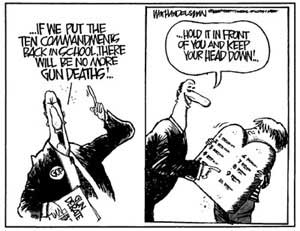
In 1997 Henry Jordan, a “born again” Christian on the State Board of Education in South Carolina, tried to get a copy of the Ten Commandments hung in every classroom in the state. When it was pointed out to him that members of other religions might not appreciate having only the Judeo-Christian teachings on display, he replied, “Screw the Buddhists and Kill the Muslims.”

Screw and Kill? Lot of good knowing the commandments did for him.
-E.T.B.


In the same year and the same state as the above incident the Charleston County Council of South Carolina unanimously passed a motion to post the Ten Commandments on a plaque outside the council chambers. Oddly enough, when a local reporter for the Post and Courier asked the nine council members to name the Ten Commandments, none could recall all ten. Two members refused to even try. Snapped Councilman Barrett Lawrimore, “I donʼt have time for this pop quiz.”
-Church and State


Letʼs Compare the U.S. Congress with the Ten Commandments

Beginning with “Do not bear false witness,” donʼt all Congresspeople “stretch the truth,” depending on which group of constituents or special interests or foreign dignitaries they are trying to woo or impress?

I also suspect thereʼs some “Sabbath-breakers” and “adulterers” in Congress.

Does Congress agree with the command, “Do not kill?”

How many Congresspeople have “used the Lordʼs name in vain” after discovering that their prize bill (say a bill to display the Ten Commandments) did not receive enough votes to become a law?

I donʼt suppose Congress will vote to display the “penalties” that go along with the Ten Commandments, since “death” is mentioned so often, even for “Sabbath-breakers.”

Lastly, I wonder how Congress will address the difference between the ancient Hebrewʼs “First Commandment” and our First Amendment? According to the “First Commandment” in the Bible “ye shall have no other gods before me” under penalty of death. While our First Amendment guarantees freedom of religion.
-E.T.B.


Preacher Pete: Without the Ten Commandments to lead them, people will wind up doing whatever they like.

Secular Sally: Most of us already do, but we like being liked, and hate being hated. In other words, most of us would sooner make friends than fill our freezers with heads, which, coincidentally, is a way to make enemies.
-E.T.B.


“Thou shalt not kill” is as old as life itself. And for this reason a large majority of people in all countries have objected to being murdered.
-Robert Ingersoll


How many people have to flip through the Bible, going, “Jeez, I want to screw my neighborʼs wife—donʼt know if I should?”
-Rick Reynolds, Only the Truth is Funny


I do not believe that ethics “without the Bible” are “completely relative.” People with no Bible to guide them still feel similar pains when stolen from, slapped, or called a stinging name. People with no Bible to guide them also feel similar pleasures when hugged, given a gift, or verbally petted. In other words, “ethical authority” resides in our bodies and brains, and in the multitude of lessons learned during lives of interaction with our fellow human beings. Neither is it easy for a person to turn to anti-social behavior if they have been taught from childhood to view other peopleʼs feelings and needs through the inner lens of their own. People also recognize (regardless of their religious beliefs or lack thereof) that “joys shared are doubled, while sorrows shared are halved.” Such recognitions even form the basis for wanting to “double” societyʼs joys, and “halve” societyʼs sorrows.

Of course not everyone learns morality in the manner described above. Some are raised to “fear hell” and memorize lists of “holy commandments.” Such people are liable to “fear what they (and others) might become” once such “external” holy threats and commands are called into question. Ironically, in nearly all cases, such a “hell” does not exist to promote universal ethical behavior, but to promote belief in the truth of that personʼs particular theology/denomination as opposed to rival theologies/denominations. So if you do not share their particular theology nor belong to their particular denomination, then they are convinced you are going to hell regardless of whatever kindnesses you share with them or society at large. So the threat of “hell” only helps promote good behavior in those who accept that particular theology/denomination that preaches “hell;” and such people can only understand the idea of a “moral” nation as one that consists solely of “fellow believers” in their particular theology/denomination. Of course any morality that tries to base itself (and impose itself on others) upon purely “external” religious threats and commands will break down once the religion supporting it is called into question.

To avoid such “breakdowns” it makes more sense for a nation, culture, or family to emphasize “internal” rather than “external” morality/ethics, just as it makes more sense to raise children to think and act in terms of how “they would feel if what they did was done back to them,” rather than depending on rote memorization of lists to promote ethical understanding in all circumstances and among all people. All the worldʼs religions enshrine the principle, “Do not do to others what you would not want done to yourself,” and, “Do to others what you would want done to yourself,” which assume in both cases that “you” already possess an “internal” recognition of what you should and shouldnʼt do. So, there need not be any overt conflict between “internal” and “external” morality and ethics. However, stressing the “internal” variety seems to have a far greater chance of drawing society together, rather than tearing it apart.

“Internal” ethical recognitions preceded the composition of humanityʼs earliest law codes such as those of King Hammurabi, or the moral injunctions found in the Egyptian Book of the Dead, or the later but more famous, “Ten Commandments.” Such “internal” recognitions inspired the creation of laws, and still do, and remind us that laws are but dust when people neglect to seek out what is best within themselves and each other.
-E.T.B.


A manʼs ethical behavior should be based effectually on sympathy, education, and social ties; no religious basis is necessary. Man would indeed be in a poor way if he had to be restrained by fear of punishment and hope of reward after death.
-Albert Einstein


Darwin proposed that creatures like us who, by their nature, are riven by strong emotional conflicts, and who have also the intelligence to be aware of those conflicts, absolutely need to develop a morality because they need a priority system by which to resolve them. The need for morality is a corollary of conflicts plus intellect:

“Man, from the activity of his mental faculties, cannot avoid reflection. Any animal whatever, endowed with well-marked social instincts, would inevitably acquire a moral sense or conscience as soon as its intellectual powers had become as well-developed, or anything like as well-developed as in man.” (Charles Darwin, The Descent of Man)

That, Darwin said, is why we have within us the rudiments of such a priority system and why we have also an intense need to develop those rudiments. We try to shape our moralities in accordance with our deepest wishes so that we can in some degree harmonize our muddled and conflict-ridden emotional constitution, thus finding ourselves a way of life that suits it so far as is possible.

These systems are, therefore, something far deeper than mere social contracts made for convenience. They are not optional. They are a profound attempt—though of course usually an unsuccessful one—to shape our conflict-ridden life in a way that gives priority to the things that we care about most.

If this is right, then we are creatures whose evolved nature absolutely requires that we develop a morality. We need it in order to find our way in the world. The idea that we could live without any distinction between right and wrong is as strange as the idea that we—being creatures subject to gravitation—could live without any idea of up and down. That at least is Darwinʼs idea and it seems to me to be one that deserves attention.
Mary Midgley, “Wickedness: An Open Debate,” The Philosopherʼs Magazine, No. 14, Spring 2001

Commandments from Other Religions

(Just to show how evil and depraved the souls of Non-Christians are)

Do not return evil to your adversary; Requite with kindness the one who does evil to you,
Maintain justice for your enemy, Be friendly to your enemy.
-Akkadian Councils of Wisdom (from the ancient Babylonian civilization that existed two millennia before Jesus was born)


May I be no manʼs enemy, and may I be the friend of that which is eternal and abides.
May I never devise evil against any man; if any devise evil against me,
may I escape without the need of hurting him.
May I love, seek, and attain only that which is good.
May I wish for all menʼs happiness and envy none.
When I have done or said what is wrong, may I never wait for the rebuke of others, but always rebuke myself until I make amends.
May I win no victory that harms either me or my opponent.
May I reconcile friends who are wroth with one another.
May I, to the extent of my power, give all needful help to all who are in want.
May I never fail a friend in danger.
May I respect myself.
May I always keep tame that which rages within me.
May I never discuss who is wicked and what wicked things he has done, but know good men and follow in their footsteps.
-The Prayer of Eusebius, written by a 1st-century pagan, as quoted in Gilbert Murray, Five Stages of Greek Religion. (Incorrectly attributed on the web to a 3rd-century Christian also named “Eusebius,” but this was a 1st-century pagan philosopherʼs prayer. See Professor Murrayʼs book.)


I will be as careful for you as I should be for myself in the same need.
-Calypso, to Odysseus, in Homer, The Odyssey, Book 5, verses 184-91.
(Roughly late 8th century BCE.)


Shame on him who strikes, greater shame on him who strikes back. Let us live happily, not hating those who hate us. Let us therefore overcome anger by kindness, evil by good, falsehood by truth. Do not hurt others in ways that would be hurtful to yourself.
-Buddhist wisdom (written centuries before Jesus was born)


More Buddhist Wisdom
In this world
Hate never yet dispelled hate.
Only love dispels hate.
This is the law,
Ancient and inexhaustible.
-The Dhammapada


Return love for hatred. Otherwise, when a great hatred is reconciled, some of it will surely remain. How can this end in goodness? Therefore the sage holds to the left hand of an agreement but does not expect what the other holder ought to do. Regard your neighborʼs gain as your own and your neighborʼs loss as your own loss. Whoever is self-centered cannot have the love of others.
-Taoist wisdom (written centuries before Jesus was born)


That which you want for yourself, seek for mankind.
-Islamic holy teaching (Sukhanan-i-Muhammad, 63)


People were Christian before Christ ever existed. People were humanistic before humanism was ever organized. People were loving before LSD was ever discovered.
-Timothy Leary, as quoted by Paul Krassner, “The Cynic Route from Crazy SANE to Loving Haight,” The Realist, 1967

Christianity and Atheism

Christianity and Atheism

Purdue philosophy professor a gentle atheist

In a nation in which 80 to 90 percent of adults say they believe in God, the label “atheist” rarely lands quietly in a conversation.

Say it, and many folks picture some joyless, nasty-tempered misfit who spends his days filing lawsuits against public displays of crosses and menorahs.

What to do then with the gentle, civilized, dog-loving human being that is Bill Rowe?

“Iʼve always been soft about religion in spite of my…” Rowe searched for the perfect word then just smiled. “Thatʼs why I say Iʼm a friendly atheist.”

No one who knows him begs to differ, especially Roweʼs theistic colleagues in the Department of Philosophy at Purdue University, from which he soon will retire. Nor would disagreement come from thousands of philosophy of religion students (I among them) whom Rowe has taught during his 43-year career in West Lafayette.

The author of five books and editor of two more, Rowe will be honored this weekend during a three-day conference at Purdue on the “Problem of Evil.” He and his philosophy colleagues will address the thorny issue of reconciling the existence of an all-powerful, all-loving supreme being with the unrelenting existence of evil and suffering in the world.

“Iʼm just going to give a brief paper trying—once again—expressing this view that the evils in the world count against the existence of God,” Rowe said during an interview in his seventh-floor, Beering Hall office.

“Thatʼs an old argument of mine, and there are some really good criticisms of it that I need to take into account. But Iʼve got some ways of supplementing the argument that I hope will shore it up—at least in the eyes of the faithful.”

If any of that sounds simplistic—We believe in God or donʼt, right?—it isnʼt. As F. Scott Fitzgerald said about the very rich, philosophers are different from you and me. Nothing about their thought processes is a simple stroll from Point A to Point B.

When philosophers “argue” about the existence of anything, especially God, it doesnʼt look like a dinner table fight or a “Crossfire” exchange. There is no yelling or brandishing of Bibles. Often there isnʼt any speech at all because philosophers argue on paper a lot more than in person. Rowe himself is the author of nearly 100 major papers, book chapters, encyclopedia or dictionary entries and reviews. The titles of his papers range from the very big picture—“God and Evil” and “Death and Transcendence”—to the super-specific—“The Fatalism of ‘Diordorus Cronus’” and “Evil and the Theistic Hypothesis: A Response to Wykstra.” In a similar vein, it would be a mistake to assume that Roweʼs arguments for the non-existence of God are the product of an unexamined spiritual path.

Schooled as a boy on Sundays in a variety of Protestant denominations, Rowe experienced an Evangelical conversion in a Baptist church when he was a teenager. For college, he chose the Detroit Bible Institute, with plans to enter Christian ministry.

He transferred after his second year to Wayne State University because his favorite teacher at Detroit was dismissed from the faculty for something called “ultra-dispensationalism.” (Space prohibits even a cursory definition of the term here but, trust me, it isnʼt remotely connected to a disbelief in God.)

At Wayne State, Rowe took philosophy courses to better study theology. One professor, an atheist from whom he was “oceans apart” on religion, emerged as an intellectual mentor, friend and, eventually, catalyst for change. Roweʼs first choice for graduate school, the conservative Fuller Theological Seminary, could not offer him financial aid, so he settled for a three-year fellowship at the University of Chicago Theological Seminary. The intellectual atmosphere was different from anything heʼd experienced. “It was a seminary that wasnʼt fundamentalist and was very liberal in its thinking,” he said. “So, there, I came to get a kind of critical approach to the Bible, learn something about its origins and also came in contact with theologians that were far distant from fundamentalism. The start of my third year, I could feel inside of me my fundamentalism beginning to crumble and disappear.”

How frightening was that?

“It was scary,” Rowe said. “I sat up late at night wondering what would become of me. I started to read Dostoevsky novels. I didnʼt fall apart, but I was concerned about what I sensed were changes occurring in me that I didnʼt really have full control over.”

Rowe soldiered on, received his divinity degree (summa cum laude) and figured he would continue at Chicago for a doctorate in religion. But his professor pal at Wayne State urged him to pursue his obvious gift for philosophy at the University of Michigan. Rowe changed cities and life courses.

During his first teaching stint at the University of Illinois, Rowe attended a theology lecture series and met Calvin Schrag, who was on his way to becoming one of the two pillars of Purdueʼs young philosophy department: When Rowe moved his wife and children to West Lafayette in 1962 to teach philosophy of religion, the second pillar was in place. Last autumn in Philosophy Now magazine, Rowe said his unlikely route to atheism was a gradual and very personal process, not the result of philosophical or scientific arguments contradictory of his theistic beliefs.

Studying the factual origins of the Bible had made him skeptical of its divine authenticity, but the truly compelling factor “was the lack of experiences and evidence sufficient to sustain my religious life and my religious convictions."

“I knew that it was wrong and arrogant to ask for some special sign from God. But I longed for a sense of Godʼs presence in my life,” Rowe told interviewer Nick Trakakis. “And although I spent hours in prayer and thirsted after some dim assurance that God was present, I never had any such experience.”

“I tried to be a better person and to follow whatever I could glean from the Bible as a life service to God. But in the end, I had no more sense of the presence of God than I had before my conversion experience. So, it was the absence of religious experiences of the appropriate kind that, as I would put it now, left me free to seriously explore the grounds for disbelief.”

During our discussion in his office, Rowe described the longing for a sense of Godʼs presence in the life of another theologian and philosopher, the 11th-century archbishop of Canterbury, St. Anselm. Like Rowe, Anselm was a gifted and lucid writer.

In a nutshell (which is the worst place to put any philosophical premise but all that a daily newspaper has), Anselmʼs famed ontological argument for Godʼs existence goes like this:
God exists because the very idea of a greatest possible being — what the saint called “that than which nothing greater can be thought” — exists, even in the mind of a disbelieving fool.

“Itʼs a very powerful argument,” said Rowe. “Anselm precedes that argument, however, with a kind of lament. Here he is, a Christian saint in charge of monks, and they respect him, love him, and yet his lament is that heʼs never seen God. Heʼs never had what he would be able to say is a personal experience of God himself. And thatʼs remarkable.

“In its place he has to put this argument, a wonderful argument, and itʼs not easy to tear it apart. But itʼs a long way away from a direct personal experience of God.”

Opening his studentsʼ minds to Anselmʼs argument, to the arguments against Anselmʼs argument and to scores of other arguments from centuries of great religion philosophers, is something Rowe has enjoyed since Eisenhower was in the White House. As much as he looks forward to retirement in June, he seems about as burned out on teaching as Warren Buffett is on making money. The predominance of Evangelical religions in America, he said, tends to produce high-school graduates unfamiliar with critical thinking about religion.

“So when they come to university and take a course in philosophy of religion, itʼs a new experience for them to first even realize that there are important arguments, philosophical arguments for the existence of God and to see that what theyʼve accepted on faith can have some basis in reason,” he said.

Likewise, it is a new experience for students to learn in the very same class that “there are not insignificant reasons to think perhaps God doesnʼt exist.”

After he retires, Rowe will continue reading and writing about lifeʼs Big Questions, travel with his wife, Margaret, who is Purdueʼs vice provost of academic affairs, and lavish affection on his 105-pound Labrador retriever, Cody.

“I love dogs,” Rowe said.

When I pointed out that “dog” is “god” spelled backward, Rowe laughed, more like a merry little boy than one of the most important philosophers in America. His delight made me think of a survey result Iʼd recently read: According to a poll by ChristianWebSite.com, 44 percent of U.S. adults believe that “good atheists” will make it into heaven.


Friendly Churchgoing Atheist

What exactly is a “Friendly Atheist”?

A Friendly Atheist is someone who:

Believes everyone should do what makes them happy, provided they are not stopping anyone else from doing the same.

Does not judge others for following a different path than his/her own.

Shows kindness, volunteers, and helps others.

Does not go around denigrating other religions, because he/she knows that to get respect, one must give it.

Can talk to a religious person without invoking an argument.

Questions his/her own beliefs as much as othersʼ beliefs.

Invites positive dialogue from religious people.

In my own experience, nearly every Atheist Iʼve met has been a Friendly Atheist. Weʼre everywhere. This is, sadly, a well-kept secret. By talking about the definition, as well as showcasing examples of Friendly Atheism as they occur, perhaps the public image of Atheists can be reshaped.

What did your original eBay post say?

The eBay link can be found here. But hereʼs what I wrote:

Iʼm a 22-year-old Atheist from Chicago. I stopped believing in God when I was 14. Currently, I am an active volunteer for a couple different national, secular organizations. For one of them, I am the editor of a newsletter that reaches over 1,000 Atheist/Agnostic college students. I have written several Letters to the Editor to newspapers in and around Chicago, espousing my Atheistic beliefs when Church/State issues arose. My point being that I donʼt take my non-belief lightly. However, while I donʼt believe in God, I firmly believe I would immediately change those views if presented with evidence to the contrary. And at 22, this is possibly the best chance anyone has of changing me.

So, hereʼs my proposal. Everytime I come home, I pass this old Irish church. I promise to go into that church every day— for a certain number of days— for at least an hour each visit. For every $10 you bid, I will go to the Church for 1 day. For $50, you would have me going to mass every day for a week.

My promise: I will go willingly and with an open mind. I will not say/do anything inappropriate. I will respectfully participate in service, speak to priests, volunteer with the church if possible, do my best to learn about the religious beliefs of the church-goers, and make conversation with anyone who is willing to talk. (Though I do reserve the rights to ask the person questions about the faith.)

I will record my visits through a journal, pictures, or whatever other method of proof youʼd like— I will uphold my promise.

Will I become religious? Well, I donʼt know. I really do have an open mind, but no one has convinced me to change my mind so far. Then again, I have also never attended a real church service. Perhaps being around a group of people who will show me “the way” could do what no one else has done before.

If the Irish Church doesnʼt work for you, weʼll just find some other place local to me. Iʼll go to any place of worship— a Christian Church, a Catholic Church [revision: I realize a Catholic Church is a Christian Church… so let me rephrase. By Christian, I mean Protestant], a Mosque, a Synagogue, etc. Theyʼre all nearby. Makes no difference to me, but perhaps itʼs your faith that could change the mind of this Atheist.

I also assure you that if you bid on this, I will write an article about my experiences in the newsletter mentioned earlier. The article would reach over 1,000 college students who share my current views. Even if you donʼt end up changing my mind, perhaps you can change theirs.

If you have any questions about this auction, Iʼd be glad to answer them.
The auction ended on February 3, 2006. The winning bid from Jim Henderson of www.Off-the-Map.org was $504. (Back to Top)


Atheists Are Spiritual Too


Atheism Defended By A Christian

Atheism tends to be a term of disrepute in the Western world, but we ought to do all we can to change this situation. The honest atheist is simply a person who has looked out upon the world and has come to believe that there is no adequate evidence that God is, or that there is good evidence that God is not. Very seldom does this make a man happy or popular…
A man who has no practical belief in God may nevertheless be a good man. Sometimes it is the very goodness of a man which makes him an unbeliever; he is so superlatively honest, so eager not to accept anything without adequate evidence, so sensitive to the danger of believing what is comforting, merely because it is comforting… Such a man we can only honor.”
- Elton Trueblood (Quaker theologian), Philosophy of Religion


A Christian Defends Atheists

Not one man in a thousand has the goodness of heart or the strength of mind to be an atheist.
- Samuel Taylor Coleridge


A Deist Defends Heretics

All the heretics I have known have been virtuous men. They cannot afford to be deficient in any of the other virtues, as that would give advantage to their many enemies; and they have not, like orthodox sinners, such a number of friends to excuse or justify them.
- Ben Franklin as quoted in Benjamin Franklin: His Wit, Wisdom, and Women
by Seymour Stanton Block


A Believer In God Who Lived Happily With Atheists

I believe in God, although I live very happily with atheists… It is very important not to mistake hemlock for parsley; but not at all so to believe or not in God.

One day a man was asked if there were any true atheists. Do you think, he replied, that there are any true Christians?
- Denis Diderot (1713-1784), cited in Against the Faith by Jim Herrick


A Catholic Authority Finds Atheism Permissible

Atheism is clearly always a permissible view of man in a world in which God is not immediately evident.
- 2 th Century Encyclopedia of Catholicism

What is an Anti-Christian?

You are deluding yourself if you *really* believe that you are not an “anti-Christian”.
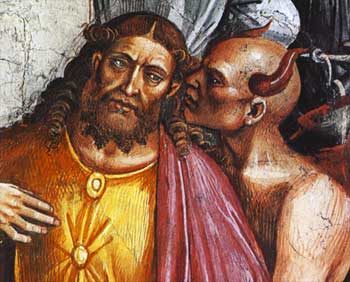
AntiChrist

Arguing “delusions” with you seems to be the order of the day. Christianity interests me, as does the Bible, the age of the earth, the fossil record, evolution, Darwinism, I.D., religion, philosophy, philosophy of consciousness, and I also have files on different religions, american history, music, comedy, famous wits, comedy and video ideas, chess. Speaking of famous wits, like Twain and Voltaire, they used their wit to deflate pomposity in their day, as they saw it, including, but not limited to, religious pomposity. Twain once remarked that the “funniest things are the forbidden.” Even as a Christian I somewhat agreed, having run into The Wittenberg Door

The “forbidden” includes topics like sex, politics, and religion, or any combination of them. Speaking of one particular combination of them: “Religion is a queer thing. By itself, itʼs all right. But sprinkle a little politics into it and dynamite is bran flour compared with it.” [Finley Peter Dunneʼs “Mr. Dooley”] Or take science and religion, or anything and religion, and youʼve got a mixture that is more volatile than most. That is partly why religion continues to interest me, like a moth drawn to the flame of volatile discussions. So I like controversy and the challenge of communicating with people who disagree with me. However, my past being what it is, you can imagine what types of controversies I continue to be attracted to today.

Do I still consider myself a Christian?
No.

Do I consider myself an “anti-Christian?”
No. But I do consider myself pro-question.

No doubt believers of MANY different religions and philosophies might consider me to be “anti-them” because such people believe that the cosmos revolves around their particular holy book, religion and/or denomination, so whenever I question their holy book (or more precisely, their understanding of their holy book), or question the possibility of them basing scientific theories on various passages in their holy books, I become in their eyes, their “anti,” but of course if they hadnʼt made such singular claims to a particular holy book and equally singular claims to their particular understanding of that book, and made claims to particular dogmas and their particular understanding of those dogmas, then I wouldnʼt have anything to question.

As things stand, I live in a country with a Christian majority, and in the Southern part of that country, the “Bible Belt.” (I moved down from New Jersey after college.) And that, along with my past, has contributed to my continuing interest in, and questioning focus on the dominant religion of my past and of where I live.

If you donʼt define yourself by what you are not, what do you define yourself as that more accurately expresses what you in fact are and do?

Each believer in a particular holy book and/or holy religion, prides themselves on wearing the label of their faith, prides himself on raising and calling his chldren by his particular faith label too. And they cannot conceive how anyone would eschew labels!

I think in our commercialized society there are already far too many labels, ads, religions. I am a thinking loving laughing caring changing human being and would like to leave it at that and simply have people call me by name, though I grant that some people are not comfortable unless they have securely labeled themselves and all the people around them, either metaphysically, or psychologically, or politically, etc.

And you responded to this with a message that you titled “Your friendly neighborhood “anti-Christianʼs” intellectual journey”.

It was meant as a joke. If someone had called me a “scowling monk” I would probably reply with an email that said, “Your friendly neighborhood scowling monk.” I used to read Spiderman comics, and he was a reviled criminal in the eyes of the editor of the Daily Bugle, and so in response, Spider Man would respond to being reviled with the tag line, “Your friendly neighborhood Spider Man.”

Now do you get the joke? Especially after having read the previous portion of this email?

Apart from yours truly perceiving you to be an “anti-Christian”, you *are* perceived by other Christians as an “anti-Christian”, indeed as an “antichrist”

I joked in my email directly previous to this one that although you called me an “antichristian” at least you hadnʼt called me the “antichrist” When I joked about that, I hadnʼt even read this email of yours! Bingo! I guess I know how you think. “Everyone who is not for us is again us” Jesus says in one part of the Gospels. Itʼs a metaphysical wrestling match to you, and Iʼm the guy in the black hood. Though Iʼd prefer grey come to think of it, because people who only see things in black in white arenʼt using their grey matter. But you may not get that, because you seem to have had trouble with my sense of humor.

As for Douglas Cox, the fellow who named me “AntiChrist for a Day” at his site,
Nominations for the Antichrist-for-a-Day Award
he seems to abide by the biblical rule that “one day is as a thousand years,” because Iʼve remained the one and only antichrist for a day since he first put up that page. As for just how “on target” Mr. Cox is with his beliefs, including me being “an antichrist,” why not study his site? Mr. Cox is sure that “in the second century BC, Antiochus IV caused corruptions supporting the supported the flawed geocentric cosmology of the Greeks to be inserted in the Greek and Hebrew versions of the scriptures.” Unlike Mr. Cox, I have no idea how Antiochus could have done that to all the Greek and Hebrew versions around, “causing corruption” of the text in so many ways so as to give people the impression that the heavens moved, indeed were commanded to move and to stop on occasion, and to fiddle with Genesis (in all three versions, namely the Hebrew MT, the Greek Septuagint, and Samaritan versions of the Pentateuch!), making it appear to be speaking of a solid “firmament” in which the sun moon and stars are set, and “above” which lay waters. But Mr. Cox is sure that Antiochus did something evil like that, and his corruption of Scripture is confusing almost all of Christendom today. Without such a conspiracy hypothesis as Mr. Coxʼs, then it would indubitably be true that the Bible appears to be as unscientific as other ancient creation accounts of its day and age; and Mr. Cox canʼt stand that thought. (Though of course once you accept that corruptions occur why not recognize the possibility of more corruptions of many different types? Additions of myths, legends, exaggerations? How can you trust the Bible as being incorruptible, infallible?)

Mr. Cox also has some ideas concerning a world-wide Flood I believe, based on the other articles listed at his site. He also cites George MacCready Price, a 7th Day Adventist and “Flood” geologist at this site. So if you want to cite Cox as proof of me being an “antichrist” go ahead. Both Cox and I agree that the Bible as it stands, reflects ancient prescientific cosmologies.

just because one denies what seems obviously to be the truth, does not make it true. A person might deny till he is blue in the face that his position is not what it obviously seems to be, but the mere fact of that denial, does not make it so. He/she could be sincerely mistaken, or deluded. And especially in the case of anti-Christianity, those on the receiving end, namely us Christians

“us Christians?” But exactly which “Christian” are you? There are geocentrist “Biblical Astronomers” like Dr. Bouw, young-earth creationists, old-earth creationists, theistic evolutionists, pre-mid-post-trib and amillennialists, Christians with different sacramental practices and beliefs, and also Calvinists, Arminians, “Openness Theologians,” Moderates, Liberals, Snake-handlers, Holy Ghosters, Fire and Brimstoners, “Soul-Deathers,” Universalists, and for a while there were lots of Unitarians or non-Trinitarians (Isaac Newton among them, but I was speaking primarily of the Arians and Athanasians and their disputes). Often in history “us Christians” [quote] did not feel all that “us-y” but instead one Christian called the other “AntiChrist” which was what Luther said about the Pope. In fact the Reformers themselves were known to speak ill of each other when it came to debating their different sacramental views.

I donʼt know if you want to consider changing the headings from “Remember: attack the *position* not the *person*!” to “Remember: threaten the *person* with eternal hell [the “wager” you P.S.ed me] if youʼre not ‘a Christian’ and use every assumption and association you can to make others think he is an ‘atheist’ or in league with the ‘anti-Christ.’”

I view you as a fellow human being and neither as demon nor angel. You are like me in more ways that you currently care to think about, and probably also share many commonsense doubts concerning things that neither you nor I have personally seen nor heard.

Still, you throw around the word “Christianity” like you or a few particular church councils in the past held the exclusive patent on it. Have you studied the conflicts in the early church? Do you know how even some of the most basic “Christian” interpretations of sacraments and doctrines that you take for granted today were not taken for granted early on? How one church council denounced another and then was in turn ignored by other church councils? The history of “Christianity” appears to be, among other things, the history of conflicts too numerous to mention:

Even during the persecutions of the Romans against the Christians, churches were cleft by rivalry and schism.
- Samuel Laeuchli, The Serpent and the Dove: Five Essays on Early Christianity
[Christians and their churches were cleft by rivalries and schisms even before the persecutions if you read Acts and the Letters in the New Testament. - E.T.B.]


Constantine [the first Roman Emperor to embrace Christianity] united the whole Roman Empire under his rule and reigned for twenty-five years. He brought up his sons to be pious Christians, and the last of them reigned for another twenty-five years, having ultimately reunited the empire under his rule. During that half-century the Church had enjoyed imperial protection and paganism had been viewed with disfavor. Christians had been promoted and pagans frowned upon. With only two short-lived exceptions no pagan was to reign as Emperor after Constantine.
- A. H. M. Jones, Constantine and the Conversion of Europe


A spirit of scornful tolerance breathes through not a few of his [Constantineʼs] edicts. As the years passed, toleration of paganism gave place to active repression; the emperor felt that he was strong enough to advance to a frontal attack upon paganism. The important fact to realize, however, is that this alteration in policy entailed no change of spirit, only a change of method. What Constantine would have recommended in 323 he later felt free to proclaim as the imperial will.
- Norman H. Baynes, Constantine the Great and the Christian Church


Constantine…banned the construction of new pagan temples, the consulting of oracles, and animal sacrifices. That these decrees were enforced sporadically did not detract from their symbolic value. With the old faith in decline, new converts poured into the Christian churches.
- Richard E. Rubenstein, When Jesus Became God: The Epic Fight over Christʼs Divinity in the Last Days of Rome


Constantineʼs allegiance to his God was backed by massive patronage. Emperors had always honored their favored gods with benefactions and buildings. Constantineʼs patronage was so lavish that he had to strip resources from pagan temples to fund it. One of his early foundations in Rome was the church of St. John Lateran, whose apse was to be coated in gold. Around 500 pounds of it was needed…Another 3,700 lbs was required for light fittings and another 400 pounds of gold for fifty gold vessels.
- Charles Freeman, “The Emperorʼs State of Grace,” History Today, January 2001


Edward Gibbon On Constantine and The Church

The grateful applause of the clergy has consecrated the memory of a prince, who indulged their passions and promoted their interest. Constantine gave them security, wealth, honors, and revenge; and the support of the orthodox faith was considered as the most sacred and important duty of the civil magistrate. The edict of Milan, the great charter of toleration, had confirmed to each individual of the Roman world the privilege of choosing and professing his own religion. But this inestimable privilege was soon violated: with the knowledge of truth the emperor imbibed the maxims of persecution; and the sects which dissented from the catholic church were afflicted and oppressed by the triumph of Christianity. Constantine easily believed that the heretics, who presumed to dispute his opinions or to oppose his commands, were guilty of the most absurd and criminal obstinacy; and that a seasonable application of moderate severities might save those unhappy men from the danger of an everlasting condemnation.
- Edward Gibbon, The Decline and Fall of the Roman Empire, Chapter 21


The privileges that have been granted in consideration of religion must benefit only the adherents of the Catholic faith. It is Our will moreover, that heretics and schismatics shall not only be alien from these privileges but shall also be bound and subjected to various compulsory public services.
- Letter of Constantine to his Vicar of the Praetorian Prefect, 326 A.D.; as cited in A New Eusebius: Documents Illustrating the History of the Church to AD 337, Ed., J. Stevenson, newly revised by W. H. C. Frend


The First Ecumenical Church Council at Nicea and The Arian Controversy

From the very first the Church was faced with the task of establishing dogmas. For Christianity abounds in problems more hinted at than answered in the New Testament…The first ecumenical church council, the Council of Nicea, assembled in the year 325 in the imperial palace of the first Christian emperor, Constantine. Once the discussions started the participants threw their episcopal dignity to the wind and shouted wildly at each other. They were concerned primarily with improving their positions of power. Diplomacy was wielded as a weapon, and intrigues often replaced intelligence. There were so many ignorant bishops that one participant bluntly called the council “a synod of nothing but blockheads.” Constantine, who treated religious questions from a political point of view, assured unanimity by banishing all the bishops who would not sign the new profession of faith hammered out at the council. In this way unity was achieved.

[The Christians at Nicea displayed their shrewd theological insight by condemning and forbidding kneeling at prayer on Sundays and also between Easter and Whitsunday. - E.T.B.] The council also pronounced a Christian theologian named “Arius” to be a heretic. People who owned his writings were ordered to deliver them up on pain of punishment. Arius was banished.
- Walter Nigg, The Heretics


If any treatise composed by Arius should be discovered, let it be consigned to the flames, in order that no memorial of him may be by any means left. This therefore I [Constantine] decree, that if any one shall be detected in concealing a book compiled by Arius, and shall not instantly bring it forward and burn it, the penalty for this offence shall be death; for immediately after conviction the criminal shall suffer capital punishment.
- Letter of Constantine To the Bishops and People, c. 333 A.D. in which he proscribed the works of Arius [a Christian] and in which he also proscribed the works of the pagan scholar Porphyry [who had written numerous works that questioned Christianity, all of which were destroyed]; as cited in A New Eusebius:
Documents Illustrating the History of the Church to AD 337, Ed., J. Stevenson, newly revised by W. H. C. Frend


Probably more Christians were slaughtered by Christians in two years [A.D. 342-343, during the Arian controversy] than by all the persecutions of Christians under the Romans during the previous three hundred years.
- Will Durant, The Story of Civilization, Vol. 4, The Age of Faith


In the century opened by the Peace of the Church [after the first Christian Roman Emperor began his rule], more Christians died for their faith at the hands of fellow Christians than had died before in all the persecutions.
- Ramsay MacMullen, Christianity and Paganism in the Fourth to Eighth Centuries


Arianism, which orthodox Christians now consider the archetypal heresy, was once at least as popular as the doctrine that Jesus is God…Ordinary tradespeople and workers felt perfectly competent - perhaps even driven - to debate abstract theological issues and to arrive at their own conclusions…Disputes among Christians, specifically arguments about the relationship of Jesus Christ the Son to God the Father, had become…intense.
[p.7]

The anti-Arians…demanded that Christianity be “updated” by blurring or even obliterating the long-accepted distinction between the Father and the Son. From the perspective of our time it may seem strange to think of Arian “heretics” as conservatives, but emphasizing Jesusʼs humanity and Godʼs transcendent otherness had never seemed heretical in the [Eastern half of the Roman Empire]. [p.74]

The Great Council of Nicaea…was the largest gathering of Christian leaders, up to that time with 250 bishops in attendance, almost all of them from the Eastern Empire…To some extent, this Eastern predominance can be attributed to the westernerʼs lack of interest in the Arian controversy, which still seemed to them an obscure “Greek” matter.

The Council of Nicaea, then, was not universal…Several later gatherings would be more representative of the entire Church; one of them, the joint council of Rumini-Seluicie (359), was attended by more than five hundred bishops from both the East and West. If any meeting deserves the title “ecumenical,” that one seems to qualify, but its results - the adoption of an Arian creed - was later repudiated by the Church. Councils whose products were later deemed unorthodox not only lost the “ecumenical” label but virtually disappeared from official Church history. [p.74]

[After the Council of Nicaea, Constantine exiled Arian theologians.] But within three years, Arius, Eusebius, and their fellow exiles would be forgiven by Constantine and welcomed back to the Church. Eusebius would become Constantineʼs closest advisor, and would insist that Athanasius, now bishop of Alexandria, readmit Arius to communion in that city as well. A decade after that, Bishop Athanasius himself was exiled, and Arianism was well on its way to becoming the dominant theology of the Eastern Empire. [p.84]

The Council of Nicaea was the last point at which Christians with strongly opposed theological views acted civilly toward each other. When the controversy began, Arius and his opponents were inclined to treat each other as fellow Christians with mistaken ideas. Constantine hoped that his Great and Holy Council would bring the opposing sides together on the basis of a mutual recognition and correction of erroneous ideas. When these hopes were shattered and the conflict continued to spread, the adversaries were drawn to attack each other not as colleagues in error but as unrepentant sinners: corrupt, malicious, even satanic individuals. [p. 84-85]

Athanasiusʼs ambition was endless; and he was very much at home in the “real” world of power relations and political skullduggery…Athanasius would soon be recognized as the anti-Ariansʼ champion. But first, he had to become bishop of Alexandria. [p. 104-105]

Athanasius sent gangs of thuggish supporters into the Melitian Christian district, where they beat and wounded supporters of the Melitian leader, John Arcaph, and, according to Arcaph, burned churches, destroyed church property, imprisoned and even murdered dissident priests. [p. 106]

Constantine ordered a council of bishops to meet in Tyre [concerning charges leveled against Athanasius]…Athanasius reacted with desperation…He had his agents terrorize those who might have provided evidence against him and prevented them from leaving the country…The pro-Athanasius bishops who attended the council at Tyre behaved so disruptively that the council later cited their activities as proof of Athanasiusʼs unfitness for office…The debate at the council was stormy, with many witnesses contradicting each otherʼs stories, and much name calling…After weeks of squabbling the bishops decided to send a commission to the region to interview witnesses there and the decide the truth of various accusations…The investigative commission left for Egypt…accompanied by a company of imperial troops…For the next two months Egypt was in an uproar. The Athanasians charged that the commission was obtaining evidence by means of threats and torture. The commissioners charged that Athanasiusʼs supporters were intimidating and kidnapping witnesses. By the end of the investigation it was clear that the commissionʼs report would indict Athanasius, who fled the city by night…The Bishops in Tyre condemned Athanasius for specific acts of violence and disobedience. [p.123-125]

When Constantine convened the Great Council of Nicaea, he could not have imagined that the bishops would be meeting almost every year to rule on charges of criminal activity and heresy. Partisan control of these gatherings virtually guaranteed that condemned churchmen would attempt to rehabilitate themselves and punish their enemies by denying the authority of “illegitimate” councils and convening new ones. The emperor probably considered this a temporary problem. Surely, after blatant troublemakers and fanatics like Bishops Athanasius and Marcellus were removed from office, reasonable churchmen could learn to live together despite occasional differences of opinion! But this was to repeat the original mistake made at Nicaea. It was to assume that doctrinal differences among Christians were not that important, that they did not reflect serious divisions of class, culture, and moral values within the community, and that they could be resolved by discovering the correct form of words. [p.133]

[The former exile, Arius, on the eve of being readmitted to membership in the church at Alexandria, was found dead on the floor beside a toilet. Poisoning is one possibility to account for the timing and manner of his passing. However, Athanasius used Ariusʼs death as a public relations opportunity.] He announced that Alexandriaʼs prayers had been answered and “condemned the Arian heresy, showing it to be unworthy of communion with the Church.” Most telling is the language Athanasius uses in describing the manner of Ariusʼs death: “Arius…urged by the necessities of nature withdrew, and suddenly in the language of Scripture, ‘falling headlong, he burst asunder in the midst,’ and immediately expired as he lay, and was deprived of both communion and of his life together.’” [The biblical reference is to Acts 1:18 - the manner of death of Judas, the apostle who betrayed Jesus.] [p. 137]

[But even after Ariusʼs death, Arianism remained, for there remained other more influential Christian leaders who dominated the movement.] Moreover, another death was of greater consequence than Ariusʼs. The death in question was Emperor Constantineʼs…Eusebius [an Arian Bishop] heard the Emperorʼs confession, and administered the last rites…Following Constantineʼs death a decree was made that permitted all exiled bishops to return to their sees…

Athanasius [who was in exile at that time] returned to Alexandria after making a political tour of several provinces. Everywhere he rallied the anti-Arian forces and helped return exiles to power, organized opposition to “heretical” bishops, and intervened actively in local disputes. Violence dogged his steps, since both sides had organized popular support and were quite ready to use angry mobs to expel churchmen they despised or defend friendly incumbents. The result in a number of key cities was something close to civil war…Finally, Athanasius returned to Alexandria where, according to his enemies, ‘he seized the churches…by force, by murder, by war.’” [p.141-142]

Soon afterwards a large council of bishops met in Antioch [in 338] to declare that Athanasius had committed new atrocities…The leaders of the church met again in Antioch in the winter of 338-339. With the new Emperor, Constantineʼs son, Constantius in attendance, they convicted Athanasius of violence and mayhem, and ordered him deposed…Warned by his agents, Athanasius fled, and rioting and arson (which had also accompanied his return) erupted across the city…The Church of Dionysius was burned, a number of people on both sides were injured and killed, and fighting even broke out on Easter Sunday in the Church of Quirinius. Several weeks later, the mobs supporting Athanasius had been suppressed, at least for the time being.

What really happened in Alexandria during this stormy month? Athanasius in a letter charged that “Arian madmen” incited pagans, Jews, and “disorderly persons” to attack the faithful, set churches on fire, strip and rape holy virgins, murder monks, desecrate holy places, and plunder the churchesʼ treasures. He presents pictures designed to horrify and madden his readers: Jews, for example, are presented as cavorting naked in the churchesʼ baptismal waters. And, of course, he says nothing about any violence that his own supporters may have offered in his defense or in opposition to the installation of the new bishop.

Athanasius had always had a following in Alexandria, but Arius was also an Alexandrian with his share of supporters…The truth seems to be that in Alexandria and many other cities large groups of militant fighters could be mobilized by both sides, and that both sides made frequent use of them in the confused period following Constantineʼs death…What is most striking is the closeness and bitterness of the conflict in important cities like Constantinople, Antioch, Ancyra, Caesarea, Tyre, and Gaza. [p. 143-144]

But what caused this deep division?…The split between Nicene and Arian Christians seems to reflect a rough division between those more in need of a powerful, just ruler and those more in need of a loving advocate and friend. Neither side in the controversy could afford to turn its back entirely on either image: the Athanasians therefore called Jesus “God from God.” And the Arians called him “a paradigm and an example.” Each side put its primary emphasis on one image while paying lip service to the other, and each side was prey to fears that the other side was aiming to obliterate “its” Jesus. While Athanasians denounced the Arians for lowering Christ to the point that his majesty and saving power would be lost, the Arians accused Athanasius and Marcellus of raising him to the point that his love (and Godʼs majesty) would be lost…

The violence in the Eastern cities ended for the time being with the forcible eviction of major anti-Arian bishops and their exile to the Western half of the Roman Empire. Many were arriving in Rome, where Athanasius had already fled. But the uncalculated efforts of these deportations would be to make the Roman pontiff [the pope] a major participant in the controversy, to embroil the Western bishops, and, finally, to dive a wedge between the Christian churches of the Greek East and the Latin West. [p. 146-147]

[It was at this time that the Emperor Julian “the Apostate,” though raised a Christian, came to power and declared himself a pagan.] He reflected the common peopleʼs distaste for the scandalous disunity of the Church. Christianity had conspicuously failed to bring the empire together or to secure it from enemy attack. As the contemporary historian Ammianus said, “no wild beasts are such enemies to mankind as are most Christians in their deadly hatred of one another.” He deprived the Christian clergy of the special privileges [and tax exemptions] bestowed on them by his predecessors, and also took steps to re-inflame the Arian controversy by permitting Athanasius and other anti-Arians to return from exile. Violence between competing Christian groups broke out almost immediately…Bishop George of the city of Alexandria [and several of his fellows]…were killed by a mixed mob of pagans and anti-Arian Christians, his body paraded through the streets on the back of a camel and burned. [p. 195]

In the second century, Christians in the city of Alexandria, inspired by anti-Semitic preaching, had launched one of the earliest riots against the cityʼs Jewish community. Two hundred years later those who called Jesus “Lord” were battling each other in the streets…and lynching bishops. By the time bishop George of Alexandria met his grisly death, religious riots had become commonplace throughout the region. [p.6]

[Julian “the Apostate” was killed in battle which led to a string of more Christian Roman Emperors, one of the most intolerant of whom was Theodosius] Theodosius banned Arianism and officially declared Christianity the religion of the Roman Empire…[p.226]
- Richard E. Rubenstein, When Jesus Became God: The Epic Fight over Christʼs Divinity in the Last Days of Rome


Theodosius passed a decree in 380 A.D. that read: “We shall believe in the Holy Trinity. We command that those persons who follow this rule shall embrace the name of Catholic Christians. The rest, however, whom We adjudge demented and insane, shall sustain the infamy of heretical dogmas, their meeting places shall not receive the name of churches, and they shall be smitten first by divine vengeance and secondly by the retribution of Our own initiative, which We shall assume in accordance with the divine judgment.”
- J. N. Hillgarth, The Conversion of Western Europe


[During the reign of Theodosius] bands of wandering monks attacked synagogues, pagan temples, hereticsʼ meeting places, and the homes of wealthy unbelievers in Mesopotamia, Syria, Egypt, Palestine, and North Africa. [Also during his reign] the bishop of Alexandria incited local vigilantes to destroy the Temple of Serapis [also known as the Serapeum], one of the largest and most beautiful builds in the ancient world that also housed a library donated by Cleopatra. Alexandrian Christians whipped up by Bishop Cyril rioted against the Jews in 415, and then murdered Hypatia, a wise and beloved Platonic philosopher. Since Arianism was now identified with the “barbarians” who were its main advocates, the remaining Arians within the empire, now split into small, powerless sects, were also fair game for Christian avengers. And the struggle to uproot paganism, conducted sporadically ever since the days of Constantine the Great, now resumed in earnest.

Was the Arian controversy resolved?…Unresolved issues, appearing in changed form, continued to produce serious religious conflicts…which ended in the Great Schism separating the Roman Catholic and Orthodox churches. [p.226-227]

In the Greek-speaking lands, the end of the Arian controversy triggered more than two centuries of intense conflict [over the question of the relationship between Jesusʼs human and divine natures]. Once again, bishops met in councils to proclaim the orthodoxy of their views and to excommunicate their opponents. Once more the East knew depositions and exiles, riots and assassinations. Each side accused the other of Arianism. The Second Council of Ephesus (449) condemned the school of Antioch; the Great Council of Chalcedon (541) condemned the Alexandrians; numerous emperors intervened on one side or the other; and the controversy did not end until the one-nature “Monophysites” were driven from their own churches, many of which exist to this day.
- Richard E. Rubenstein, When Jesus Became God: The Epic Fight over Christʼs Divinity in the Last Days of Rome


The Donatist Controversy

[After the persecution of Christians by pagan Emperors ended, Christians in North Africa debated whether or not priests that had recanted their faith under threat of persecution should still be recognized as valid members of the priesthood.] This issue [among others] led to a schism between Donatist Christians and mainstream Christians of North Africa. Saint Augustine advocated violent suppression of the Donatists, justifying massacres in the name of Christian unity. Armed groups, called the Circumcellions, formed to defend the “pure” [Donatist] churches, and perpetrated acts of terrorism in their name, and some committed mass suicide rather than yield to the forces they identified as Antichrist. The virtual civil war among North African Christians would not end until the fifth century, when invading Vandals suppressed all the churches, Donatist and orthodox alike. [p.39]
- Richard E. Rubenstein, When Jesus Became God: The Epic Fight over Christʼs Divinity in the Last Days of Rome


At the church council held at Ephesus in 449 the discussion became so inflamed that the delegates went at one another with clubs, until one party held the field and could enforce the decree it desired. Fanatical bands of monks terrorized the assembly of Church notables. Envoys from the church at Rome were set upon and soundly thumped. Leo the Great called it “The Robber Council,” nor was this the only one of its kind. There were other councils at which the Church Fathers became so incensed that they hurled the Bible at each otherʼs heads.
- Walter Nigg, The Heretics


After one “election meeting” in a church, in October 366, the “ushers” picked up from the floor one hundred and sixty Christian corpses! It is sheer affectation of modern Roman Catholic writers to question this, as we learn it from a report to the emperor of two priests of the time. The riots of the Christians that filled the streets of Rome with blood for a week, are, in fact, ironically recorded by the contemporary Roman writer, Ammianus Marcellinus.

In one day the Christians murdered more of their brethren than the pagans can be positively proved to have martyred in three centuries, and the total number of the slain during the fight for the papal chair (in which the supporters of Pope Damasus literally cut his way, with swords and axes, to the papal chair through the supporters of the rival candidate Ursicinus) is probably as great as the total number of actual martyrs. If we add to these the number of the slain in the fights of the Arians and Trinitarians in the east and the fights of Catholics and Donatists in Africa, we get a sum of “martyrs” many times as large as the genuine victims of Roman law; and we should still have to add the massacre by Theodosius at Thessalonica, the massacre of a regiment of Arian soldiers, the lives sacrificed under Constantius, Valentinian, etc.

This frightful and sordid temper of the new Christendom is luridly exhibited in the murder of Hypatia of Alexandria in 415. Under the “great” Father of the Church, Cyril of Alexandria, a Christian mob, led by a minor cleric of the church, stripped Hypatia naked and gashed her with oyster shells until she died [though I have read that she was clubbed to death before her flesh was stripped off her bones - E.T.B.]. She was a teacher of mathematics and philosophy, a person of the highest ideals and character. This barbaric fury raged from Rome to Alexandria and Antioch, and degraded the cities with spectacles that paganism had never witnessed.

Salvianus, a priest of Marseilles of the fifth century, deplores the vanished virtue of the pagan world and declares that “The whole body of Christians is a sink of iniquity.” “Very few,” he says, “avoid evil.” He challenges his readers: “How many in the Church will you find that are not drunkards or adulterers, or fornicators, or gamblers, or robbers, or murderers - or all together?” (De Gubernatione Dei, III, 9) Gregory of Tours, in the next century, gives, incredible as it may seem, an even darker picture of the Christian world, over part of which he presides. You cannot read these truths, unless you can read bad Latin, because they are never translated. It is the flowers, the rare examples of virtue, the untruths of Eusebius and the Martyrologies, that are translated. It is the legends of St. Agnes and St. Catherine, the heroic fictions of St. Lawrence and St. Sebastian that you read. But there were ten vices for every virtue, ten lies for every truth, a hundred murders for every genuine martyrdom.
- Joseph McCabe, How Christianity Triumphed


Art, philosophy, literature, the very psychology of Western man, all suffered by the victory of the bishops.
- John Holland Smith, The Death of Classical Paganism


The Christian zealots for conversion took to the streets or criss-crossed the countryside, destroying no doubt more of the architectural and artistic treasure of their world than any passing barbarians thereafter.
- Ramsay MacMullen, Christianizing the Roman Empire


Institutions of higher learning had been largely destroyed. The [Christian] emperorsʼ attacks had centered on the chief of them, Athens and Alexandria, in the late fourth century and were turned against them again toward the end of the fifth and in 529 [the year that the School of Athens was closed by the decree of the Christian Roman Emperor Justinian. - E.T.B.].

As to the initiators of the persecution, the [Christian] emperors themselves, a steady decline in their level of cultivation has been noticed. Thus books and philosophy were bound to fade from sight.

After Constantine there existed an empire-wide instrument of education: the church. What bishops, even emperors, made plain, and what could be heard in broader terms from every pulpit, was an agreed upon teaching. Every witness, every listener should know the great danger to his soul in Platoʼs books, in Aristotleʼs, in any of the philosophical corpus handed down from the past. The same danger threatened anyone using his mind according to their manner, with analytical intent, ranging widely for the materials of understanding, and independent of divine imparted teachings.

Another factor that arose specifically out of the ongoing conversion of the empire was the doctrine of demonic causation. The belief in the operation of maleficent forces on a large scale had to await Christianity; and it was of course Christianity that was to form the medieval and Byzantine world.

Satanic agents were to be seen as the cause not only of wars and rebellions, persecution and heresy, storms at sea and earthquakes on land, but of a host of minor or major personal afflictions. So, in consequence, Christians were forever crossing themselves, whatever new action they set about, and painted crosses on their foreheads too, responding to their leadersʼ urging them to do so. It would protect them against all evil.
- Ramsay MacMullen, Christianity and Paganism in the Fourth to Eighth Centuries